Sworn Translation Services UK for Overseas Use
Need a sworn translation for an overseas authority? Send the document, destination country and receiving organisation's instructions so the correct sworn or authorised translator route can be confirmed before work begins.

What Is a Sworn Translation?
It is an official translation prepared under the legal or administrative system recognised by a particular country or jurisdiction. Depending on that system, the translation may need to be completed, signed, stamped or certified by a translator formally authorised there.
Can I order a sworn translation from the UK?
Yes. The important question is which sworn or authorised translator status the receiving country recognises. Send the destination and written requirement first so the correct route can be checked.
This is commonly relevant when civil, identity, academic, court or business documents are being submitted to an overseas court, consulate, embassy, civil registry, university, notary or other public authority.
A sworn translation is therefore not simply a more formal version of every certified translation. The destination country and receiving organisation determine which translator status and formalities apply.
Looking for a Sworn Translator in the UK?
The answer usually depends on where the completed translation will be submitted rather than where you are currently located.
A certified translation is often the relevant starting point
Many UK authorities and organisations ask for a complete translation with a signed certification statement rather than a sworn translation under a foreign legal system.
- Check the receiving organisation's current instructions
- Do not order extra formalities simply because they sound more official
- Use notarisation or apostille only when specifically required
The destination may require a sworn or authorised translator
Countries with formal sworn-translator systems may require the translator to hold a particular appointment, registration or authorisation and to follow prescribed declaration, stamp or signature rules.
- State the destination country
- Name the exact receiving authority
- Send its checklist, email or written translation requirements
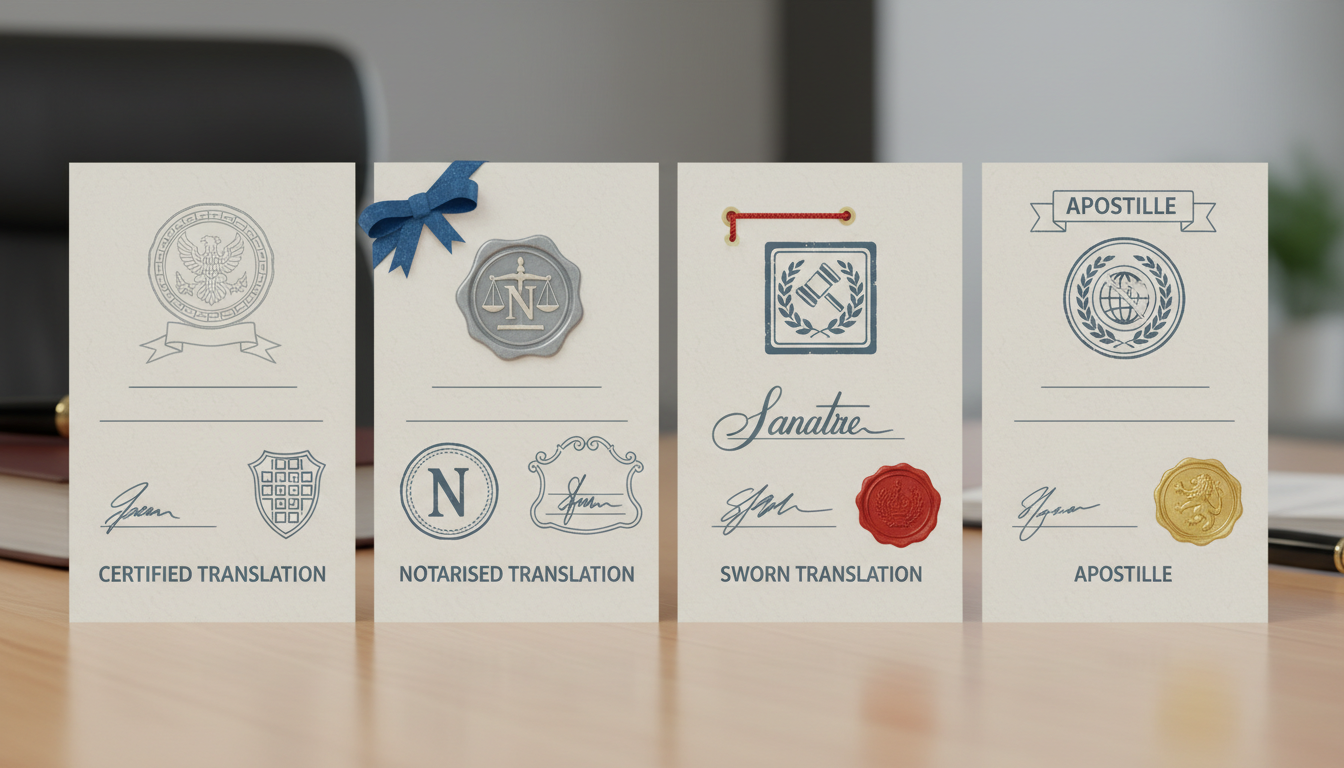
Certified, Sworn, Notarised or Apostilled?
These services are not interchangeable. Choose the route named in the receiving organisation's instructions rather than automatically selecting the most formal option.
Commonly relevant when a UK authority, employer, university or court requests a complete translation with signed certification.
Adds an accuracy statement, certification date, signature and translator or agency details.
View service →Relevant when the destination jurisdiction recognises sworn translators and the receiving authority specifically asks for that route.
Adds the declaration, signature, stamp or translator formalities required under that system.
Current serviceUsed when the recipient asks for a notary to verify the relevant declaration, signature or identity.
Adds a separate notarial stage after the appropriate translation and certification have been prepared.
View service →Relevant when a public document, certification or supporting signature must be authenticated for use in another country.
Adds the relevant authentication or legalisation stage in the sequence required for that document.
View service →Common Destinations for Sworn Translation
Sworn-translator rules are not identical from one country to another. These are destinations frequently raised in sworn translation enquiries, but the receiving authority's current instructions still need to be checked for each submission.
A country being listed here does not mean every authority in that country requires a sworn translation. The document, authority and purpose of the submission must be considered together.
What a Sworn Translation May Include
The final format depends on the destination system and the receiving authority's instructions. The exact document pack is confirmed after those requirements have been reviewed.
Complete translation of visible text
Printed fields, entries, stamps, seals, annotations and legible handwritten wording are translated rather than selected sections being silently omitted.
Required declaration or certification
The appropriate declaration, certification wording or sworn formalities are included where the destination system requires them.
Relevant translator details
Name, signature, date, contact information or other identifying details are supplied in the format required for the agreed route.
Clear, comparable formatting
Headings, tables, fields and structure are presented so the translated document can be compared easily with the source.
Pre-submission file check
Obvious missing pages, cropped edges, unclear stamps, inconsistent names and unreadable areas are raised before translation where possible.
Documents Commonly Sent for Sworn Translation
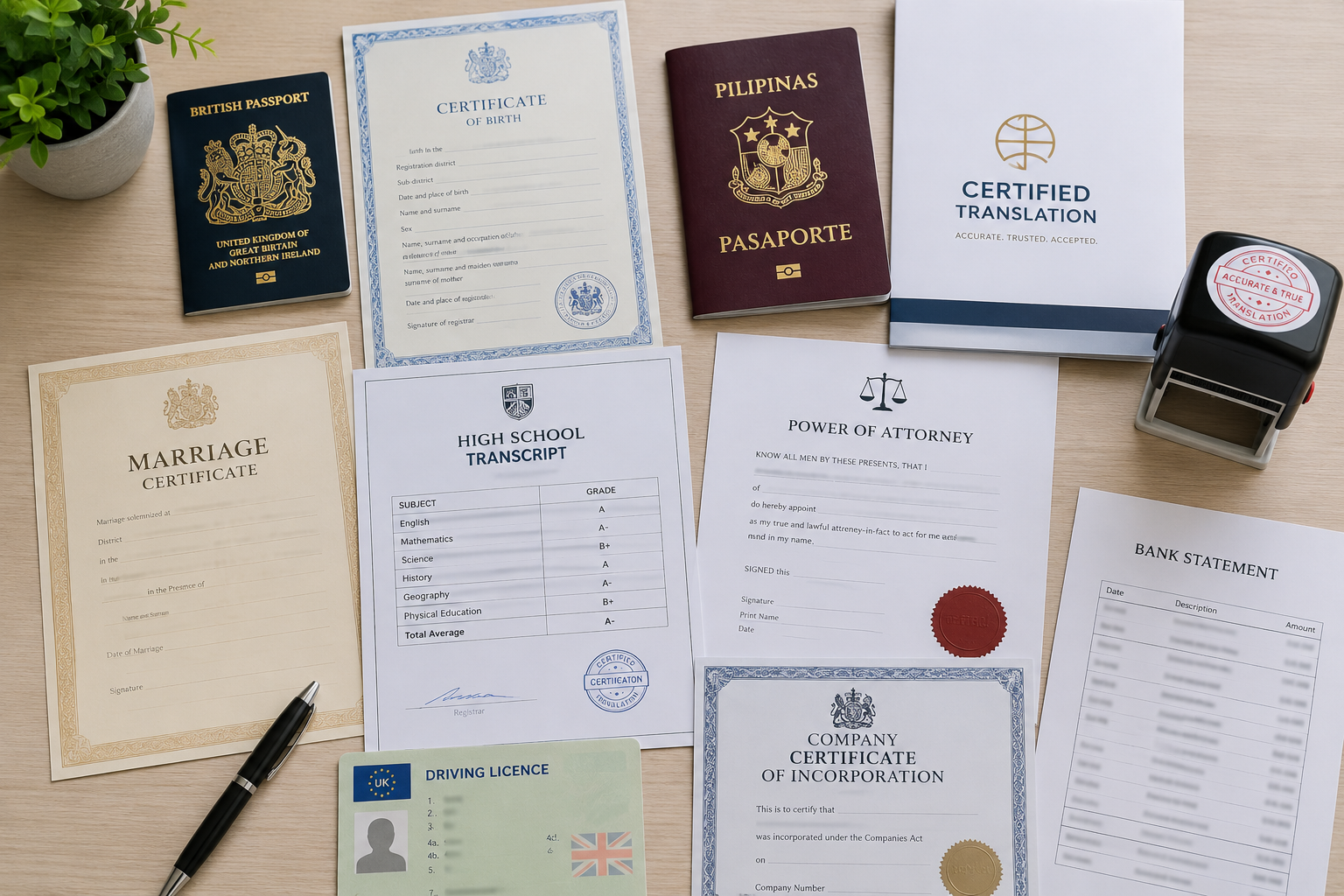
Personal, identity, academic, legal and corporate documents may all require sworn translation when they are being submitted under an overseas jurisdiction's official translation rules.
Civil & family records
- Birth certificates
- Marriage certificates
- Divorce decrees
- Death certificates
- Adoption and guardianship records
- Change-of-name documents
Identity & immigration
- Passports
- National identity cards
- Residence permits
- Visa documents
- Police certificates
- Government and court letters
Academic documents
- Diplomas and degree certificates
- Academic transcripts
- Grade records
- Attendance and enrolment letters
- Training certificates
- Professional licences
Legal & corporate
- Contracts and agreements
- Court documents and statements
- Company registration records
- Employment and HR documents
- Policies and compliance files
- Reports, tenders and correspondence
Your document is not listed?
International submissions often contain mixed document packs. Sending the complete
set helps related names, dates and terminology to be reviewed together.
Sworn Translation, Apostille and Legalisation Are Separate Steps
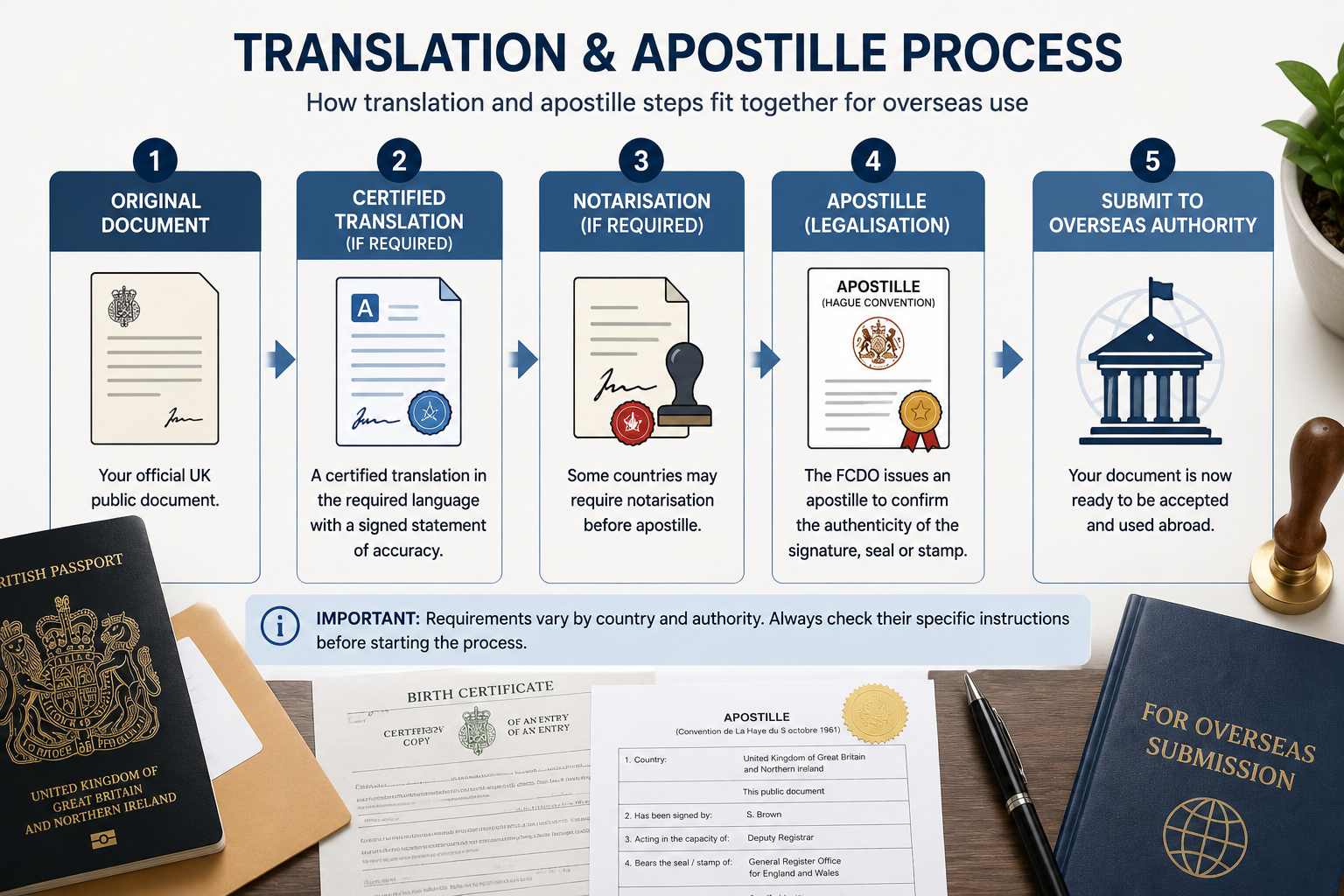
A sworn translation concerns the recognised translation and translator formalities. An apostille authenticates a public document or an eligible signature for international use. Some authorities may request one, the other or both.
The sequence is not always the same. An authority may require an original document to be apostilled before translation, may require the apostille page itself to be translated, or may specify a further certification stage.
Check the written instruction
Confirm what the recipient says must be translated, sworn, notarised or legalised.
Identify the document stage
Establish whether the instruction applies to the original document, translation, certification or several items.
Confirm the sequence
Agree the translation and authentication order before the work begins.
From Document Review to Sworn Translation Delivery
The language pair, destination, receiving authority, required formalities, price and realistic turnaround are reviewed before translation begins.
Send your documents
Upload a clear scan, photograph, PDF or Word file and include every relevant page.
Confirm the requirement
State the destination country, receiving authority, language, deadline and preferred delivery format.
Translation & checking
The document is translated and reviewed for completeness, terminology, names, dates, numbers, stamps and formatting.
Receive your completed pack
Digital delivery is provided by email, with printed hard copies arranged where required.
What to Send Before Ordering
Complete source files and clear submission instructions help identify the correct translation route at the beginning rather than after the document has already been translated.
Send these details
- Every page and reverse side containing text, stamps or official markings
- A clear, uncropped scan or well-lit phone photograph
- The source language and required target language
- The destination country
- The full name of the receiving organisation
- Your exact deadline and relevant time zone
- Whether printed hard copies are needed
- Any written instruction mentioning sworn status or apostille
- Preferred name spellings shown on a passport or identity record
Common causes of delay
- The destination country is known but the receiving authority is not
- A certified translation is ordered when sworn translation was requested
- An apostille or legalisation stage is discovered after translation
- A physical copy is required but only digital delivery was planned
- Document edges, signatures, seals or reference numbers are cropped
- Names are spelled differently across documents
- Reverse sides, attachments or continuation pages are missing
- The deadline does not allow for additional formalities
Sworn Translation Pricing Depends on the Destination Requirement
Unlike a standard certified translation, sworn translation costs and timing can depend on the destination country, language pair, required translator, document length, certification formalities and delivery method.
Completed PDF
Supplied by email for electronic submission where the receiving organisation accepts digital documents.
Editable Word version
An editable file can be discussed where the document format and submission rules allow it.
Printed hard copies
Posted copies can be arranged where original signatures, stamps or physical documents are required.
File pre-check
Obvious missing pages, cropped stamps and inconsistent names are flagged where they can be identified.
Confidential documents
Personal, academic, legal and corporate files are shared only with the people needed to complete and review the agreed project.
One point of contact
Requirements, quote, turnaround, file questions and delivery can be coordinated through the same translation team.
Sworn Translation Services FAQs
Requirements vary between countries and organisations, so send the recipient's current instructions whenever they are available.
What is a sworn translation?
A sworn translation is an official translation prepared under the sworn-translator system recognised by a particular country or jurisdiction. It may require a country-specific declaration, signature, stamp, registration or other formal requirement.
Does the UK have sworn translators?
The UK does not operate a national system of government-appointed sworn translators. For many UK-only official submissions, a certified translation is requested instead. A translator based in the UK may nevertheless hold sworn-translator status granted under another country's legal system.
What is the difference between sworn and certified translation?
A certified translation normally carries a signed statement confirming accuracy and completeness, together with the relevant date and translator or agency details. A sworn translation is produced under a formal translator-authorisation system recognised by the destination country or jurisdiction.
Which countries may ask for a sworn translation?
Clients frequently ask about sworn translation for submissions involving Spain, France, Germany, Italy, Belgium, Austria, Poland, Greece and Brazil. This does not mean every organisation in those countries uses the same requirement, so the individual authority and document type must still be checked.
Can you review a request for a Spanish, French or German sworn translation?
Yes. Send the document together with the destination country, receiving authority and any written instructions. The request can then be reviewed to establish the appropriate sworn or authorised translator route before work begins.
Can a passport be translated as a sworn translation?
Passport identity pages, endorsements and other readable content can be translated under the required sworn-translator route when an overseas authority asks for it. Send a complete, uncropped copy together with the recipient's instructions.
Can an ID card be sworn translated?
National identity cards can be translated where sworn translation is required. Supply both sides when they contain text, document numbers, validity dates, signatures or official markings.
Can a birth or marriage certificate be sworn translated?
Yes, where the receiving authority requires the sworn-translator route. Civil certificates are commonly translated for international registration, citizenship, marriage, residency, education and legal procedures. Include every relevant page, stamp, annotation and reverse side.
Is sworn translation the same as an apostille?
No. Sworn translation concerns the translation and recognised translator formalities. An apostille authenticates a public document or eligible signature for international use. An authority may request either service or both.
Do I need the original physical document?
A clear scan or well-lit, uncropped phone photograph is generally suitable for the initial review. The receiving organisation may nevertheless require a physical original or hard-copy translation for the final submission.
How much does sworn translation cost?
The total depends on the language pair, document length, file clarity, destination country, required translator, formalities and delivery method. A document-specific quote is therefore confirmed after the file and submission requirements have been reviewed.
How long does a sworn translation take?
Turnaround depends on the language pair, document length, destination system, required translator and any additional notarisation, apostille or hard-copy stage. Send your exact deadline so realistic availability can be confirmed before work starts.
Is a sworn translator the same as a sworn interpreter?
No. Translation concerns written documents, while interpreting concerns spoken communication. A request for an interpreter for a court, notary, ceremony or official appointment should be assessed separately from document translation.
Are my documents handled confidentially?
Personal, legal, academic and corporate documents are handled confidentially and shared only with the linguists, reviewers and relevant professionals required to complete the translation and any agreed certification stages.
Send your document and the authority's instructions
Include the destination country, receiving organisation, language pair, deadline and preferred delivery format. The appropriate translation route, price and realistic turnaround can then be confirmed before work starts.