Notarised Translation UK – Notary Translation Services
Need a certified translation with an additional UK notary stage? Send your document together with the receiving authority’s instructions so the correct certification, notarisation and delivery route can be confirmed before work begins.
- Certification and notary stages coordinated
- Requirement reviewed before payment
- Digital and posted delivery options
What is a notarised translation in the UK?
A notarised translation normally starts as a complete professional translation with a certification statement confirming its accuracy and completeness. A UK notary is then involved to authenticate the relevant declaration, signature or execution of that certification.
The notary stage adds formal authentication to the translation pack. It does not replace the translation, and it does not mean the notary independently checks the linguistic accuracy of every translated word.
How do I order a notarised translation in the UK?
Send the complete document, language pair, destination country and the receiving authority’s instructions. We confirm whether a notary stage is actually required and provide the complete quote before work begins.
Do You Need a Notarised Translation?
Use the exact wording supplied by the organisation receiving your documents. If its instructions are unclear, send them with your file for review rather than ordering extra formalities by assumption.
Notarisation may be appropriate when
- An embassy, consulate, overseas authority or legal representative explicitly asks for a notarised translation.
- The translator’s declaration or signature must be authenticated by a UK notary.
- A company, court or foreign institution requests a notarial certificate as part of its procedure.
- A power of attorney, company record, affidavit or formal transaction document has destination-specific authentication requirements.
- The recipient requires a physical translation pack carrying the appropriate signatures and notarial wording.
A different service may be appropriate when
- The organisation asks only for a certified translation with an accuracy statement and identifying details.
- The destination country requires a translation completed by a locally authorised or sworn translator.
- The instruction specifically requests legalisation or an apostille after the appropriate certification stage.
- The recipient wants a certified copy of the original document rather than notarisation of the translation.
- No additional authentication is mentioned in the application instructions.
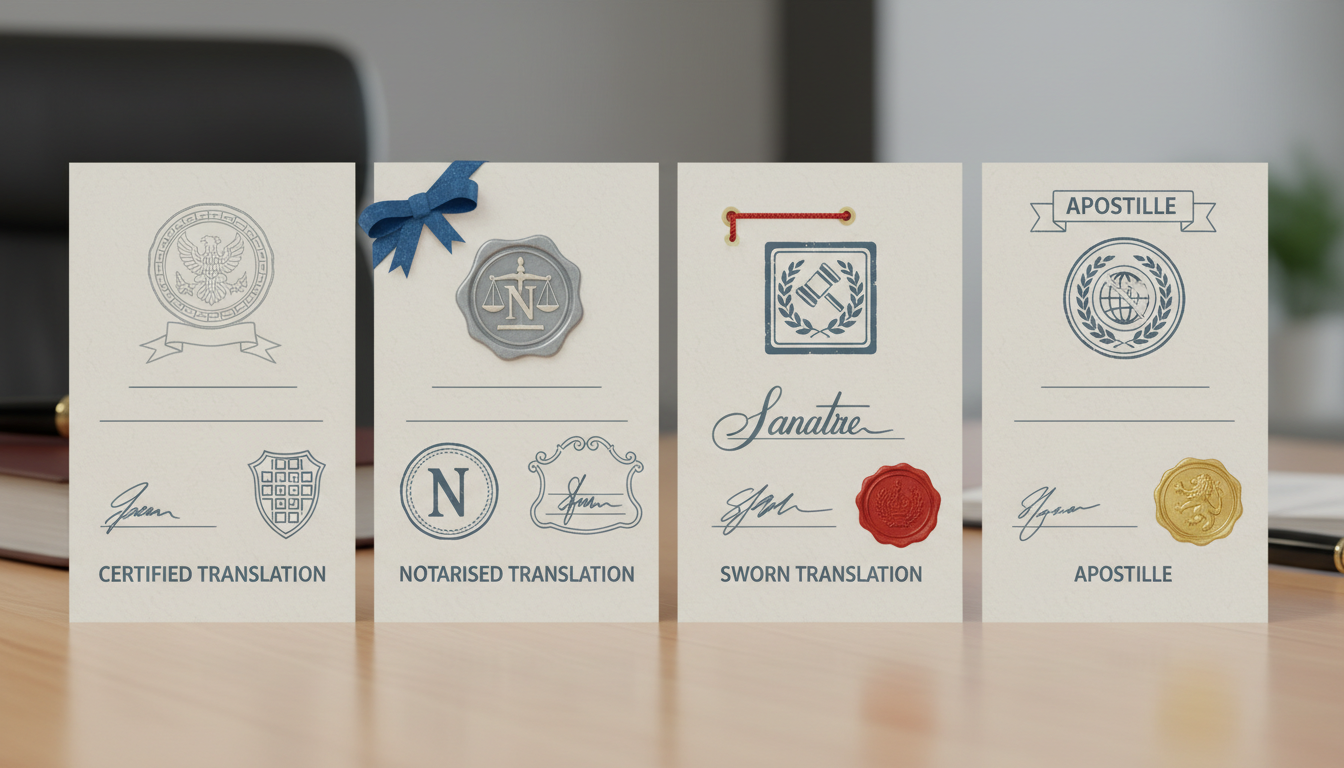
Certified, notarised, sworn or apostilled?
These terms are not interchangeable. The correct service is the one that matches the receiving authority’s current instructions and the destination jurisdiction.
| Service | What it normally includes | Common reason for use | Important distinction |
|---|---|---|---|
| Certified translation | A complete translation with a signed statement confirming that it is true and accurate, plus the relevant date and contact details. | Many UK immigration, employment, academic, passport and general official submissions. | It does not automatically include a notary, sworn translator or apostille. |
|
Notarised translation This service |
A certified translation followed by a notary stage that authenticates the relevant declaration or signature. | Specific overseas, embassy, legal, corporate or formal international submissions. | The notary stage adds authentication; it is not the same as apostille legalisation. |
| Sworn translation | A translation prepared through the authorised or sworn-translator system recognised by a particular country. | Authorities in countries that formally recognise sworn or court-appointed translators. | The required translator status is governed by the destination jurisdiction. |
| Apostille or legalisation | A separate authentication process applied to an eligible document or recognised public signature. | Documents that must be formally recognised in another country. | Legalisation normally follows the appropriate document, certification or notarial stage. |
If you have written instructions from the embassy, court, university, company or overseas authority, include them with your document so the route can be checked against the wording they use.
Documents Commonly Sent for Notarised Translation
The document type alone does not decide the certification level. The receiving authority’s instructions normally determine whether notarisation is needed.
Civil and personal records
- Birth, marriage and death certificates
- Divorce and adoption records
- Name-change and single-status documents
- Police certificates and identity records
Legal documents
- Affidavits and witness statements
- Powers of attorney
- Court orders and judgments
- Contracts and formal agreements
Business and corporate files
- Company registration documents
- Board resolutions and corporate records
- Commercial agreements
- Compliance and financial documents
Academic and professional
- Diplomas and degree certificates
- Academic transcripts
- Professional licences
- Training and qualification records
Property and international matters
- Property deeds and purchase documents
- Inheritance and estate papers
- Overseas employment documents
- Consular and residency paperwork
Other formal documents
- Medical or insurance records
- Bank and pension documents
- Government-issued letters
- Destination-specific supporting evidence
What the notarised translation service includes
The exact notarial wording and delivery format are confirmed after the destination requirement has been reviewed.
Complete translation
Visible and legible text is translated, including headings, field labels, entries, stamps, seals, annotations and relevant notes.
Certification statement
The translation is accompanied by the appropriate statement, signature, date and identifying details required for certification.
Notary stage
The relevant declaration or signature is presented for notarial authentication according to the agreed process.
Quality checks
Names, dates, numbers, terminology, document completeness, formatting and certification details are reviewed before delivery.
Confirmed delivery format
Digital files, printed copies and postal delivery are arranged according to what the receiving authority requires.
How Notarised Translation Works in Four Steps
The requirement, quote, turnaround and delivery method are confirmed before the translation and notarial stages begin.
Send the document
Upload a complete scan, photograph, PDF or Word file and tell us the destination and receiving authority.
Confirm the requirement
The route is checked for certification, notarisation, sworn translation, apostille support or a combination.
Translate and certify
The document is translated, formatted, checked and prepared with the appropriate certification statement.
Notarise and deliver
The agreed notarial stage is completed and the final pack is delivered in the confirmed digital or physical format.
What to send for an accurate quote
Complete information at the start helps confirm the correct certification route and reduces avoidable questions during the notarial stage.
How much does a notarised translation cost?
There is no single fixed price for every notarised translation because the total must cover both the translation work and the exact notarial procedure required for your document.
Standard certified translation rates published on our pricing page start from £40 per page. Notarisation is an additional formality, so the complete translation-and-notary total is confirmed after your document and the receiving authority’s instructions have been reviewed.
Turnaround also depends on the language pair, document complexity, notary availability, delivery method and whether originals, courier delivery or further legalisation are involved.
Certification, notarisation and legalisation are separate steps
GOV.UK says a certified translation should confirm that it is a true and accurate translation, include the translation date, and provide the translator’s full name and contact details. Legalisation is a separate process for eligible signatures, stamps or seals.
Not every submission needs every stage. Follow the receiving authority’s wording and confirm the sequence before ordering.
Language availability is checked alongside the document type, destination requirement and deadline. For less common combinations, send the language pair and authority instructions before the notary stage is arranged.
Browse languagesNotarised Translation FAQs
Requirements vary by authority and destination. Send the current written instructions with your document whenever possible.
What is a notarised translation in the UK?
It is normally a complete certified translation followed by a UK notary stage that authenticates the relevant declaration, signature or execution of the certification. The precise format depends on the receiving authority’s instructions.
What is the difference between certified and notarised translation?
A certified translation includes a statement confirming that the translation is true and accurate, together with the appropriate date and translator or agency details. A notarised translation adds a notarial authentication stage after the translation and certification have been prepared.
Does a notary check the accuracy of the translation?
The translator remains responsible for the linguistic accuracy and completeness of the translation. The notary’s role normally concerns authentication of the declaration, signature or execution of the relevant certification rather than independently translating the document.
Is a notarised translation accepted by every authority?
No provider can decide acceptance on behalf of every receiving organisation. Requirements vary between courts, embassies, consulates, companies and overseas authorities. Provide the current written instructions so the translation can be prepared using the requested route.
Is notarisation the same as an apostille?
No. Notarisation and apostille legalisation are separate processes. An apostille is issued through the UK Legalisation Office for eligible documents or recognised signatures. It should be added only when the receiving authority specifically requires legalisation.
Do I need to send the original document?
A clear scan or photograph is normally suitable for an initial review and quotation. Depending on the notary, document and receiving authority, an original, certified copy or wet-signed document may later be required. Do not post originals until this has been confirmed.
How long does notarised translation take?
Turnaround depends on the language pair, document length, complexity, required certification wording, notary availability and delivery method. The translation and notary stages are reviewed together before a completion time is confirmed.
Can I order a notarised translation online?
Yes. Begin by sending a clear scan, photograph, PDF or Word file through the online order page. Include the language pair, destination country, receiving authority, deadline and any written instructions.
Do UKVI or the Home Office usually need notarised translations?
If the organisation asks only for a certified translation, adding notarisation is not automatically necessary. Use the exact wording in the current application instructions and send it with your document if you are unsure which route is required.
Can a solicitor certify a document instead of using a notary?
Certification of a copy, certification of a translation and notarisation are different tasks. The receiving organisation decides what it will accept, so check whether its instruction specifically requires a notary, a solicitor, a certified translation or another form of authentication.
Is “notarized translation” the same as “notarised translation”?
Yes. “Notarised” is the usual British English spelling, while “notarized” is the US English spelling. They describe the same general concept, although the exact notarial procedure still depends on the country and receiving authority.
Send your document and the authority’s instructions
Include the language pair, destination country, intended use and deadline. The suitable translation, certification, notary and delivery route can then be confirmed before work begins.