Apostille Translation UK – Certified Translation & Legalisation
Need a document translated and apostilled for use overseas? Send the document, destination country and receiving authority so we can confirm whether translation, certification, notarisation and apostille are required — and the correct order.
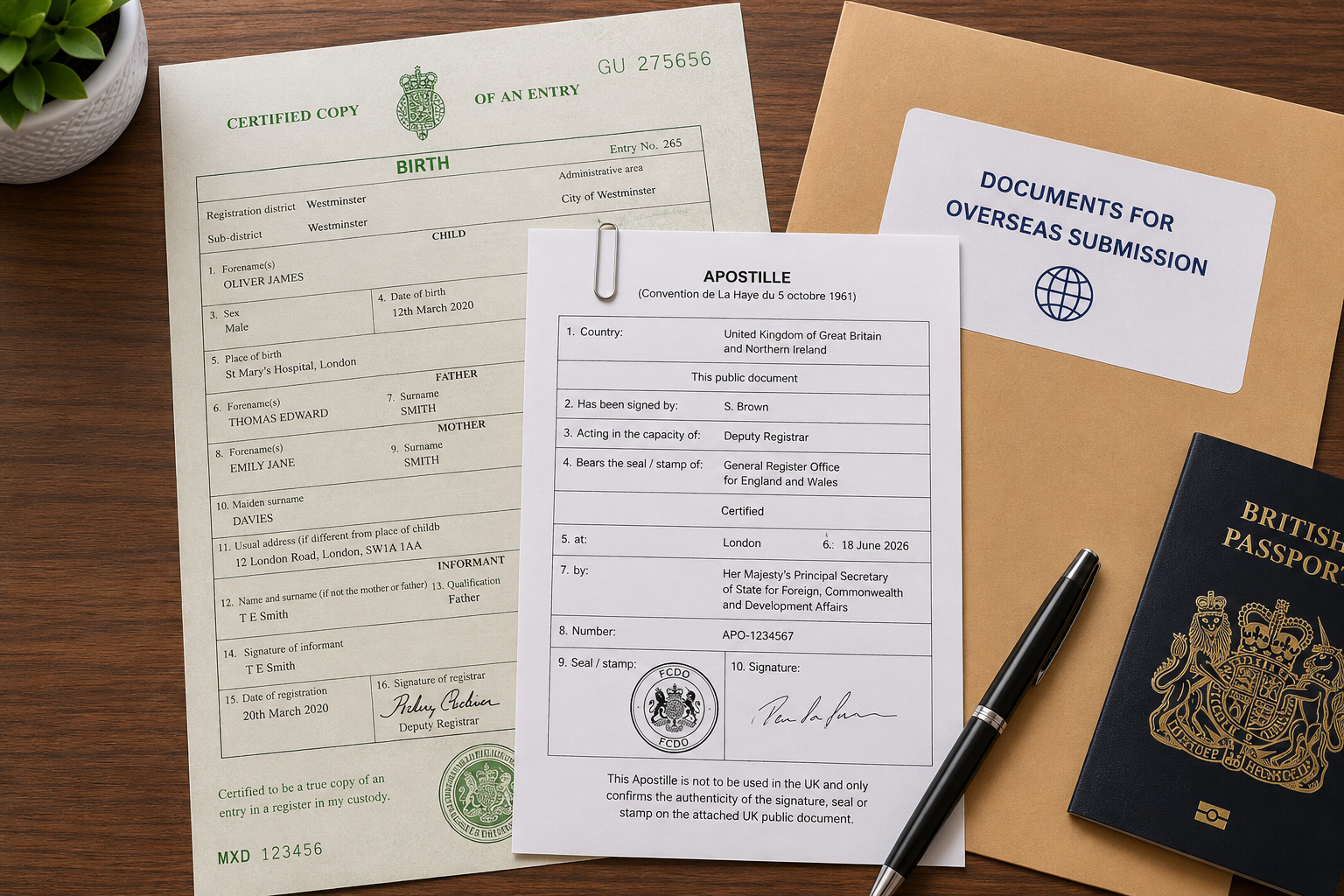
Apostille Translation: What Does the Service Include?
An apostille is used to authenticate the origin of an eligible UK document for use overseas. The UK Legalisation Office checks whether a recognised signature, seal or stamp matches its records and, when the document is eligible, attaches an apostille.
An apostille does not translate the document and does not certify that the factual contents are true. If the receiving organisation also needs the document in another language, a certified translation may form a separate part of the same document process.
Our apostille and certified translation service is designed for customers who need the stages reviewed together rather than arranged as separate jobs.
Does an apostille need to be translated?
Sometimes. If the receiving authority needs the apostille wording in its working language, the apostille page can be translated with the underlying document. If it does not, translating the apostille may be unnecessary.
Apostille before or after translation?
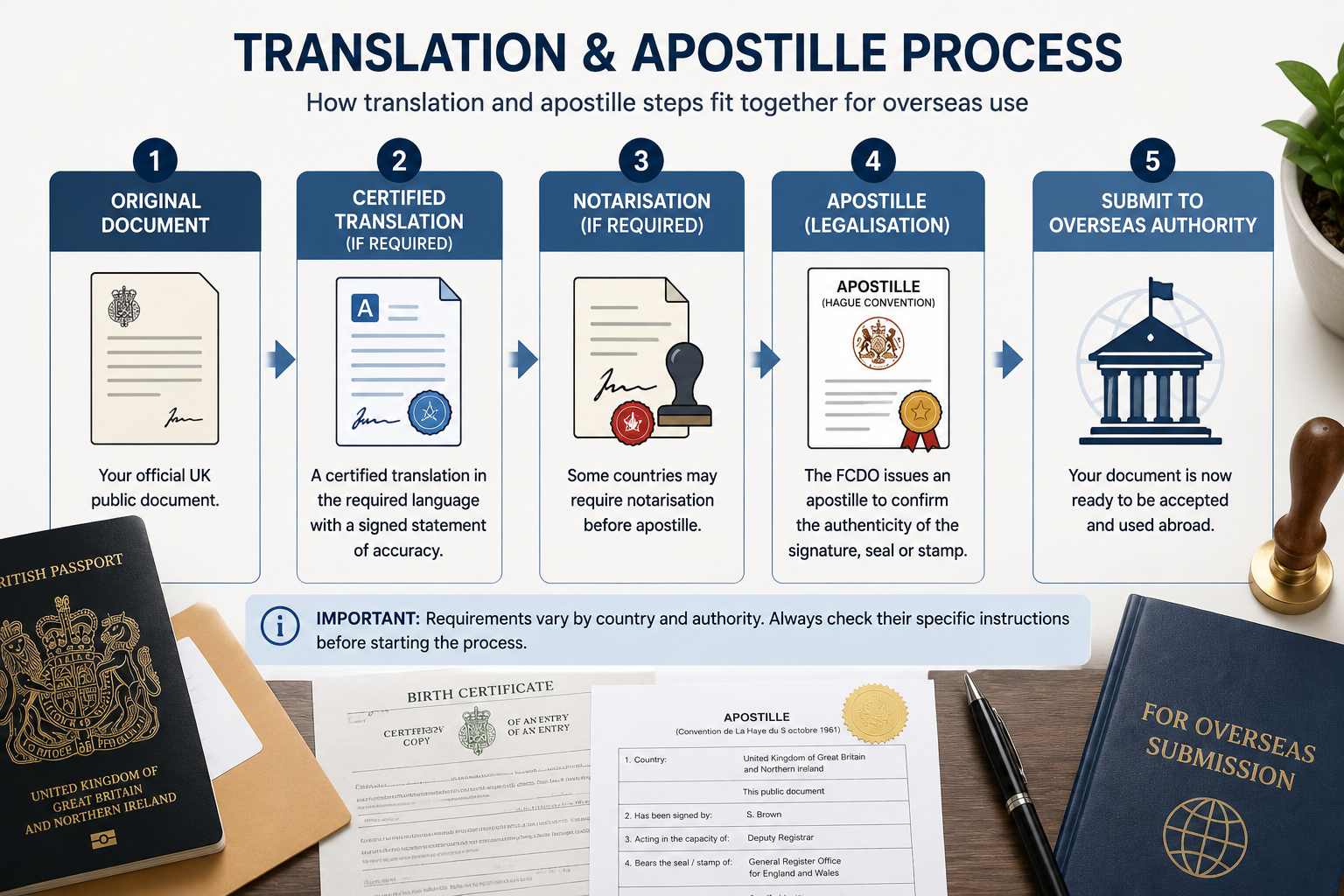
There is no universal order. Some authorities want the original document apostilled first and then translated; others require certification or notarisation before legalisation. Their written instructions take priority.
If you need translation only, see our certified translation service. If the overseas authority specifically asks for a sworn translator, see our sworn translation services. If a notarial step has specifically been requested, see notarised translation services.
The receiving authority's written instructions take priority. Do not assume that every request for “translation with apostille” follows the same order.
Apostille vs Certified Translation vs Notarisation
More formal does not automatically mean more appropriate. Use the level of authentication and certification requested by the organisation receiving your documents.
| Step | What it does | What it does not do | When it may be required |
|---|---|---|---|
| Apostille | Authenticates the origin of an eligible UK document through a recognised signature, seal or stamp. | Does not translate the document or confirm that its factual content is true. | When an overseas organisation asks for an eligible UK document to be legalised. |
| Certified translation | Provides the translated text together with the agreed certification statement and identifying details. | Does not automatically legalise or apostille the original document. | When the receiving organisation requires the document in another language. |
| Notarisation / solicitor certification | May verify a copy, signature, declaration or certification where the legalisation route requires it. | Does not replace an apostille when an apostille is specifically required. | For documents or copies that require a UK public official's certification before legalisation. |
Documents We Review for Apostille and Translation
Apostille requirements vary according to the document itself. Some UK public documents can be legalised in their original form, while other documents may first need certification by a UK notary or solicitor.
Mixed document packs can be reviewed together. This is especially useful where several documents depend on the same destination country's requirements.
Personal & immigration
- Birth certificates
- Marriage certificates
- Divorce decrees
- Death certificates
- Passports and ID documents
- Residence and visa documents
- Police certificates
- Change-of-name documents
Academic & professional
- Degree and diploma certificates
- Academic transcripts
- Enrolment and attendance letters
- Professional licences
- Training certificates
- Qualification records
- Employment letters
- Experience certificates
Legal & corporate
- Powers of attorney
- Affidavits and statutory declarations
- Court documents
- Contracts and agreements
- Certificates of incorporation
- Articles of association
- Certificates of good standing
- Company resolutions and reports
What to Send Before We Confirm the Route
Clear, complete files help avoid questions and delays. You can usually send a scan, photograph, PDF or Word file for the initial document review.
- Include every relevant page and attachment
- Include reverse pages containing stamps, notes or official markings
- Keep all page edges, seals and signatures visible
- Avoid blur, glare, shadows and cropped corners
- State both the source and target languages
- Name the destination country and receiving organisation
- Provide your exact deadline
- Share preferred English spellings of names where already established
- Tell us whether you need digital files, editable files or posted copies
How Apostille and Translation Work Together
The document, route, certification format, price and available complete turnaround are reviewed before work begins.
Send the documents
Upload clear files with the language pair, destination country, receiving organisation and deadline.
Confirm the route
We review whether translation, certification, notarisation, apostille or another legalisation step is likely to be required.
Translate and check
Names, dates, numbers, visible stamps, formatting and certification details are reviewed with the translation.
Legalisation & delivery
The agreed legalisation stage is coordinated and the completed documents are supplied in the agreed digital or physical format.
Certified Translation From
£40 / pageThis is the published starting rate for standard certified translation. The complete price depends on the document, language pair, certification route, formatting and deadline.
Apostille, legalisation, notarial, handling and return-delivery requirements are reviewed separately so the combined cost can be confirmed before work begins.
Current GOV.UK Apostille Fees and Processing Information
These are Legalisation Office fees, not our combined service prices. Government fees and processing times can change, so check the official guidance when your documents are being prepared.
Important: urgent translation and apostille processing do not necessarily follow the same timetable. The complete expected route and delivery schedule should be confirmed together.
Do You Need a Paper Apostille or an e-Apostille?
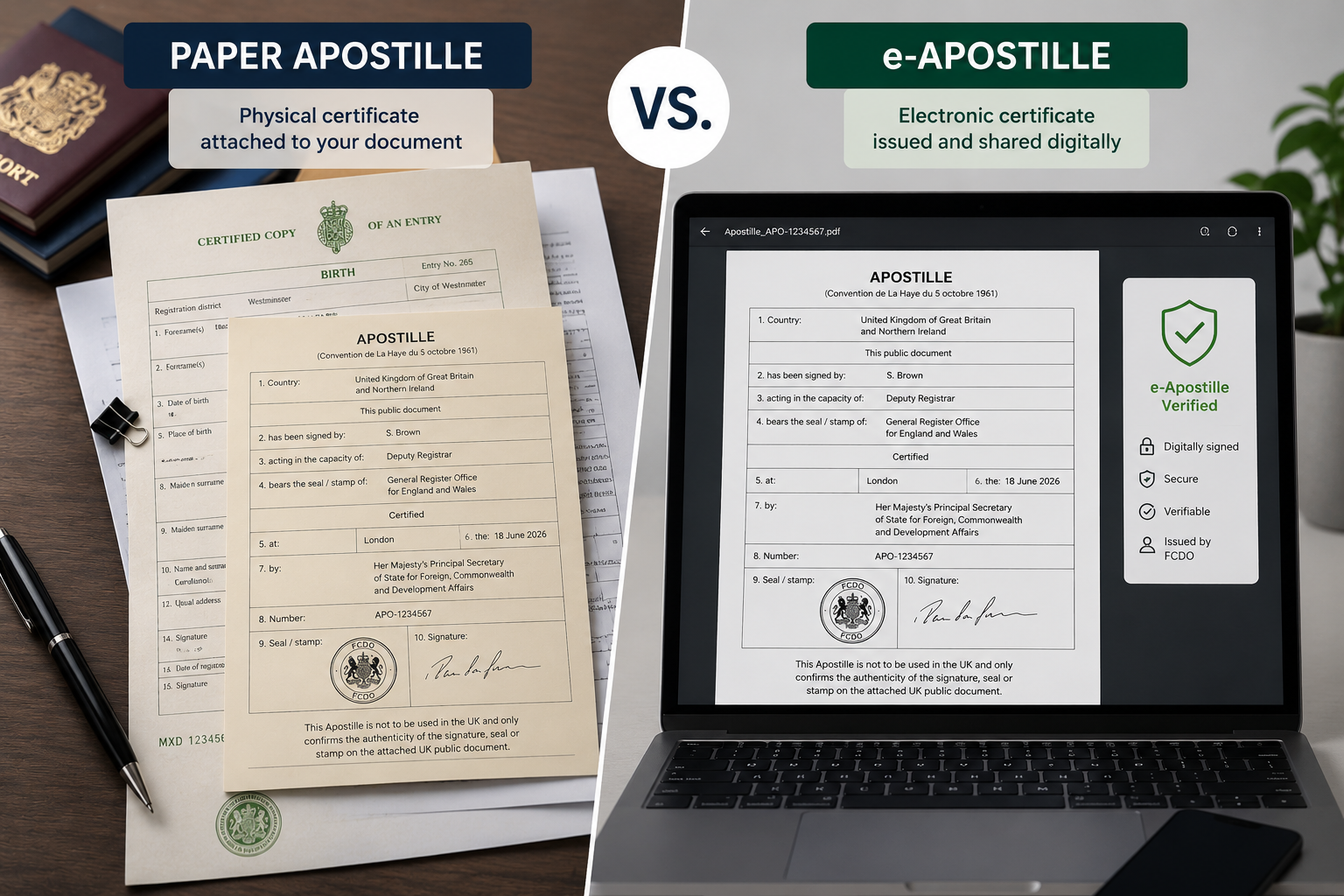
The UK Legalisation Office offers both paper and electronic apostilles, but an e-Apostille is not available for every document.
For an e-Apostille, the document must meet the Legalisation Office's electronic requirements. GOV.UK states that certain documents cannot currently use this route, including General Register Office birth, death, marriage, civil partnership and adoption certificates, as well as various police and disclosure certificates.
The person or organisation requesting the legalised document should also confirm whether it will accept an electronic apostille or requires the paper version.
Common Apostille and Translation Routes
These examples show why the destination authority's instructions need to be checked rather than assuming one sequence applies to every document.
UK birth or marriage certificate
The receiving authority may ask for the original UK certificate to be apostilled and then translated. General Register Office civil certificates are not currently eligible for the UK e-Apostille route.
Power of attorney
A power of attorney may need certification by a UK public official before it can be legalised. Translation may then be required according to the overseas authority's instructions.
Document issued outside the UK
The UK Legalisation Office does not legalise documents issued outside the UK. Those documents normally need to follow the legalisation process of the country in which they were issued.
A Complete, Clearly Organised Translation Pack
Once the correct scope has been agreed, the translation can be prepared so the receiving organisation can compare names, dates, headings, reference numbers and official markings with the source document.
Visible field labels, entries, tables, stamps, seals, annotations and legible handwritten notes can be translated where they form part of the relevant document.
- Complete translation of agreed visible content
- Certification statement where ordered
- Translator or agency identifying details in the agreed format
- Comparable document formatting
- Checks for names, dates and reference numbers
- Initial flagging of obvious missing or cropped document areas
- Certified PDF where digital delivery is appropriate
- Posted hard copies where required and agreed
Apostille Translation FAQs
Requirements vary by document, country and receiving organisation. Share any written submission instructions when sending your files.
Do I need both an apostille and a certified translation?
Not always. Some organisations need only a certified translation. Others require the original UK document to be apostilled, while some need translation plus notarisation or another legalisation step. The receiving organisation's instructions determine the correct combination.
What is the difference between an apostille and a certified translation?
An apostille authenticates the origin of an eligible document through a recognised signature, seal or stamp. A certified translation provides the translated text together with a formal certification statement. One does not automatically replace the other.
Can you coordinate translation and apostille support as one service?
Yes. We can review the document set, destination and receiving organisation, then coordinate the agreed translation, certification, notarisation and apostille stages as one managed process.
Does the original document need the apostille?
Often, but not universally. The apostille may relate to an original public document, a certified copy, a notarial act or another eligible document. The exact requirement should be checked before processing begins.
Can the apostille page itself be translated?
Yes, when the receiving authority requires it. Some submissions require the apostille wording to be translated together with the underlying document, while others do not.
Is notarisation also required?
It may be required for certain copies, signatures, declarations or documents before legalisation. It should not be added automatically when the authority has not requested or required that step.
Can I get an e-Apostille for a birth or marriage certificate?
GOV.UK currently states that General Register Office birth, death, marriage, civil partnership and adoption certificates are not eligible for an e-Apostille. A paper-based apostille route may therefore be required.
Can a UK apostille be used for a document issued abroad?
The UK Legalisation Office cannot legalise documents issued outside the UK. A document issued abroad generally needs to be legalised through the appropriate process in the country where it was issued.
Does an apostille prove the contents of a document are accurate?
No. An apostille authenticates the relevant signature, seal or stamp associated with the document. It does not certify that the factual contents of the document are true.
What should a certified translation include?
The required format depends on the receiving organisation. A certified translation commonly includes the complete translated text, an accuracy statement, the certification date and identifying or contact details for the translator or translation company.
Can I send a photograph taken with my phone?
Yes, a clear photograph can be used for the initial review. All relevant text, page edges, signatures, stamps and seals should be visible without blur, glare, shadows or cropped corners.
How much does apostille translation cost and how long does it take?
The total depends on the document type, page or word count, language pair, certification route, apostille requirements, delivery format and deadline. Certified translation starts from the published standard rate of £40 per page, while the complete apostille and legalisation cost and timetable are confirmed after the documents have been reviewed.
Is my document handled confidentially?
Documents are handled securely and shared only with the linguists, reviewers and relevant service providers needed to complete the agreed work.
Send the Document, Destination Country and Receiving Authority
We will review the files, clarify the likely apostille and certified translation route, and confirm the scope, price and available complete turnaround before work begins.