Transliteration is not translation
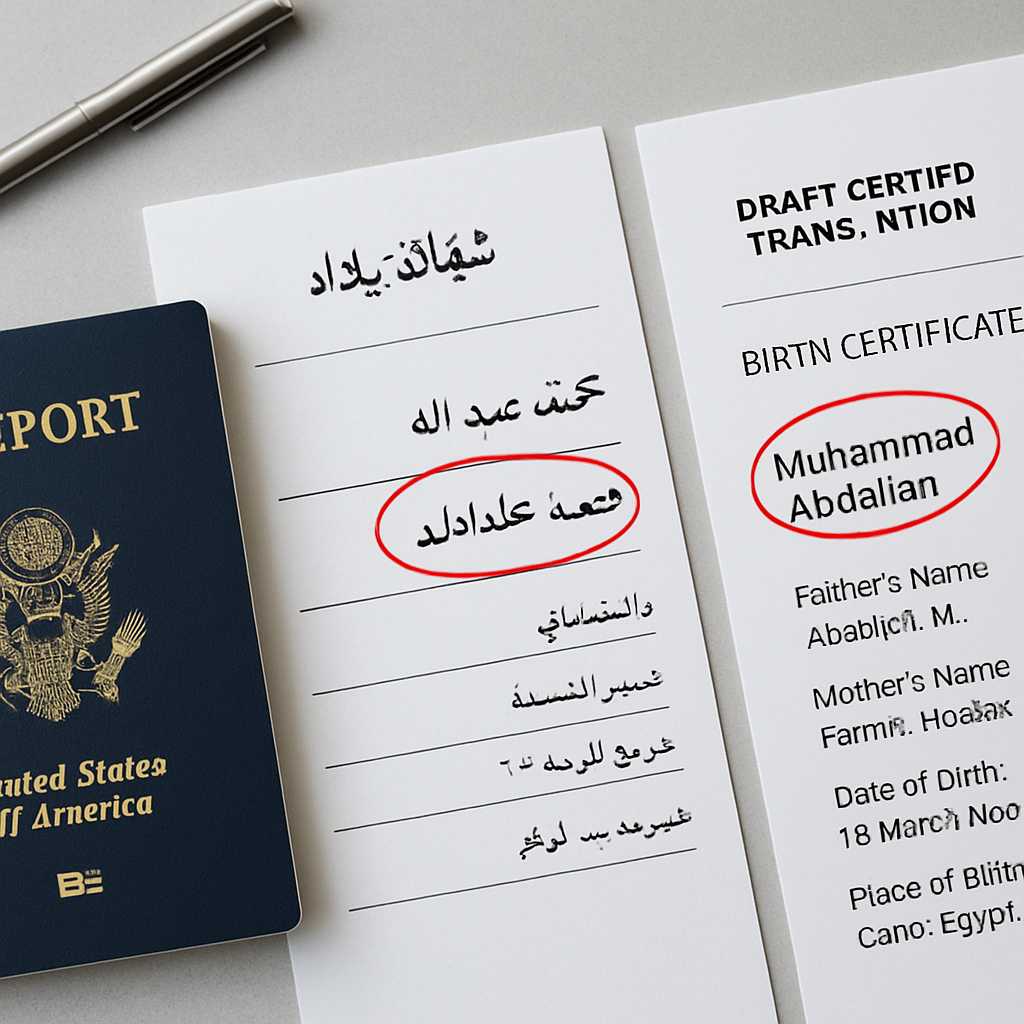
A personal name is usually transliterated, not translated. This means the translator is typically carrying the sound or established official spelling of the name into Latin characters, rather than converting its meaning into English. In official documents, that difference matters. A name should remain an identity marker, not become a rewritten version of itself.
So the question is usually not, “What is the English version of this name?” The better question is, “What spelling best matches the holder’s existing official records?” That single shift in thinking prevents a lot of common mistakes.
The simple rule hierarchy that works
When a name appears in a non-Latin script, use this order of priority.
1. If the passport already shows the name in Latin characters, follow that spelling
This is the safest rule in most official-use cases. Where a passport, residence permit, national ID, or other accepted identity document already shows the holder’s name in Latin script, that spelling is usually the best anchor for the translation. It creates a direct match between the translated document and the identity document most reviewers will check first.
This is especially important for:
- visa applications
- Home Office submissions
- university admissions
- employer right-to-work packs
- bank and compliance checks
- court or solicitor bundles
If the source document says محمد but the passport already says MOHAMED, the translation should not suddenly switch to Muhammad halfway through the file because it “looks better.” That kind of improvement often creates more risk, not less.
2. If there is no Latin-script ID, follow the strongest official reference available
If no passport spelling exists, use the best document-backed spelling you have. That could be:
- a national ID
- a birth certificate issued with a Latin version
- a residence card
- a previous visa
- a driving licence
- a university record already accepted in the UK
- an authority-issued transliteration standard linked to that script or country
The goal is not to chase a theoretically perfect transliteration. The goal is to choose a defensible spelling and keep it stable.
3. Keep one spelling throughout the whole translation
This sounds obvious, but it is where many submissions fail. A reviewer may accept one unfamiliar spelling. What creates doubt is seeing several spellings for what appears to be the same person:
- Mohamed / Mohammed / Muhammad
- Yulia / Iulia / Julia
- Abd al-Rahman / Abdulrahman / Abdel Rahman
- Ekaterina / Yekaterina
Once one form is chosen, it should stay the same everywhere it appears in the translation unless the original documents themselves clearly use different spellings and that difference needs to be shown.
4. Do not over-normalise names
Over-normalising means quietly “tidying” a name into a more familiar English-looking form. That is risky. Examples of over-normalising include:
- changing a document-backed spelling because another version is more common online
- removing part of a double surname because it feels redundant
- flipping surname and given name order without checking the source convention
- turning a transliterated name into a translated nickname
- smoothing out spaces, hyphens, apostrophes, or particles without a reason
A professional translation should clarify identity, not rewrite it.
5. Use a short translator note when it genuinely helps
A good translator note can solve confusion before it starts. Useful examples include:
- Translator’s note: The holder’s name appears in Latin characters on the passport as “MOHAMED HASSAN”. This spelling has been followed throughout this translation for consistency.
- Translator’s note: The original document shows the family name before the given name. The order has been retained to reflect the source document accurately.
- Translator’s note: Different source documents supplied by the client show minor spelling variation in the same name. The passport spelling has been used consistently in this translation.
The best note is short, neutral, and practical.
Why name transliteration causes problems in the UK
The issue is rarely the script itself. The issue is cross-document comparison. Most problems appear when:
- the passport shows one spelling
- the birth certificate translation shows another
- the bank letter shows a third
- the application form uses a fourth
At that point, the reviewer is no longer reading the name as language. They are reading it as evidence. That is why matching passports matters so much. If your translated certificate says one thing and your identity page says another, even a correct translation can trigger extra questions, requests for explanation, or a resubmission cycle.
What official systems look at before a human reviewer does
Many passport and identity systems rely on machine-readable fields, not just the visual page. UK Home Office design guidance explains that names taken from passport chip or MRZ data can appear different from the visual display because they may be truncated, transliterated into the 26-character Latin alphabet, or have diacritics removed. ICAO passport standards also require a Latin-script representation when mandatory name data is written in a non-Latin script.
That matters in practice. A client may look at the visual page and prefer one spelling, while the machine-readable line or an existing UK record reflects another form. A careful translator checks both where available, then chooses the form that best matches the wider official record.
Matching passports, visas, BRPs, licences, and certificates
For official submissions, the safest transliteration choice is often the one that aligns with the main identity trail. That usually means checking the spelling against:
- passport biodata page
- visa or entry vignette
- BRP or residence card
- driving licence
- previous certified translations
- academic or employment records already used in the UK
A useful working rule is this:
- If this is your strongest ID record: Use this as the anchor spelling
- If a passport with Latin spelling: Use the passport spelling
- If a national ID with Latin spelling but no passport: Use the ID spelling
- If no Latin-script ID, but accepted UK record exists: Use the accepted UK record and note it if needed
- If no Latin-script record at all: Use a consistent standard-based transliteration and keep it stable
This is one reason clients often send more than one document when they contact our team for a fast quote. A second document can prevent a preventable mismatch.
Diacritics, accent marks, hyphens, spaces, and apostrophes
Names do not only vary because of script. They also vary because of formatting. A small change can create a big mismatch:
- José / Jose
- Dvořák / Dvorak
- El-Haddad / El Haddad
- O’Neil / ONeil
- Al Zahrani / Alzahrani
UK passport guidance for names explains that diacritical characters and accent marks may be replaced with alternative spellings, and that official systems may not display those marks in the same way. It also shows that where an accepted alternative spelling exists on the relevant transliteration table, that alternative can be used without further evidence; where it does not, further written evidence may be required.
For translation work, the practical lesson is simple: do not assume a missing accent, moved hyphen, or lost space is trivial. Compare the client’s main ID documents before treating it as cosmetic.
What to do with patronymics, middle names, and name order
Some naming systems do not map neatly onto standard English form fields. That includes:
- patronymics
- multiple family names
- father-name structures
- matronymics
- gendered surname endings
- surname-first document layouts
UK passport guidance specifically notes that where a difference is due to patronymic naming conventions, the name difference may be accepted, and patronymic names in Cyrillic may be transliterated using the ICAO table rather than forcing artificial alignment.
For translators, the better habit is to preserve the source structure first, then explain it briefly if the receiving reader may not recognise the naming pattern. Do not flatten a culturally specific naming system into a standard English first-name/last-name template unless the receiving authority explicitly requires that presentation and you can still preserve accuracy.
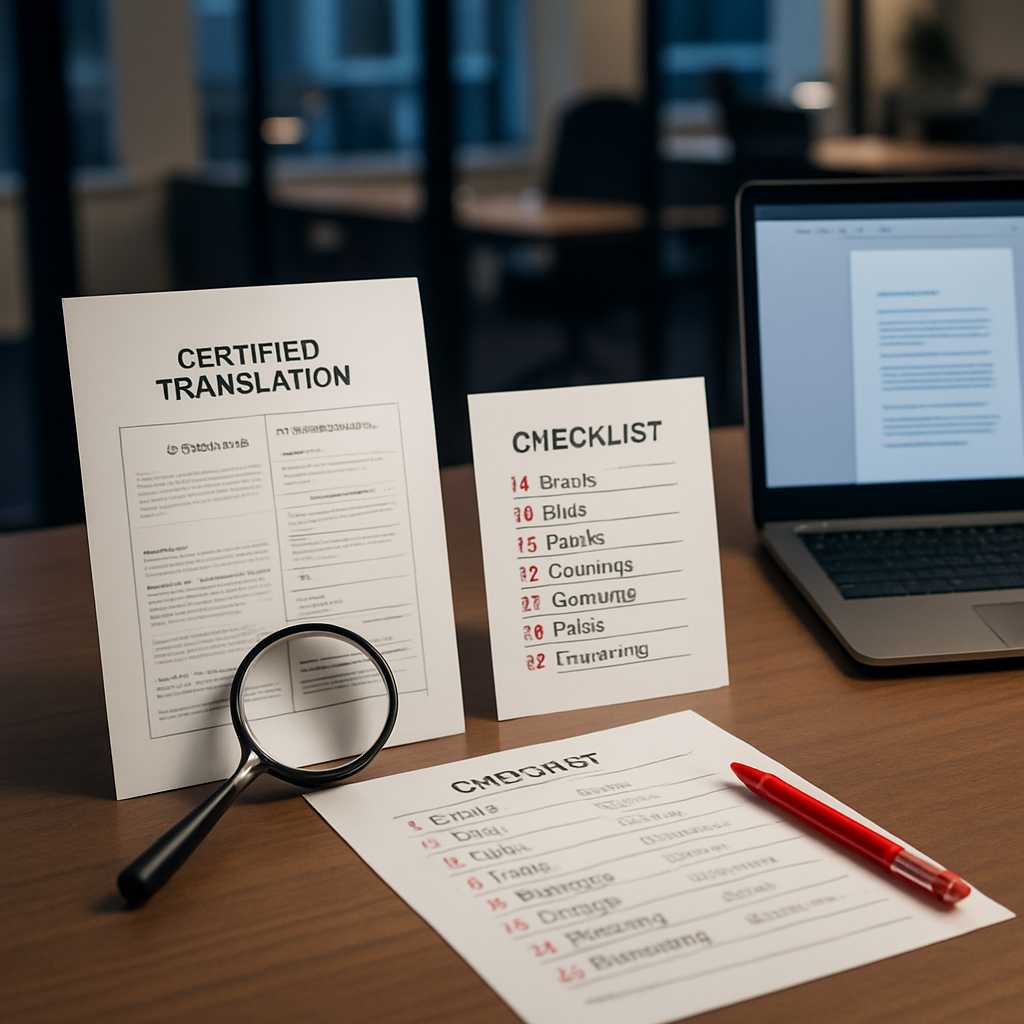
The five-point consistency check that catches most problems
Before certifying a translation, run this check:
Check 1: Passport match
Does the translated spelling match the client’s passport or primary ID exactly where a Latin spelling already exists?
Check 2: Whole-file consistency
Is the same spelling used every time the person’s name appears in the translation?
Check 3: Cross-document consistency
If the client submitted several documents, do the translated names line up across the whole bundle?
Check 4: Formatting details
Have hyphens, apostrophes, spaces, initials, and surname order been checked rather than guessed?
Check 5: Clarifying note
Would a one-line translator note prevent a reviewer from misreading a minor variation?
This is where many weak translations fall short. They translate the document line by line, but they do not review the identity trail as a whole.
A practical example
A client submits:
- an Arabic birth certificate
- a passport showing MOHAMED ALI HASSAN
- a bank statement showing Mohammad Hassan
- a degree certificate showing Mohamed A. Hassan
A weak translation might produce yet another version based only on the Arabic script. A strong translation anchors the spelling to the passport, keeps that spelling consistent in the translated document, and adds a short note only if the wider file genuinely needs it. That approach reduces friction because it helps the reviewer connect the documents quickly. The translation is not just accurate at sentence level. It is coherent at identity level.
What a certified translation should include
If a document is being submitted to the Home Office and it is not in English or Welsh, GOV.UK says the full translation must be independently verifiable and include confirmation that it is an accurate translation, the date, the translator’s full name and signature, and the translator’s contact details. That means name transliteration is only one part of acceptance. The file also needs the right certification wording and a professional presentation standard.
For clients who need official-use support, it helps to review our certified translation service pages and about page alongside the document requirements themselves.
Common mistakes that lead to avoidable delays
Choosing the most familiar spelling instead of the document-backed spelling
A common spelling is not automatically the right spelling.
Using one transliteration in the body and another in the certificate
This creates instant inconsistency.
Changing surname order without explanation
What looks tidier in English can look inaccurate to a reviewer.
Ignoring passport MRZ or existing UK records
The visual page is not always the only spelling that matters.
Treating diacritics as irrelevant
Sometimes they are only cosmetic. Sometimes they are the reason two records stop matching.
Failing to ask for supporting IDs
A one-page document does not always give enough evidence to choose the safest spelling confidently.
The simplest rule clients can follow before ordering
Send the document you need translated and the ID document you want the spelling matched to. That one step saves time, reduces revision requests, and helps the translator make a consistent decision from the start. If you already hold a passport, visa, BRP, licence, or previous accepted translation, include it. If you do not, say which document the receiving authority is most likely to compare against. That gives the translator a usable reference point.
A better way to think about transliteration standards
People often ask, “Which transliteration standard should I use?” In real official-use work, the better answer is usually: Use the standard that is most defensible for this document pack. Sometimes that will be the passport spelling. Sometimes it will be a country-specific official Latin rendering. Sometimes it will be a standard convention for the script. Sometimes it will be the client’s already-established UK record.
The mistake is assuming there is one universal answer for every script, every authority, and every application type. There is not. What works is a hierarchy: official ID first, evidence-backed consistency second, theory third.
When speed matters, the name check matters even more
Urgent jobs are where name errors do the most damage. When a client is rushing for a visa, court deadline, university place, employer check, or travel window, the temptation is to focus only on turnaround. But the faster the deadline, the less room there is for a spelling dispute after delivery.
That is why urgent certified translation is not just about speed. It is about getting the identity details right the first time. If your documents contain non-Latin names, mixed spellings, or unclear formatting, send them with any supporting ID and let us review the safest spelling route before the work begins. You can explore our language translation services, browse the official document types we translate, or request your quote here.
A short case snapshot
A client preparing an immigration bundle often assumes the “translation” problem is the foreign language text. In reality, the bigger problem is often this: the passport is one spelling, the certificate is another, the sponsor letter is a third, and the application form uses a shortcut version. When that happens, a careful translator does more than convert text. They stabilise the identity record across the file. That is often the difference between a document that merely reads well and a document pack that is easier to accept.
Final takeaway
The best name transliteration UK approach is not complicated. Use the strongest official spelling already attached to the person. Keep it consistent across the whole file. Do not over-normalise. Check diacritics, hyphens, spacing, and name order carefully. Add a short note only when it genuinely helps. That is how simple rules keep non-Latin names clear, credible, and submission-ready.
If you need a certified translation prepared with careful name matching, official-use formatting, and attention to every spelling detail, get in touch with Urgent Certified Translation UK.
FAQs
What does name transliteration UK mean?
Name transliteration UK usually means representing a name from a non-Latin script in Latin characters for use in passports, certified translations, visa files, academic records, and other official UK-facing documents. The aim is normally consistency with identity records, not a creative or stylistic rewrite.
Should a certified translation match the passport spelling exactly?
In many official-use situations, yes. If the passport already shows the name in Latin characters, that spelling is usually the safest anchor because it helps the translated document match the main identity document likely to be checked first.
Is transliteration the same as translating a name?
No. Transliteration carries a name from one writing system into another. Translation converts meaning. For official documents, names are usually transliterated, not translated.
How should diacritics be handled in name transliteration UK work?
Diacritics should be handled carefully, not automatically removed or rewritten. The right choice depends on the client’s existing identity trail, passport spelling, and the receiving authority’s expectations. What matters most is consistency across the document pack.
What if my documents show two different spellings of the same name?
That is common. The safest approach is to identify the strongest official anchor, usually a passport or primary ID, use that spelling consistently in the translation, and add a brief translator note if the variation needs explaining.
Can a translator explain a name difference in a certified translation?
Yes, where it is genuinely useful. A short, neutral translator note can explain that the passport spelling has been followed throughout, that the source uses surname-first order, or that a minor variation exists across supporting documents.