Employment Letter Translation: HR-Friendly Formatting
When an employer letter is being used for a visa file, onboarding check, lender review, university application, or compliance process, the translation has to do more than turn one language into another. It has to help the reader verify employment quickly. In UK immigration and supporting-document contexts, employer letters are commonly used to confirm role, salary, length of employment, and company details. If the document is not in English or Welsh, a certified translation is generally required.
That is why employment letter translation format matters so much. A good translation does not bury key details in dense text, guess at job titles, flatten salary information, or strip away headings, signatures, stamps, and reference numbers. It presents the original clearly, keeps the meaning intact, and makes the final file easy for an HR officer, caseworker, or document reviewer to follow.
If you need a professionally prepared file for submission, Urgent Certified Translation UK offers certified translation services, broader document translation support, and multilingual coverage through its languages page. The site also presents its service around careful handling of names, dates, formatting, and official details.
Why Employment Letters Are Often Harder to Translate Than They Look
An employment letter usually appears simple: one or two pages, company letterhead, a short statement of employment, maybe salary, dates, and a signature. But for the receiving organisation, it often carries more weight than the page count suggests.
A reviewer may rely on it to confirm:
- whether the employee is currently employed
- what the job title means in practical terms
- whether the salary figure is gross or net
- how long the employment has lasted
- whether the work is permanent, fixed-term, or temporary
- whether the document comes from a genuine employer and has identifiable company details
That last point matters because UK guidance on employment evidence often expects specific details from employer letters, including role, salary, length of employment, and company contact information. In some routes, employer letters are used alongside payslips and bank statements to evidence gross annual salary, the period paid, length of employment, and employment type.
The translation, then, should not read like a generic office letter. It should read like a submission-ready document.
What Makes a Translation “HR-Friendly”
HR-friendly formatting is not about making the translation look more polished than the original. It is about making the document easier to review without changing its meaning.
In practice, that means five things:
1. The Layout Should Help the Eye Move Logically
The best employment letter translation format keeps the original order of information but makes each section easy to spot. Company details sit at the top. Employee details come next. Employment facts follow in a clear sequence. Signatures, stamps, and notes appear where the reviewer expects them.
2. Headings and Labels Should Be Visible
If the original includes lines for “Position,” “Department,” “Salary,” “Date of Joining,” or “Responsibilities,” those labels should not disappear into long paragraphs. They should remain distinct. This is especially useful for salary confirmation translation and dates-and-duties sections.
3. Numbers Must Be Protected from Ambiguity
Dates, salary figures, employee IDs, reference numbers, tax identifiers, and contract periods should be checked line by line. A translation that is linguistically fine but numerically careless creates the fastest route to rejection, follow-up queries, or internal HR confusion.
4. Job Titles Should Be Translated for Meaning, Not Prestige
One of the biggest mistakes in employment letter translation format is over-inflating a job title. A title should reflect the original role as closely as possible, not be “upgraded” for English-speaking readers. If a literal rendering would confuse the reader, a short translator note can help.
5. Explanatory Notes Should Be Rare, But Smart
A good translator does not annotate every line. But when a local employment term, grade code, internal title, or payroll expression has no clean English equivalent, a brief note can prevent a bad assumption.
The Best Employment Letter Translation Format for UK-Facing Submissions
A strong translation usually follows this order:
Company Header
Keep the employer’s letterhead information visible in translation. That can include:
- company name
- registered address
- branch address if shown
- phone number
- email address
- website
- registration or tax number if present
- document reference number
If the original is on headed paper, say so where necessary. If a stamp or logo appears, note it in square brackets only when relevant, for example: “[Company stamp]” or “[Logo at top left]”.
Date of Issue
Translate the issue date exactly and keep the format consistent. If the original date style could be misread internationally, the translation should remove ambiguity. For example, writing “14 March 2026” is better than “14/03/26”.
Addressee or “To Whom It May Concern” Line
Keep this line in place. It signals who the letter was intended for and can affect how formal the translation should sound.
Employee Identification Block
This should make the employee easy to identify at a glance:
- full name
- date of birth if shown
- employee number if shown
- passport or national ID number only if present in the original
- department or team
- work location if stated
This is where consistency matters. The name should match the spelling used elsewhere in the file set, especially if the client is also submitting a passport, ID card, or payslips.
Job Title Translation
This deserves its own line, not a passing mention inside a paragraph. A good job title translation:
- preserves seniority accurately
- avoids inflating the role
- keeps sector-specific meaning intact
- uses a note only where needed
For example, if the original title sits somewhere between “Administrative Officer” and “Executive Assistant,” the right solution is not guesswork. It is either the closest clean equivalent or a faithful translation supported by a short note. Job title translation is one of the first things HR reviewers notice because it affects salary expectations, professional level, and consistency with CVs, contracts, and reference letters.
Employment Dates
This section should state:
- start date
- current status or end date
- any break in service if shown
- whether the employee is currently employed
If the original says the employee has worked “since” a date, keep that exact sense. Do not convert ongoing employment into a fixed past period.
Salary Confirmation Translation
Salary lines should be presented carefully because they are often read as financial evidence, not just HR information. A clear salary confirmation translation should show:
- salary amount
- currency
- whether it is gross or net, if stated
- whether it is monthly, annual, weekly, or hourly
- whether bonuses, allowances, commissions, or housing are separate
- whether the figure is current or historical
This matters because UK immigration guidance often focuses on gross annual salary, the period over which salary has been paid, and how employment evidence aligns with the rest of the application.
Where the original uses payroll shorthand, internal abbreviations, or local tax language, the translation should stay accurate and resist the urge to simplify away meaningful distinctions. “Base salary,” “total compensation,” and “net take-home pay” are not interchangeable.
Duties and Responsibilities
Many employment letters include a short duties section. This is where translators sometimes become too literary. That is a mistake. The best approach is:
- keep duties in the same order as the original
- keep the tone professional and neutral
- preserve verbs that show actual responsibility
- avoid rewriting routine tasks into dramatic achievements
If the letter is being used to support skilled work history, consistency between duties, job title, and dates matters more than elegant wording.
Employment Type and Contract Status
If the original mentions permanent employment, fixed-term status, agency work, probation, part-time hours, or full-time hours, these details should be easy to find. In some UK evidence frameworks, employment type is specifically relevant.
Signature, Stamp, and Verification Details
Do not drop these. If the source document includes:
- an HR signature
- manager signature
- company stamp
- seal
- QR code
- contact block
- annex or attachment
the translation should record that clearly. A reviewer needs to see not only the translated text, but also the document features that help establish authenticity and context.
A Simple Formatting Model That Works Well
For most employment letters, this structure performs well:
- Title of document: Employment Confirmation Letter / Employment Reference Letter / Salary Certificate / Employer Statement
- Source layout mirrored clearly
- Section 1: Employer details
- Section 2: Employee details
- Section 3: Job title and department
- Section 4: Employment dates
- Section 5: Salary and compensation details
- Section 6: Duties and responsibilities
- Section 7: Contract status or working hours
- Section 8: Closing statement from employer
- Section 9: Signature, stamp, and contact details
- Section 10: Certification page
That final certification page matters. GOV.UK says a certified translation should include confirmation that it is a true and accurate translation, the date of translation, and the translator’s full name and contact details. Home Office caseworker guidance also states that a fully certified translation should include confirmation of accuracy, the date, the translator’s full name and signature or an official from the translation company, and contact details. CIOL also points readers to UK best-practice guidance for certified translations.
What Should Be in a Certified Translation Pack
A proper certified translation pack for an employment letter should usually include:
- the full translation, not excerpts
- translated headings, body text, and sign-off
- visible treatment of stamps, seals, logos, or handwritten signatures where relevant
- a certification statement
- translator or translation company details
- date of certification
- signature on the certification where required
- digital PDF delivery, with hard-copy option where needed
This matches both live practice on the Urgent Certified Translation UK site and current UK guidance on what a certified translation should contain. A weak pack, by contrast, often contains only a plain translated page with no certificate, no company details, no signature, and no clear link between the source document and the translation.
The Four Biggest Mistakes to Avoid
Over-Normalising the Job Title
A translator should not “improve” the title to sound more impressive in English. That may create inconsistency with the employee’s contract, payslips, CV, or visa form.
Blurring Salary Language
Gross salary, net salary, allowances, bonuses, commissions, and overtime should never be collapsed into one vague “salary” line unless the original does that.
Hiding Dates and Duties Inside Long Paragraphs
HR teams scan. They do not want to hunt through a wall of text for the start date or contract type.
Forgetting the Submission Context
An employment letter for internal HR onboarding, a salary certificate for a bank, and an employer letter for a visa application may overlap, but they are not identical in purpose. The translation should keep the wording faithful while formatting the document so the intended reviewer can verify it quickly.
A Practical Example of Good Versus Bad Formatting
A poor translation often looks like this in effect: one long paragraph, no line breaks, salary and dates buried in the middle, no indication of stamp or signature, and a vague title such as “Work Letter.”
A better version keeps the employer’s structure visible:
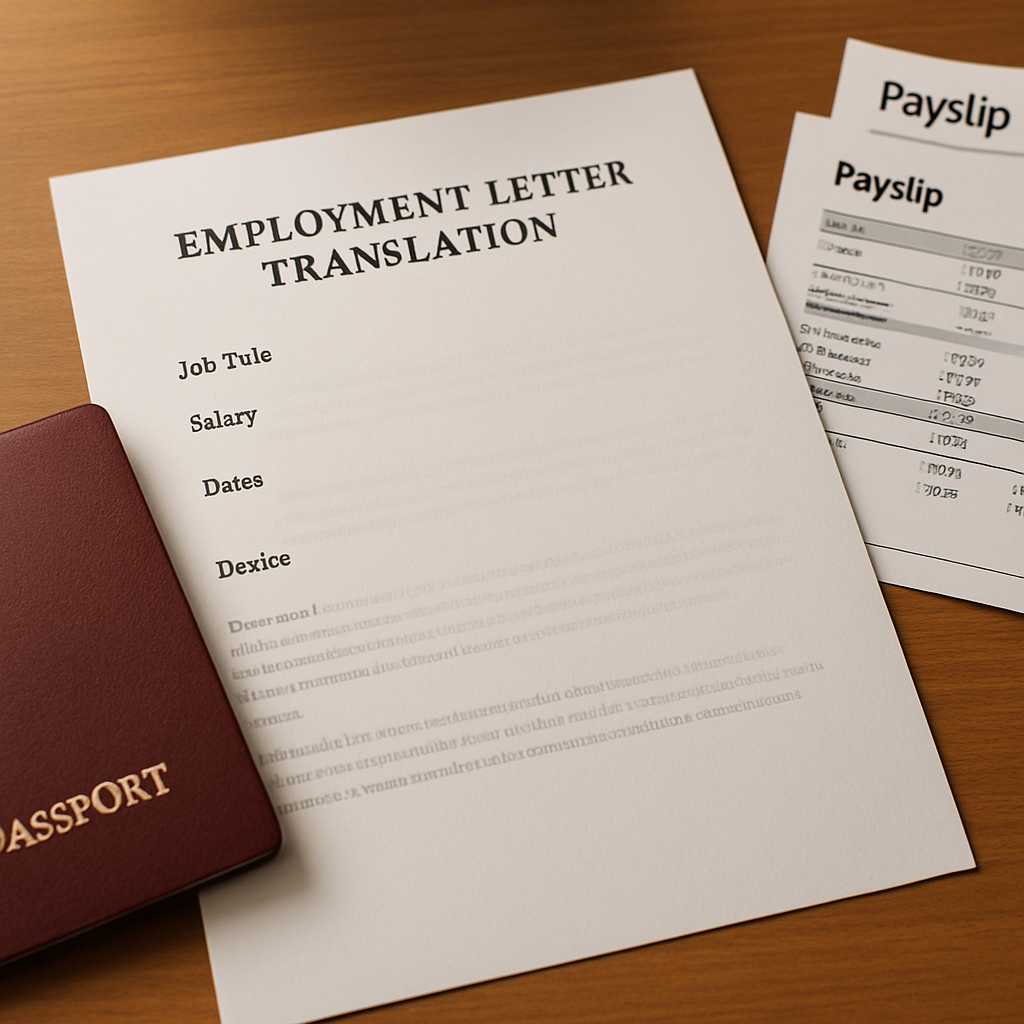
Employee: Maria Ivanova
Position: Senior Accounts Assistant
Employment start date: 12 September 2021
Current status: Currently employed
Gross monthly salary: EUR 2,850
Duties: Accounts reconciliation, invoice review, supplier communication, monthly reporting
Document features: [Signed by HR Manager] [Round company stamp]
That is easier for a recruiter, caseworker, solicitor, compliance officer, or lender to read in seconds.
When a Translator Note is Useful
Translator notes are valuable when they solve a real problem. Good uses include:
- explaining a local employment rank with no exact English equivalent
- clarifying that a number refers to gross annual salary rather than monthly net pay
- identifying an unreadable handwritten signature as “[signature illegible]”
- explaining that a company seal contains text not repeated elsewhere
Bad uses include:
- re-explaining obvious job titles
- adding legal commentary
- guessing what a missing word probably meant
- turning the translation into an editorial document
Why This Topic Earns Trust with HR Teams
HR departments are used to documents that are internally consistent. They expect names to match, dates to line up, job titles to make sense, and salary figures to be interpretable without a follow-up email.
That is why the most convincing employment letter translation format is rarely the fanciest one. It is the one that is easiest to verify.
If your document includes a job title that needs careful handling, a salary line that needs precise labelling, or a dense duties paragraph that should remain faithful without becoming unreadable, it is worth sending it for review before submission through the contact page or by starting with the firm’s document translation service page.
A Quick Pre-Submission Checklist
Before sending an employment letter translation to HR, a visa team, or another reviewing body, check that:
- the employee name matches the passport or primary ID
- the job title translation is accurate and not inflated
- the salary figure states currency and pay period clearly
- gross or net status is preserved if shown
- start date and current status are obvious
- duties are translated fully and in order
- company letterhead, signature, and stamp are accounted for
- any reference number is preserved
- the certification page includes the required statement, date, and translator details
- the final PDF is clean, legible, and easy to navigate
Final Thought
Employment letters are often treated like minor supporting documents until one gets questioned. In reality, they often sit at the intersection of HR, finance, immigration, and compliance. That is exactly why formatting matters.
A strong employment letter translation format does not just sound accurate. It helps the next person trust the document faster. When that is the goal, the right approach is simple: preserve the original meaning, surface the key facts, label the salary carefully, translate the job title honestly, and deliver the file as a complete certified translation pack.
FAQs
What is the best employment letter translation format for UK use?
The best employment letter translation format keeps the original structure clear while making core facts easy to review: employer name, employee name, job title, salary, dates, duties, and signature details. It should also include a certification page when the translated document is being used officially in the UK.
Does a job title translation need to be literal?
Not always word-for-word, but it should be faithful. A job title translation should preserve the real level and function of the role. The aim is not to make the title sound grander in English. It is to make it understandable without changing the underlying employment reality.
How should salary confirmation translation be presented?
Salary confirmation translation should state the amount, currency, and pay period clearly, and should preserve whether the figure is gross or net if the original states that. If allowances, bonuses, or commissions are separate, the translation should not merge them into a single salary figure.
Should dates and duties be translated in full?
Yes. Dates and duties should be translated completely and placed where they are easy to review. Missing a start date, shortening a duties section too aggressively, or changing the tense of ongoing employment can create problems when the document is checked against other records.
What is included in a certified translation pack for an employment letter?
A certified translation pack usually includes the full translated document, any relevant notes for stamps or signatures, and a certification page confirming accuracy, date, and translator or company details.
Can an employment letter translation be used for HR, visa, and bank purposes?
Often yes, but the exact usefulness depends on what the receiving organisation wants to verify. Some readers focus on job title and duties, others on salary and employment length, and others on whether the translation is properly certified. That is why formatting the document for quick review is so important.