Translation Price Per Page Explained
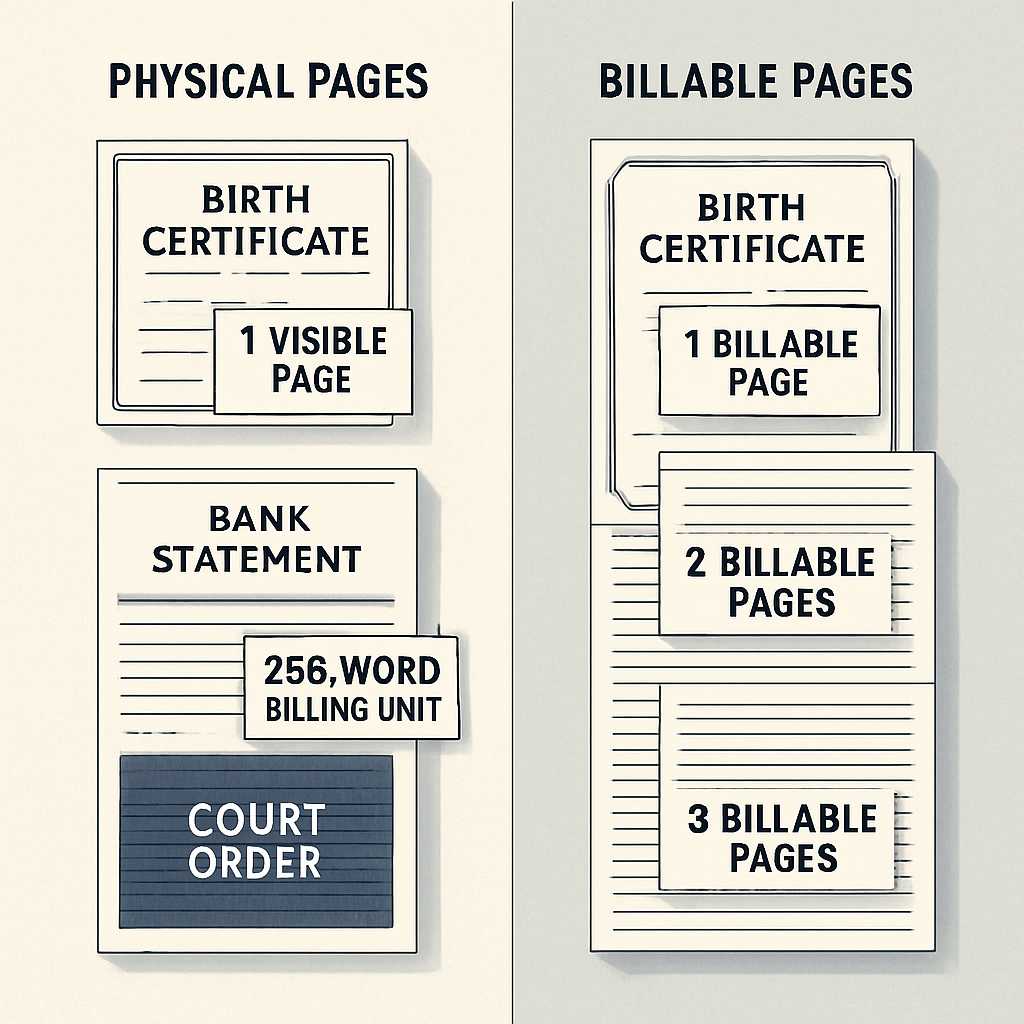
If you have ever looked at a translation quote and thought, “But my document is only one page,” you are not alone. This is one of the biggest sources of confusion in certified translation. A “page” in a quote often means a billing unit, not just a sheet of paper. That is why a one-page birth certificate can sometimes still be one billable page, while a one-page court order can price like several. It is also why a six-page bank statement may not always cost six times as much as a short but dense legal document.
The simplest way to understand translation pricing is to separate three things:
- Physical pages — the sheets or PDF pages you can see.
- Billable pages — the amount of text that actually has to be translated.
- Submission pack size — the full set of files you are sending for immigration, court, academic, banking, or official use.
Once you understand the difference, quotes become much easier to compare.
Need an exact answer for your own file rather than a rough rule of thumb? Send your scan to Urgent Certified Translation UK and we will confirm the billable page count before work starts, so you know what is included from the start.
The Short Answer: How Translation Companies Usually Count Pages
For many certified document quotes, one billable page is based on a standard word allowance rather than the visible number of sheets in the PDF. In practice, many providers treat up to around 250 source words as one page for common official documents such as certificates, passports, diplomas, and statements.
That means:
- A physically small document can count as more than one billable page if it is dense.
- A multi-page document with very little text may count as fewer billable pages than expected.
- Stamps, seals, handwritten notes, headers, footers, tables, and back-side text can matter.
- Certification, urgent turnaround, notarisation, apostille support, and formatting can affect the final quote too.
This is why “price per page” only makes sense when the provider also explains how a page is defined.
Why the Number of Visible Pages is Not the Whole Story
Clients naturally count the pages they can see. Translators and project teams count the text that has to be read, translated, checked, formatted, and certified.
That difference matters because certified translations are usually prepared for official use. The translation often needs to reflect:
- Names exactly as shown
- Dates in the right format
- Stamps and seals
- Registration numbers
- Handwritten annotations
- Document notes and footnotes
- Tables, headings, and signature lines
In other words, the job is not just to convert sentences. It is to produce a complete, professionally presented translation that matches the source closely enough for official review.
Three Counts Every Client Should Understand Before Requesting a Quote
1. Physical Page Count
This is the easiest number to spot. If your PDF has four pages, your physical page count is four.
This number is useful because it tells the translation team:
- How many sides or images need reviewing
- Whether there are annexes, reverse sides, or attachments
- Whether the file is likely to include repeated layouts such as bank statement tables
But physical page count alone is not enough to price fairly.
2. Billable Page Count
This is the figure that usually decides the quote. A common estimation method is:
Total source words ÷ 250, rounded up
That does not mean every company uses exactly the same threshold. Some are stricter. Some allow a little buffer. Some switch to per-word pricing for dense narrative files. The important point is that the billable count follows the amount of translatable content, not empty space.
3. Submission Pack Count
This is the number that actually affects your budget. For example, you may only be translating:
- 1 birth certificate
- 3 months of bank statements
- 1 court order
- 1 passport page
- 1 supporting affidavit
Each item may look manageable on its own. Together, they create the real project total. This is why the smartest way to budget is by the full pack you are submitting, not by one document in isolation.
Birth Certificate, Bank Statement, Court Order: How Page Counting Works in Real Life
Below is the clearest way to think about the most common document types.
| Document Type | What Clients Often Assume | What Usually Matters in the Quote |
|---|---|---|
| Birth Certificate | “It is one page, so it should be one page.” | Total word count, stamps, bilingual layout, margin notes, reverse-side content, registration entries |
| Bank Statement | “It is six pages, so it must be six pages.” | Whether the pages are text-light, repetitive, table-heavy, or partly non-translatable |
| Court Order | “It is only three pages.” | Dense legal wording, numbered paragraphs, footnotes, judge details, annexes, signatures, seals |
Birth Certificates
A standard birth certificate is one of the easiest documents to estimate, but even here the details matter. A simple certificate often includes:
- Child’s name
- Date and place of birth
- Parents’ names
- Registration details
- Stamp or seal
- Signatures
That may fit neatly within one billable page. But the count can change if the document:
- Is bilingual and contains more total text than expected
- Includes handwritten notes or amendments
- Has reverse-side text
- Includes a legalisation page, registry notes, or explanatory wording
- Comes as part of a certificate pack with multiple related records
Practical takeaway: Many birth certificates still quote cleanly at one billable page, but never assume that “one sheet” always equals “one billable page” without checking the actual text density.
Bank Statements
Bank statements cause the opposite problem. Clients often overestimate cost by counting visible pages only. A statement may run to several pages because of:
- Repeated column headers
- Transaction tables
- White space
- Branding and layout
- Month-by-month separation
If the document is mostly repetitive table content and short transaction descriptions, the billable count may be more reasonable than the raw PDF length suggests. That said, bank statements can become more labour-intensive when they include:
- Long narrative payment references
- Account notes and notices
- Multiple currencies
- Explanatory footers
- Handwritten marks
- Low-quality scans where numbers are hard to read
Practical takeaway: A five-page or six-page bank statement is not always priced like five or six dense pages of prose. The decisive factor is how much content truly needs translation and how clearly it can be read.
Court Orders
Court orders tend to be where clients underestimate price. A court order may only run to a few pages physically, but it often contains:
- Dense legal language
- Long sentences and formal terminology
- Numbered clauses
- Case references
- Dates and procedural history
- Signatures, stamps, seals, and issue information
- Annexes or attached schedules
Because accuracy matters so much in legal material, these files also need slower checking and more careful formatting.
Practical takeaway: A short court order can price higher than a longer-looking bank statement because the work is more text-heavy, more sensitive, and more formatting-dependent.
What Counts as “Text” in a Certified Translation Quote?
A common mistake is assuming that only body paragraphs count. In certified document work, many non-paragraph elements still need translating or describing. These often count toward the workload:
- Headings and titles
- Seals and stamp text
- Side notes and registry notes
- Typed and handwritten annotations
- Identity numbers and reference numbers
- Signature labels
- Table headings
- Footer notices
- Back-side legends
- Abbreviations and official short forms
This is one reason official-document translation is not the same as copying the visible main text into another language. The finished translation has to be complete, internally consistent, and suitable for submission.
Per Page vs Per Word: Which Pricing Model is Better?
Neither model is automatically better. They suit different document types.
Per-Page Pricing Usually Works Best When:
- The document is a common official format
- The file is short and easy to classify
- The client wants a fast, predictable estimate
- The translation needs certification for submission
Typical examples include birth certificates, marriage certificates, passports, diplomas, and simple statements.
Per-Word Pricing Usually Works Best When:
- The document is unusually dense
- The text is narrative rather than form-based
- The file contains mixed sections and annexes
- The project includes business, legal, technical, or editorial content
- The provider wants to price precisely around actual text volume
Typical examples include contracts, witness statements, judgments, detailed court orders, reports, and multi-document business packs.
The Most Useful Question to Ask
Instead of asking only, “What is your price per page?” ask this:
How do you define a page, and what is included if my document has seals, tables, notes, or back-side text?
That single question reveals far more than a headline rate.
The Hidden Factors That Change a Quote Even When the Page Count Looks Simple
Two documents can both show “2 pages” and still price differently. Here is why.
Scan Quality
Low-quality scans slow down every stage of the process. If the team has to zoom, decipher blurred text, or reconstruct cut-off page edges, the file takes longer to handle. Common issues include:
- Shadows across the page
- Cropped corners
- Glare over stamps or signatures
- Skewed photos from mobile phones
- Low-resolution screenshots
- Faint or overlapping print
Handwriting
Even a small handwritten note can change the effort level if it is important to the document.
Tables and Formatting
Statements, academic transcripts, and court schedules often need more formatting care than plain text pages.
Language Pair
Some language pairs are more readily available than others. Rare or specialist combinations may require a different pricing structure.
Certification Level and Add-Ons
Depending on your use case, you may need:
- Certified translation
- Notarised translation
- Sworn translation for another jurisdiction
- Apostille or legalisation support
- Printed hard copies in addition to digital delivery
- Urgent or same-day turnaround
If you are unsure what level is required, ask before ordering. It is much cheaper to set the right scope at the start than to reissue documents later.
Need help working out what is actually required for your submission? Upload your file to Urgent Certified Translation UK and we will check the document type, likely page count, and the most suitable certification route before work begins.
How to Estimate Your Own Page Count Before You Request a Quote
You do not need to be exact. You just need to be realistic.
A Simple Client-Friendly Method
- Count every page and every side that contains text.
- Check whether the document includes stamps, notes, seals, or handwritten additions.
- Estimate whether the text is light, medium, or dense.
- Group documents by type: certificates, statements, legal documents, academic records.
- Assume that dense legal or court material may not follow the same logic as a simple certificate.
- Send the full pack together rather than requesting separate mini-quotes.
A Useful Rule of Thumb
- Simple certificate: often around one billable page
- Multi-page statement: may bill more gently than the visible page count suggests if text is repetitive
- Dense legal order: may price above the visible page count because the wording is heavier and the review burden is higher
This is only a planning guide, not a final quotation method.
Why Clear Scans Help You Get a More Accurate Quote
The quality of the file directly affects quote accuracy. For the most reliable estimate, send:
- A full scan of the original document where possible
- Every page and every reverse side with text
- Clear images of stamps, seals, and handwritten notes
- All annexes, attachments, or explanatory pages
- The complete pack in one email or upload, not one page at a time
This helps avoid the most common pricing surprises:
- A missed reverse side
- An omitted annex
- A blurry stamp that later needs manual clarification
- A “one-page” document that actually includes a second certification or registry page
Why Official-Use Translations Are Priced Differently from Casual Translations
When a document is going to a visa officer, court, university, employer, bank, or official body, the translator is not just helping someone “understand the gist”. The translation has to be complete enough to stand alongside the original and be independently checked.
That is why official translations usually involve more than language conversion alone:
- Document review
- Terminology checking
- Formatting and layout care
- Certificate preparation
- Quality checking
- Delivery in the required format
For UK submissions, the translation also needs to be properly presented for official review. That is one more reason why names, dates, seals, notes, and supporting details matter in the quote.
A Smarter Way to Compare Quotes from Different Providers
If you are comparing providers, do not focus only on the headline number. Compare the quote on the same basis. Check whether each quote confirms:
- How a page is defined
- Whether certification is included
- Whether stamps, seals, and notes are included
- Whether back-side content is included
- Whether digital delivery is included
- Whether hard copies cost extra
- Whether urgent turnaround changes the unit price or adds a rush fee
- Whether revisions for formatting or missed page sides are chargeable
A cheap-looking quote can become expensive later if these details are unclear.
The Most Common Quoting Mistakes Clients Make
“It Is One Page, So It Must Be the Minimum.”
Not always. A single page can be text-heavy.
“The Bank Statement Is Eight Pages, So It Will Definitely Cost Eight Page Rates.”
Not always. Statements can be layout-heavy and text-light.
“The Back Side Is Just a Stamp.”
If the stamp, note, or legend matters, it still needs reviewing and may need translating.
“I Will Send the Rest Later.”
That often creates fragmented quoting and surprises when the real submission pack is larger than the first sample.
“Every Provider Counts Pages the Same Way.”
They do not. The safest approach is to ask how their count works before ordering.
A Simple Pricing Mindset That Saves Time and Money
Think of certified translation pricing like this:
- Certificates are often the easiest to estimate.
- Statements are often easier than they look.
- Court and legal documents are often heavier than they look.
- Poor scans and missing pages make everything harder.
- Full-pack quoting is better than guessing one document at a time.
That mindset alone helps clients avoid most misunderstandings.
When to Request a Custom Quote Instead of Relying on a Page Estimate
A custom quote is the better route when:
- Your file includes many stamps, seals, or handwritten notes
- The document is partly illegible
- The text appears on both sides
- There are annexes, appendices, or schedules
- The document is legal, court-related, or highly technical
- You need certification plus notarisation or apostille support
- The pack includes different document types with different formatting needs
- The deadline is urgent or same day
If any of those apply, a proper file review is faster and safer than trying to self-calculate a page count.
Final Word: The Fairest Quote is the One That Explains the Count
Translation price per page is not confusing once you know what a provider means by “page”. The key is not the number printed on the PDF viewer. The key is the amount of material that must be translated, checked, formatted, certified, and delivered for official use.
So before you compare prices, compare definitions. A strong quote should tell you:
- What counts as a page
- What is included in the certification
- Whether notes, seals, and reverse sides are included
- Whether your deadline changes the pricing
- Whether the full submission pack has been reviewed together
If you want a clear, document-specific answer rather than a guess, send your file to Urgent Certified Translation UK. We will review the pages, identify anything that affects the quote, and confirm the most suitable turnaround before your project starts.
Frequently Asked Questions
What Does Translation Price Per Page Explained Actually Mean?
It means the provider is explaining how a “page” is counted for billing. In certified translation, a page often refers to a standard word allowance rather than just one visible sheet of paper.
Is a Birth Certificate Always One Billable Page for Translation?
Often, but not always. A simple certificate may fit neatly into one billable page. If it includes bilingual text, handwritten notes, registry additions, reverse-side wording, or heavy stamp content, the count can change.
Why Can a Bank Statement Cost Less Than the Number of PDF Pages Suggests?
Because multi-page statements often contain repeated table layouts, white space, and short transaction entries. The real cost depends on the amount of translatable content and the readability of the file, not only the raw number of visible pages.
Why Can a Short Court Order Cost More Than a Longer Statement?
Court orders are often dense, terminology-heavy, and more sensitive to formatting and checking. Even when they look short physically, they may contain far more translation work per page.
Do Stamps, Seals, and Handwritten Notes Count in Translation Quotes?
Yes, they often do. Official translations usually need to reflect significant document features such as stamps, seals, side notes, annotations, and registration information.
Is Per-Page Pricing Better Than Per-Word Pricing for Official Documents?
For common official documents, per-page pricing is often simpler and easier to budget. For dense legal, business, or technical material, per-word pricing may be more precise. The better model depends on the file, not just the headline rate.