Introduction
If you need name change translation UK support, the real challenge is usually not the translation itself. It is making the link between your old name and your new name obvious across every document in the file. When that link is unclear, applications slow down, records do not match, and simple updates can turn into repeated document requests. UK guidance on official name changes repeatedly focuses on evidence that shows the linkage between the previous and acquired names, while passport and immigration submissions also require certified translations for documents not in English or Welsh.
The safest approach is simple: do not “fix” old names inside older records. Translate the document exactly as issued, then make the connection clear with the right supporting document and, where needed, a precise translator note.
A strong submission usually shows three things at once:
- the name on the older record
- the document that legally links the old and new name
- the name now used for official purposes
That middle document is often the difference between a smooth submission and a confusing one.
Why Name Change Translations Cause Problems
A name change file becomes difficult when the record trail is split across different events, languages, and spellings. One document may show a maiden name, another may show a married surname, a passport may use a transliterated spelling, and a bank statement may still show the previous legal name. The translation can be accurate and still leave the reader wondering whether all the records belong to the same person.
That is why name change cases need more than literal translation; they need continuity.
Common pain points include:
- a deed poll translation with no accompanying document showing the previous surname
- a marriage name change file where the certificate is translated but the passport still shows the old spelling
- older records using one alphabet and newer records using another
- hyphenated, double-barrelled, or multi-part surnames presented differently across systems
- documents translated separately by different providers, each using slightly different spellings
What Usually Needs to Be Translated?
For most cases, translate the document that creates the legal bridge between names, then check whether any supporting records in the old name also need translation for context.
Usually Relevant Documents
- deed poll or change of name deed
- marriage certificate
- civil partnership certificate
- adoption order or adoption certificate
- court order or affidavit
- statutory declaration
- selected supporting records still showing the previous name
Home Office and passport guidance accepts documentary evidence such as marriage certificates, deed polls, change of name deeds, adoption records, affidavits, and statutory declarations where they show the link between the old and new name. The guidance also makes clear that the link must be clear; divorce papers alone are not accepted on their own as proof of a change back to a former name.
Building a “Name-Link Chain”
A useful rule is to build one clean chain from the earliest name to the current one:
- Old name on record
- Linking document
- Current name used
For example:
- Elena Petrova – Marriage certificate – Elena Petrova Smith
- Amir Hassan Ali – Deed poll – Amir Hassan Reed
- Sofia Ionescu – Adoption order – Sofia Patel
If a reviewer can follow that chain instantly, your file is already much stronger.
What the Chain Should Do
It should answer four questions without guesswork:
- What name appears on the older document?
- What legal event changed that name?
- What name is now being used?
- Do all the translated documents preserve that history consistently?
Deed Poll Translation: What Matters Most
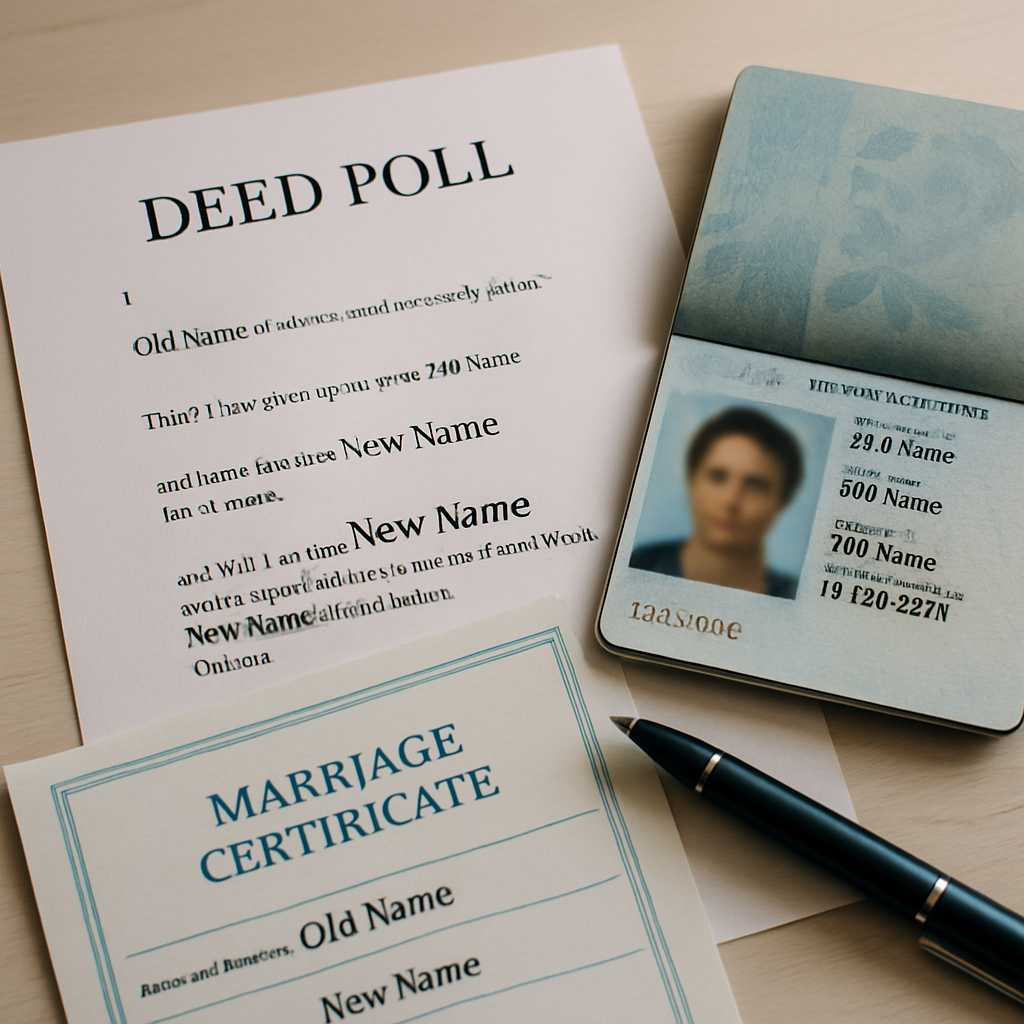
A deed poll is one of the most common name-link documents in the UK. GOV.UK describes deed poll as the route used to prove a change of name, and Home Office passport guidance recognises enrolled and unenrolled deed polls and change of name deeds as evidence when the required signatures, dates, and linkage are present.
For translation purposes, a deed poll usually needs careful treatment of:
- the old full name
- the new full name
- the date of change
- witness details where shown
- any formal declarations or legal wording
- signatures, seals, stamps, and handwritten annotations
The biggest mistake here is trying to modernise older identity references. A correct translation keeps the old name where the original uses it and the new name where the original introduces it.
Good Practice for a Deed Poll Translation
- Translate the full declaration, not just the names
- Keep dates and names exactly as issued
- Reproduce layout labels clearly
- Describe stamps or seals where relevant
- Add a concise translator note only where it helps explain a genuine name variation
Marriage Name Change Cases
Many name change cases are not about a deed poll at all. They are about a surname change after marriage or civil partnership. In official passport guidance, marriage and civil partnership certificates are accepted as evidence of a change of name as long as they show the link between the old and new names. Home Office guidance also states that applications should be supported by documentary evidence that shows the linkage to the previous name, such as a marriage certificate or deed poll.
This means a marriage name change file often turns on one practical question: does the translated certificate make the connection between the pre-marriage name and the current surname obvious enough on its own?
If yes, the file can be straightforward. If not, you may need extra translated support, such as:
- the passport page still showing the previous surname
- a birth certificate in the old name
- an affidavit or declaration linking both names
- a second document showing the new name already in use
Example
A passport shows Nadia Karim. A marriage certificate shows Nadia Karim marrying Daniel Brooks. A newer tenancy record shows Nadia Brooks. A strong submission does not try to erase “Karim” from the earlier record; it shows the sequence clearly.
When Divorce or Reversion to a Previous Surname Gets Messy
This is where many people assume one document will do everything. Often it will not. Passport guidance states that divorce documents on their own are not accepted as evidence that the customer has changed their name, because those records may not show the clear link between the current and former names.
So if someone is returning to a previous surname, the stronger file is often:
- marriage certificate
- divorce document
- current ID or supporting record
- any additional declaration needed to make the name progression obvious
This is exactly why a “translate whatever document I have nearest to hand” approach is weaker than a continuity-first approach.
Translator Notes: When They Help and When They Should Not
Translator notes are useful when they explain, not when they rewrite history. A good translator note can clarify:
- that a name appears in a previous legal form on the source document
- that a spelling difference is a transliteration variation
- that a handwritten annotation is present in the margin
- that a seal, stamp, or endorsement is visible but partly illegible
A poor translator note tries to force documents into matching when the originals do not.
Helpful Note Examples
- “The surname on this document appears in the holder’s pre-marriage form.”
- “This spelling reflects the Latin-script transliteration shown on the source document.”
- “A round official stamp overlaps part of the surname field.”
Unhelpful Note Examples
- “The old surname should be understood as the new surname.”
- “This document has been updated for consistency.”
- “The previous name can be ignored.”
That last group creates risk. Official files should show the history, not conceal it.
Consistency Across Documents Matters More Than Most People Realise
A strong name change translation UK file is consistent in five places:
- personal names
- dates
- places of issue
- document numbers
- labels for stamps, seals, annotations, and signatures
Even small inconsistencies can create friction:
- one translator writes “Mohamed”, another writes “Muhammad”
- one file uses “Deed Poll”, another uses “Change of Name Deed”
- one translation leaves out a stamp naming the issuing authority
- one record translates a double surname as one word, another uses a hyphen
When several documents are being submitted together, it is usually better to have the whole set reviewed as one pack so the names and terms are aligned before delivery. If your file includes a deed poll, passport page, marriage certificate, bank statement, or affidavit together, send the pack in one batch so the old and new names can be checked for continuity before certification.
What a Certified Translation Should Include
For UK immigration-related supporting documents, GOV.UK states that a full translation must be independently verifiable and include confirmation that it is an accurate translation, the date, the translator’s full name and signature, and the translator’s contact details. Passport guidance also says that documents not in English or Welsh need a certified translation.
In practical terms, a good certified translation for a name change case should include:
- the full translated content
- a certification statement
- translator identity and contact details
- date of translation
- signature
- clear treatment of stamps, seals, and handwritten elements
- formatting that keeps the relationship between names easy to read
The Cases That Need Extra Care
1. Mixed Alphabets and Transliteration
If one set of records is in Arabic, Cyrillic, Greek, or another script and another set is already in Latin characters, spelling variations are common. The translation should preserve the source accurately and explain relevant variation without inventing a new standard.
2. Hyphenated or Double-Barrelled Surnames
These need exact treatment. Hyphens, spaces, and sequence matter. A double surname presented differently across institutions can create false mismatch flags.
3. Multiple Legal Changes Over Time
If the person changed their name more than once, every step in the chain should be accounted for. Passport guidance says that if a customer has multiple changes to their name, they must provide evidence for each change.
4. Foreign Nationals Updating UK Records
Home Office guidance states that applications to change names on Home Office-issued records must show linkage to the previous name, and holders of non-British passports or national identity cards are generally expected to align those documents as well, unless an exception applies.
5. Documents That Are Records of Events
Birth, adoption, marriage, and similar records are historical documents. The goal is not to rewrite the event record; the goal is to translate it faithfully and show how it links to the current identity.
Example Document Packs That Usually Work Well
Pack A: Marriage Surname Change
- marriage certificate
- passport or ID in old name
- current record in new name
- certified translation of the certificate
- supporting translation of the older ID record where needed
Pack B: Deed Poll Update
- deed poll
- passport or official ID
- one live record already showing the new name
- certified translation of the deed poll
- optional translation of any supporting record still in the old name
Pack C: Long Record Trail
- old birth or academic record
- marriage certificate or deed poll
- current passport or residence document
- one recent utility, payroll, bank, or university record in the new name
- translations prepared as one coordinated set
Common Mistakes That Weaken a Submission
- translating only the newest document and ignoring the link document
- changing earlier names inside the translation for convenience
- inconsistent spellings across multiple translated documents
- leaving stamps or handwritten endorsements untranslated
- assuming a divorce document alone proves the whole change
- sending separate files at different times with different naming conventions
- treating translator notes as a place to “correct” the source
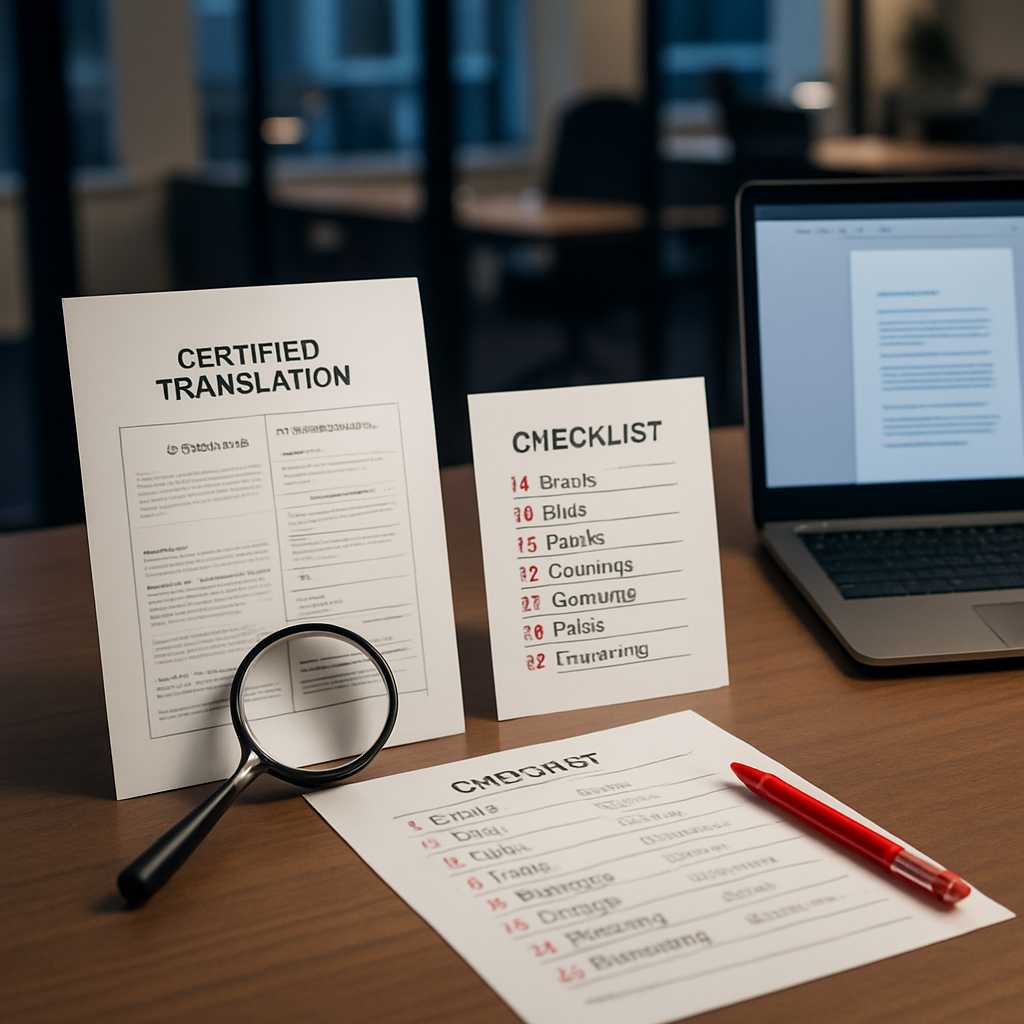
A Practical Checklist Before You Submit
Use this checklist before you send anything to a bank, employer, university, passport office, or immigration team.
Name-Link Checklist
- Does the file clearly show the old name?
- Does it include the document that legally links the old and new names?
- Does the translation preserve both names exactly where they appear?
- Are dates, signatures, and stamps included?
- Are transliteration differences explained only where needed?
- Are all documents using the same spelling style across the pack?
- Is the certification complete and easy to verify?
If you answer “no” to any one of those, fix that issue before submission.
Why This Matters for Acceptance
Reviewers do not want to guess whether two surnames belong to the same person. They want the file to answer the question for them. The strongest name change files do not rely on assumption; they show continuity. This is why this subject deserves more care than a generic certificate translation page usually gives it. A person may have one identity history but five different document states. The translation has to preserve that history while making the legal bridge obvious.
How Urgent Certified Translation UK Can Help
Urgent Certified Translation UK already positions its service around certified, sworn, and notarised translations for official use, fast turnaround options, careful handling of names and dates, and support for personal, legal, academic, and immigration documents. Its site also highlights document categories that directly relate to name change cases, including birth, marriage, divorce, passport, legal, and other official records, with a dedicated fast-quote workflow and contact page for document review.
For this topic, the most useful service message is not just “we translate your document.” It is:
- we identify the document that creates the legal name link
- we preserve the old and new names exactly as issued
- we keep multi-document packs consistent
- we provide the certification details official submissions expect
- we move quickly when the application deadline is close
Upload your file, include every document that shows the name history, and get a clear recommendation on what should be translated first.
Final Word
The safest name change translation UK strategy is not to force every record into one name. It is to show the full journey from the old name to the new one, with the correct link document translated in full and the rest of the file kept consistent around it. When the old name, the legal bridge, and the current name are all clear, the whole submission becomes easier to trust.
FAQs
Do I need a name change translation UK service for a deed poll?
You usually need a certified English translation if the deed poll or change of name document is not in English or Welsh and it is being used for an official submission in the UK. Passport and Home Office-related guidance requires certified translations for relevant non-English or non-Welsh documents.
Is a marriage certificate enough for a marriage name change?
It can be, if it clearly shows the link between the old and new names. UK passport guidance accepts marriage and civil partnership certificates as evidence of a name change when that link is clear.
Can divorce papers alone prove I changed back to my old surname?
Not always. Passport guidance states that divorce documents on their own are not accepted as evidence of the name change because they may not show the link clearly enough.
What should be included in a certified translation for UK submissions?
For Home Office supporting documents, the translation should be full and independently verifiable, with confirmation of accuracy, the date, the translator’s full name and signature, and the translator’s contact details.
How do translator notes help with consistency in documents?
Translator notes can explain genuine issues such as pre-marriage names, transliteration differences, stamps, or handwritten endorsements. They should clarify the source, not rewrite it.
What if several documents show different versions of my name?
Treat the file as one chain, not as isolated pages. Translate the legal bridge document first, then align the rest of the pack so the progression from old name to new name is easy to follow. Passport guidance specifically expects evidence for multiple name changes where they exist.