Translator Declaration Example UK: What to Include and How to Structure It
If you are searching for a translator declaration example UK, you usually need one thing: wording that is clear enough for an official reviewer to trust, and simple enough not to create new questions. A good translator’s declaration is not long. It is precise, traceable, and easy to verify.
Whether you are preparing a birth certificate, marriage certificate, court paper, academic transcript, bank statement, or business document, the declaration should help the receiving body understand three things immediately: what was translated, who is taking responsibility for the translation, and how that person or company can be verified.
If you need a submission-ready translation with the right declaration wording from the start, upload your file before ordering so the certification format can be matched to the document and destination.
What a translator’s declaration actually does
A translator’s declaration is the formal statement attached to a translated document confirming that the translation is accurate and complete to the best of the translator’s professional knowledge and ability. It turns a plain translation into something more usable for official review because it adds accountability.
In practice, the declaration should do three jobs:
- Identify the document being translated
- Certify that the translation is true and accurate
- Verify who produced it and how they can be contacted
That is why the strongest declarations are usually short, formal, and specific. A declaration is not there to impress; it is there to make the translation identifiable, certifiable, and verifiable.
Why weak declarations cause delays
Many rejected or queried translations are not rejected because the wording is dramatic or the English is poor. They are queried because the declaration leaves gaps. Typical gaps include:
- no date
- no signature
- no contact details
- no clear statement of accuracy
- no document title
- no language pair
- no way to match the declaration to the attached translation
A reviewer should not have to guess whether the declaration belongs to the document in front of them.
What to include in a translator’s declaration
A practical translator declaration example UK should include the following core elements.
1. A clear title
Use a heading that immediately tells the reader what the statement is. Examples include:
- Translator’s Declaration
- Certificate of Translation Accuracy
- Certified Translation Statement
Keep it formal and consistent across your templates.
2. Identification of the source document
State what document has been translated. This is one of the most overlooked details. Include:
- document name
- issuing country or authority where helpful
- page count if relevant
- file or reference number if available
Example: “Attached is the English translation of the original Arabic birth certificate issued in Cairo.” This helps the reviewer connect the declaration to the exact document pack.
3. The accuracy declaration
This is the core sentence. It should say plainly that the translation is true and accurate. Common wording includes:
- “I certify that this is a true and accurate translation of the original document.”
- “I confirm that the attached translation is a complete and accurate translation of the original.”
- “I declare that the following document has been translated faithfully and accurately from the source text.”
Avoid overcomplicating this part. Simple wording is stronger.
4. Language pair
State the languages involved. Examples include:
- from Spanish into English
- from Polish into English
- from English into Arabic
This removes ambiguity, especially when multilingual files are involved.
5. Translator competence statement
This is not always mandatory, but it is often helpful and strengthens the declaration. Example: “I am competent to translate from Romanian into English.” This is especially useful when the recipient wants reassurance that the declaration is not just an administrative stamp.
6. Full name of the translator or authorised signatory
Use the full name, not initials alone. If the declaration is issued by a translation company, the signatory should still be clearly identified.
7. Signature
A declaration looks incomplete without a signature line. If you are issuing digital PDFs, the signature method should still be clear and consistent with how the business certifies translations.
8. Date of translation
Always include the date. This matters for traceability and helps distinguish revised versions from earlier ones.
9. Contact details
At minimum, include a direct verification route. This can include:
- email address
- phone number
- company address
- website
- company name
The key point is that the receiving body can independently verify the declaration if needed.
10. Optional but useful extras
These are not always essential, but they often make a declaration more robust:
- company letterhead
- company stamp
- order or reference number
- page count
- translator qualifications or membership initials where genuinely held
- statement that stamps, seals, signatures, and handwritten notes have been translated where legible
Only include credentials you can genuinely stand behind.
A practical translator declaration example UK
Below is a clean example structure that works well for many official submissions.
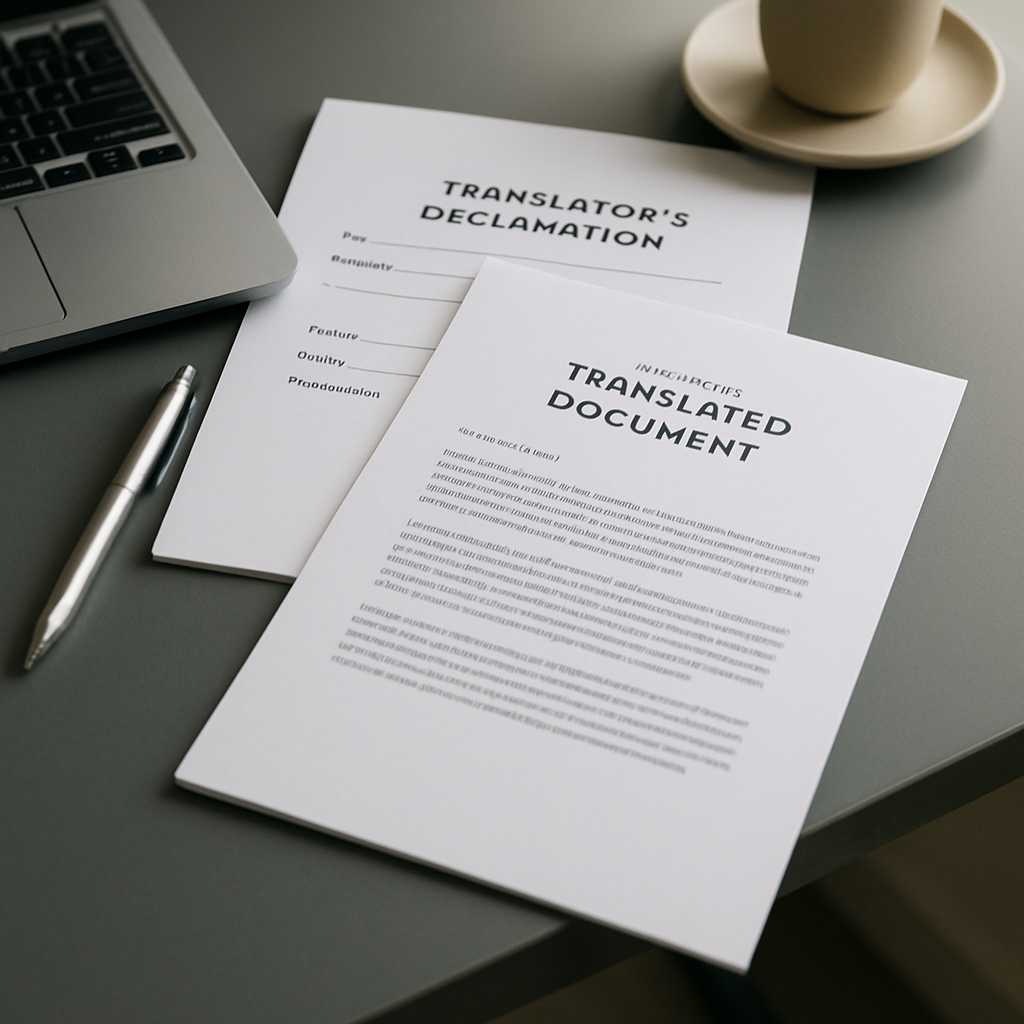
Translator’s Declaration
I, [Full Name], declare that I am competent to translate from [Source Language] into [Target Language], and that the attached translation of [Document Name] is a true and accurate translation of the original document.
Translation language pair: [Source Language] to [Target Language]
Document translated: [Document Name / Description]
Date of translation: [DD/MM/YYYY]
Signed: [Signature]
Name: [Full Name]
Company: [Company Name]
Email: [Email Address]
Phone: [Phone Number]
Address: [Business Address]
Reference number: [Optional Job / File Reference]
This structure is strong because it is easy to scan. A caseworker, admissions officer, solicitor, registrar, or compliance reviewer can understand it quickly.
A stronger version for multi-page or sensitive documents
For legal, academic, immigration, and financial documents, it helps to make the declaration slightly more specific.
Certificate of Translation Accuracy
I, [Full Name], certify that I am competent to translate from [Source Language] into [Target Language], and that the attached [number]-page translation of [Document Name] is a true, complete, and accurate translation of the original document to the best of my professional knowledge and ability.
This certification applies to the attached translation and should be read together with the translated document.
Date: [DD/MM/YYYY]
Signature: [Signature]
Full Name: [Full Name]
Company / Organisation: [Company Name]
Contact Details: [Email] | [Phone] | [Address]
Reference: [Job Number]
This version is especially useful where multiple pages, annexes, stamps, or formal attachments are involved.
Where to place the declaration
The declaration should normally be attached to the translation in a way that makes the relationship obvious. Common approaches include:
- as a final page after the translated document
- as a front certification page before the translation
- as part of a single bound PDF containing both the translation and declaration
What matters most is traceability. The declaration should not feel detached from the document it certifies. For digital delivery, a single clean PDF is often the safest format because it keeps the declaration and translation together.
When a simple declaration is enough, and when you may need more
A standard translator’s declaration is often enough for routine official use. But some destinations ask for an added step.
Standard certified translation
Usually suitable when the recipient wants:
- a full translation
- a signed declaration of accuracy
- contact details for verification
Notarised translation
This may be needed when the receiving body wants the translator’s or company representative’s signature formally witnessed.
Sworn translation
This is different from standard UK certified translation and usually relates to countries that operate a sworn translator system.
Apostille or legalisation
This may be relevant if a document is going abroad and the receiving authority wants formal authentication beyond the declaration itself. The safest approach is simple: match the declaration to the destination, not to assumptions. If a submission is urgent, send the receiving body’s wording, screenshot, or checklist with the file so the correct certification format can be used first time.
Common mistakes to avoid
Using vague wording
A declaration should never sound unsure.
Weak: “I believe this translation is mostly correct.”
Strong: “I certify that this is a true and accurate translation of the original document.”
Leaving out document identification
If you do not identify the document, the declaration can look generic rather than attached to a specific translation.
Forgetting contact details
A declaration without a verification route is weaker than most people realise.
Adding qualifications you cannot prove
Do not list memberships, court status, or specialist credentials unless they are real and current.
Forgetting signatures, stamps, or handwritten notes in the translation itself
A perfect declaration cannot rescue an incomplete translation.
Mixing different certification styles in one template
Keep a standard house format for UK certified translations, then adapt only where a recipient has a specific requirement.
The best structure: identify, certify, verify
The most useful way to think about a translator declaration example UK is this three-part framework:
Identify
Name the document clearly and, where useful, the page count or reference.
Certify
State that the translation is true, complete, and accurate.
Verify
Show who is responsible, when it was issued, and how they can be contacted.
That framework is one reason short declarations often perform better than long ones. They reduce friction for the reviewer.
A quick self-check before sending the translation
Before submission, check that your declaration answers every one of these questions:
- What document is this declaration for?
- What language pair was used?
- Does it clearly confirm accuracy?
- Is the translator or signatory named in full?
- Is it signed?
- Is it dated?
- Are contact details visible?
- Is it attached to the exact translation being submitted?
- If the file has stamps, seals, notes, tables, or handwritten text, has the translation accounted for them?
If any answer is no, fix it before the document goes out.
What clients should ask a translation provider before ordering
If you are outsourcing the work, ask these questions early:
- Will the translation include a signed declaration?
- Will the declaration include the translator’s or company’s contact details?
- Can the wording be matched to my receiving body’s instructions?
- Can you keep stamps, seals, and layout references clear?
- Will the final file arrive as one submission-ready PDF?
- If notarisation is needed, can that be arranged too?
These questions save time because they deal with acceptance risk before translation starts.
Final thought
A strong translator’s declaration does not need legal drama, complicated wording, or unnecessary length. It needs clarity, traceability, and accountability. If your declaration clearly identifies the document, confirms accuracy, and gives a reviewer a real verification path, you are already much closer to a smooth submission.
If you need a translator’s declaration prepared for a deadline, send the document and any recipient instructions today so the certification wording can be matched before translation begins.
FAQs
What is a translator declaration example UK?
A translator declaration example UK is a formal statement attached to a translation confirming that the translated text is a true and accurate translation of the original document. It usually includes the date, translator name, signature, and contact details.
Does a translator’s declaration need a signature in the UK?
In many official settings, a signed declaration is the safer format because it makes the translation easier to verify and reduces questions about authenticity. A clean signature line should be treated as standard practice.
Is a translator’s declaration the same as a certificate of accuracy?
Often, yes in practical use. Different providers may use titles such as “Translator’s Declaration,” “Certificate of Translation Accuracy,” or “Certified Translation Statement,” but the function is broadly the same: confirming that the translation is accurate and identifying who stands behind it.
Do I need notarisation as well as a translator declaration?
Not always. A standard declaration is often enough for many submissions. Notarisation is usually only needed when the receiving authority specifically asks for it or the document is being prepared for a destination that requires an extra level of authentication.
Can a translation company sign the declaration instead of the individual translator?
Yes, in many cases an authorised representative of the translation company can sign, provided the declaration is clear, traceable, and includes proper contact details. The key issue is accountability and verification.
Can I write my own translator declaration for my own documents?
That depends on the receiving body and the purpose of the translation. For official submissions, self-prepared translations can create avoidable challenges unless the recipient explicitly accepts them. A professional, independently issued declaration is usually safer.