When you are comparing translation turnaround options
The real question is not simply, “How fast can this be done?” It is, “What is the fastest option that still fits the document, the deadline, and the risk of rejection?” For official paperwork, the wrong choice can cost more than the translation itself. You can overpay for speed you do not need, or you can choose a timeline that looks fine on paper but becomes risky once formatting, certification, stamps, signatures, or poor scan quality enter the picture.
The safest way to decide is to match the turnaround to the document, not to the panic level. A one-page birth certificate is very different from a 12-page bank statement, and both are very different from a court order, medical report, or academic transcript with tables and grading notes. If you need a submission-ready file, the smartest route is to start with a provider that handles certified document translation services and can confirm the right timeline before work begins.
If your deadline is already close, send the file and deadline first. A realistic answer at the start is better than a rushed correction later.
What “turnaround” really includes
Turnaround is not just the time spent translating words. For official documents, it usually includes:
- file review
- translator assignment
- terminology and formatting decisions
- checks for names, dates, reference numbers, and document consistency
- certification wording where required
- final PDF preparation
- hard-copy planning, if needed
That is why two documents with the same page count can need completely different delivery windows. A clean passport page may be fast. A bank statement with multiple entries, stamps, and partial handwriting may not be.
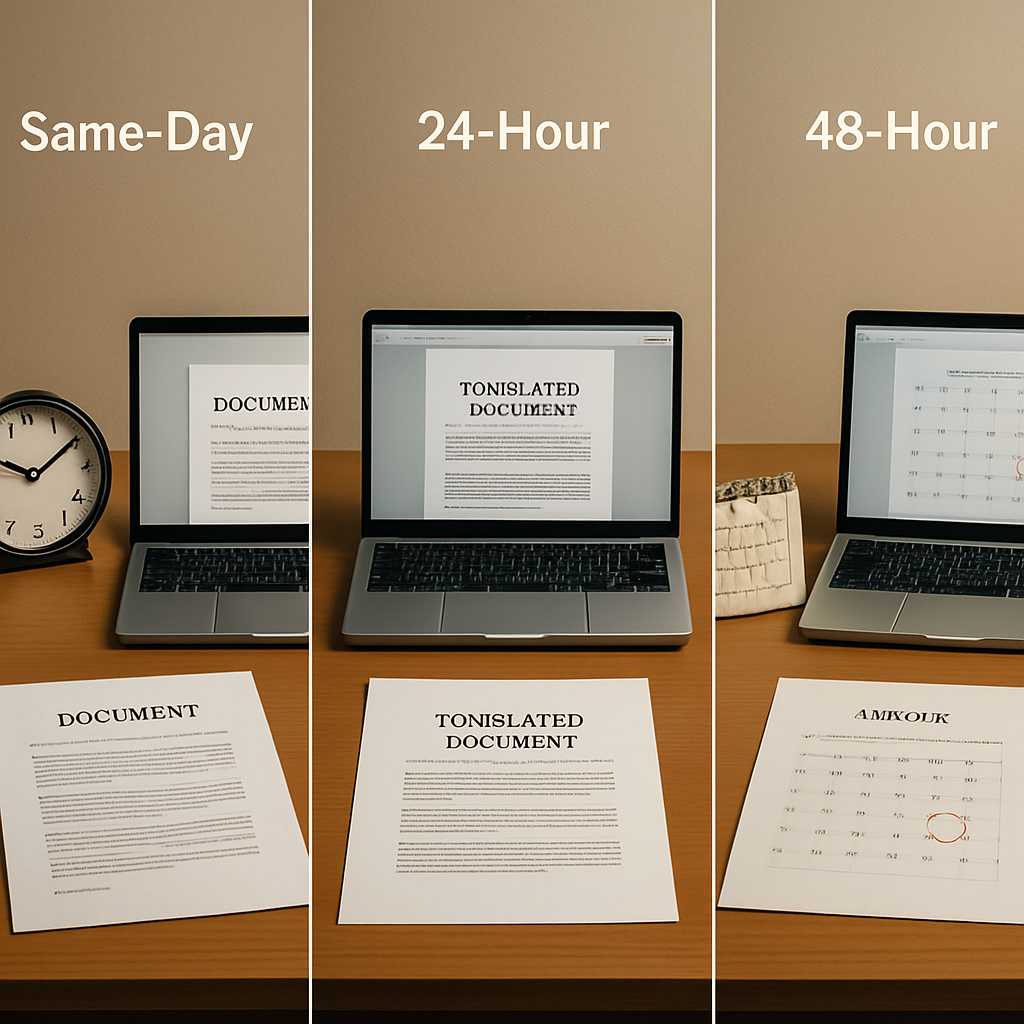
The three most common turnaround options at a glance
| Turnaround | Usually best for | Typical fit | Main trade-off |
|---|---|---|---|
| Same-day | Short, clear, standard-format documents | Single-page certificates, passport pages, police certificates, simple forms | Highest pressure and usually highest urgency cost |
| 24-hour | Moderate urgency with room for proper review | Short multi-page files, transcripts, bank statements, employment letters, visa packs | Slightly slower, but far more flexible |
| 48-hour | Higher-risk or more complex submissions | Legal documents, medical reports, long statements, poor scans, multiple files, rare language pairs | Slower than urgent options, but often better value and safer |
If you want the fastest realistic recommendation, use the fast quote form and send the document with the exact submission deadline.
The biggest mistake people make
The most common mistake is buying speed based on anxiety instead of submission risk. People often assume:
- same-day is always better
- 24-hour means “too slow”
- 48-hour means “not urgent”
In practice, the better question is this: What happens if one detail is missed, one page is unclear, or one formatting issue triggers a follow-up request? For a routine certificate, same-day can be ideal. For a document that will be reviewed by a caseworker, solicitor, university admissions team, employer, or compliance department, a little more time can reduce the chance of resubmission.
How to choose the right turnaround
1. Match the deadline, not the emotion
If your upload portal closes today, same-day may be the only viable route. If your deadline is tomorrow afternoon, 24-hour is often the smarter choice. If the submission is in two or three days, 48-hour may give you the best balance of speed, accuracy, and cost.
A useful rule:
- choose same-day when the document is short and the deadline is effectively immediate
- choose 24-hour when the deadline is tomorrow or when the file needs proper review but still cannot wait
- choose 48-hour when the submission is important enough that accuracy, layout, and completeness matter more than shaving off a few hours
2. Judge the document by risk, not page count alone
A single page can still be high-risk if it includes:
- handwritten notes
- seals or stamps
- unusual spellings
- multiple dates
- official numbers
- marginal notes
- dense legal language
Likewise, a two-page file can be easier than a one-page file if it is clean, typed, and repetitive. This is why document translation services should be selected by document type as well as urgency. A transcript, passport, affidavit, diploma, and bank statement do not move at the same pace.
3. Think about where it is being submitted
The receiving body affects the right turnaround. A fast internal business review may be less demanding than:
- a visa application
- a university submission
- a court-related filing
- an employer onboarding pack
- a banking or mortgage review
- a notarisation or apostille chain
When the translation is for official use, speed should never remove the checks that make the file easy to review and accept.
4. Check the scan quality before paying for speed
Many delays come from the source file, not the translator. Same-day becomes less realistic when:
- the scan is cropped
- corners are missing
- text is blurred
- pages are out of order
- stamps cross over text
- a phone photo has glare or shadows
- handwriting is faint
A clean scan can save hours. A poor scan can turn a same-day request into a stop-start job.
5. Separate translation from notarisation and apostille
This is where many urgent orders go wrong. A translation can be urgent. A notarised pack or apostille process may follow a different timeline. If the receiving authority wants extra authentication, mention it at the start.
If you may need more than a standard certified file, review whether notarized translation services or apostille certified translation services are relevant before you commit to a timeline.
6. Ask what is included in the quoted turnaround
A useful deadline is only useful if you know what will be delivered. Check whether the stated turnaround includes:
- certification statement
- signature and date
- final PDF
- formatting of stamps, seals, and notes
- hard-copy dispatch, if required
- any review of names, dates, and document numbers
That is the difference between “translated fast” and “ready to submit”.
When same-day is the right choice
Same-day works best when the document is short, clear, and predictable. Typical same-day fits include:
- passport photo pages
- birth certificates
- marriage certificates
- police clearance certificates
- simple diplomas
- short employment letters
- straightforward identity documents
For example, a clean passport page for a visa or employer check is usually far better suited to a same-day timeline than a long financial bundle. If that is your case, a specialist passport translation service is often the most practical route.
Good same-day candidate: one or two clean pages, typed text, standard official format, no heavy layout work, no unusual terminology.
Poor same-day candidate: multiple pages, handwritten annotations, legal clauses, tables, many stamps, or unclear scan quality.
When 24-hour is the smartest option
For many official submissions, 24-hour is the sweet spot. It is often the best fit for:
- academic transcripts
- bank statements
- multi-page visa documents
- employment bundles
- short legal letters
- certificates plus supporting pages
- ID documents with endorsements or extra notes
This is usually the safest choice when the deadline is urgent but not immediate. It allows enough room for proper checking without stretching into a standard, open-ended timeline.
Examples of documents that often suit 24-hour delivery include:
- academic document translation services
- financial documents for immigration
- short packs of identity and supporting documents for official review
If you need a certified translation tomorrow, 24-hour is often the option that delivers the best balance of cost and confidence.
When 48-hour is worth it
48-hour delivery is often the most underestimated option. It is usually the better choice for:
- court orders
- powers of attorney
- contracts
- medical reports
- large bank statement packs
- files with stamps, seals, tables, or annotations
- rare language pairs
- multi-document orders
- files likely to need careful formatting
This is especially true when the submission matters enough that one preventable issue could delay the whole process. If the document is legal, detailed, or high-stakes, a specialist certified translation of legal documents workflow is usually worth the extra time.
A 48-hour turnaround is not “slow”. In many cases, it is the most efficient way to avoid resubmissions, clarification requests, and unnecessary urgency charges.
Express vs standard: what actually changes
When you move from 48-hour to 24-hour or same-day, the content does not become less important. The workflow becomes tighter. What usually changes:
- faster project intake
- faster linguist assignment
- tighter review window
- priority handling in the queue
- more immediate communication
- less buffer for poor scans or missing pages
What should not change:
- completeness
- certification quality
- formatting clarity
- consistency checks
- readability for the receiving authority
That is why a serious urgent service should still confirm what is realistic before promising delivery.
A simple 60-second decision test
Use this quick check before choosing your turnaround:
Choose same-day if:
- your deadline is today
- the document is short
- the scan is clean
- the file is standard in format
- there are no added authentication steps yet
Choose 24-hour if:
- the deadline is tomorrow
- the document has a few pages
- there are tables, stamps, or multiple sections
- you need certification and a polished PDF
- the submission is important but still manageable overnight
Choose 48-hour if:
- the file is complex
- the language pair may need extra coordination
- the document is legal, medical, or financial
- the scan needs careful reading
- there are multiple documents in one order
- accuracy matters more than saving a few hours
If you are unsure, send the document and say where it is going. That usually produces a better answer than choosing a speed tier in the dark.
What affects turnaround more than most clients expect
Several things influence delivery more than people realise:
Language pair availability
Common language pairs often move faster than rarer combinations.
Document complexity
Legal, medical, and financial material usually needs more care than standard civil certificates.
Formatting load
Tables, seals, handwritten notes, and structured layouts take time even when the word count looks low.
Volume
A five-page bundle is not always five times harder than a one-page file, but it often needs a different production plan.
Working hours and cut-off times
A same-day request submitted early is very different from one submitted late in the day.
Final delivery format
A digital PDF is faster than a printed and posted pack.
Why “cheapest fastest” can become the most expensive choice
A poor turnaround choice creates hidden costs:
- re-uploading files
- resubmitting to the authority
- missing an appointment or filing slot
- paying extra for emergency corrections
- needing separate hard-copy dispatch
- losing time on avoidable email back-and-forth
That is why the cheapest quote is not always the lowest-cost decision. The right turnaround is the one that matches the actual submission risk.
What to send to get the right turnaround first time
To avoid delays, send:
- all pages of the document
- a clear scan or high-quality photo
- the source and target language
- the exact deadline, including date and time
- where the translation will be submitted
- whether you need certified, notarised, or apostille support
- whether digital delivery is enough or you need printed copies too
The more precise the request, the more accurate the turnaround recommendation will be. If the deadline is close, do not wait to explain everything perfectly. Upload the file first through the fast quote page and include the deadline in the message.
For official submissions, the safer choice is often the clearer choice
When a translation is headed for immigration, university, court, employment, or formal compliance use, the best turnaround is the one that gives you a submission-ready result without forcing unnecessary urgency. That often means:
- same-day for short, standard documents
- 24-hour for moderate-risk, time-sensitive submissions
- 48-hour for complex or high-stakes files
If your document needs a signed certification statement, structured formatting, and careful review, choosing the right turnaround is part of the quality decision, not just the speed decision. A strong translation process does not just ask, “How fast do you want it?” It asks, “What needs to happen so this is accepted the first time?” If you want a realistic answer based on the actual file, start with your document rather than the clock. Send it, state the deadline, and get the turnaround that fits the job.
FAQs
What are the best translation turnaround options for official documents?
The best translation turnaround options depend on the document type, scan quality, certification needs, and deadline. Same-day is usually best for short, standard files. A 24-hour turnaround often suits transcripts, bank statements, and short multi-page packs. A 48-hour turnaround is usually safer for legal, medical, or more complex official documents.
Is same-day certified translation reliable?
Yes, same-day certified translation can be reliable when the document is short, clear, and straightforward. It is most suitable for standard certificates, passport pages, and simple official records. It becomes riskier when the file includes poor scan quality, handwritten notes, complex formatting, or multiple pages.
Should I choose 24-hour or 48-hour translation for bank statements or transcripts?
For bank statements or transcripts, 24-hour is often suitable for shorter, cleaner files. A 48-hour option is often better for longer statements, dense tables, grading systems, multiple pages, or documents that need careful formatting and consistency checks.
Do notarisation or apostille affect translation turnaround options?
Yes. Notarisation and apostille can affect the overall timeline because they are separate steps from the translation itself. If you may need these services, mention them before the turnaround is confirmed so the full process can be planned properly.
Can I get a certified translation from a scan instead of the original?
In many cases, yes. A clear scan or high-quality photo is enough to produce a certified translation. What matters most is that the file is complete, legible, and suitable for review. The receiving authority may still ask to see the original separately.
Does a faster turnaround always cost more?
Usually, yes. Faster turnaround options often carry a higher price because they require priority handling, tighter scheduling, and less buffer. However, paying for the right speed is often cheaper than paying for avoidable corrections or missed deadlines later.