What counts as a police certificate?
Different countries label the document differently. Common examples include:
- Police Certificate
- Police Clearance Certificate
- Certificate of Good Conduct
- Certificate of No Criminal Record
- Criminal Record Extract
- Judicial Record Certificate
- Background Check Certificate
- Penal Record Certificate
The label does not matter as much as the function. If the document is being used to prove your criminal record status, it should be translated as a formal, complete record rather than as a casual summary.
The practical rule reviewers use
A useful way to think about this is that your translation has to pass two checks:
- Can the reviewer match the English version to the original document?
- Can the reviewer trust who translated it and how it was certified?
If either answer is unclear, delays start. If a detail helps the reviewer identify, verify, or interpret the original certificate, it belongs in the translation. That is the simplest working definition of a strong police certificate translation checklist.
What must be included in the translation itself
1) The document title and issuing authority
Translate the exact document title as shown on the original. If the title has a country-specific legal meaning, preserve that meaning clearly rather than replacing it with a vague generic phrase. Also include:
- issuing ministry, police office, court, registry, or administrative body
- local office or branch name
- city, region, or country of issue where shown
- official headers, subheadings, and form labels
- logo text or letterhead wording where it contains identifying information
A reviewer should be able to see immediately which authority issued the certificate and what kind of record it is.
2) Every identity field shown on the certificate
A criminal record translation must include every personal detail visible on the original, such as:
- full name
- previous names or aliases
- date of birth
- place of birth
- nationality
- sex or gender marker, if shown
- passport, national ID, or personal number, if shown
- address, if part of the document
- parent names, if part of the issuing country’s format
This is one of the biggest rejection points. The translation may be linguistically correct, but if the spelling of the applicant’s name does not match the passport or the original certificate exactly, the pack starts to look unreliable.
3) Certificate numbers, file numbers, barcodes, and reference codes
This is where many police certificate translations fall short. Your translation should include:
- certificate number
- reference number
- file number
- serial number
- control number
- barcode label text
- QR label text where visible
- verification code or online validation reference
- page numbers
These details are not decorative. They are often the bridge between the translated version and the source document. If the certificate is ever checked manually, those reference points matter.
4) All dates and validity wording
Translate every date exactly as it appears and keep the sequence clear:
- issue date
- print date
- validity date
- expiry date
- date range searched
- dates of any offences or court outcomes, where listed
Do not “tidy up” date logic. If the original document uses a local date format, the translation should render it clearly in English without changing the meaning.
5) The actual record result
The core result of the document must be translated fully and precisely. That includes wording such as:
- no criminal record
- no convictions recorded
- no live trace
- no information held
- record found
- convictions listed below
- proceedings pending
- certificate issued for immigration purposes only
This is not the place for interpretation. A professional translation should reproduce the wording faithfully, especially where the source country uses legally meaningful phrases that are not identical to UK terminology.
6) All offence entries, if the certificate contains them
If the certificate is not blank, every listed entry must be translated in full, including:
- offence names
- legal provisions or article numbers
- charge descriptions
- dates of offence or conviction
- sentencing details
- disposal or outcome
- rehabilitation or closure notes
- remarks or limitations attached to the record
A summary is not enough. A police certificate translation for official use should never reduce this section to “criminal record present” or similar shorthand.
7) Stamps, seals, signatures, and handwritten notes
This is the section people underestimate most. Your police certificate translation checklist should always include:
- round stamps
- rectangular office stamps
- embossed seals
- dry seals
- signature labels
- initials
- handwritten notes
- marginal notes
- remarks added by officials
- validation notes on the reverse side
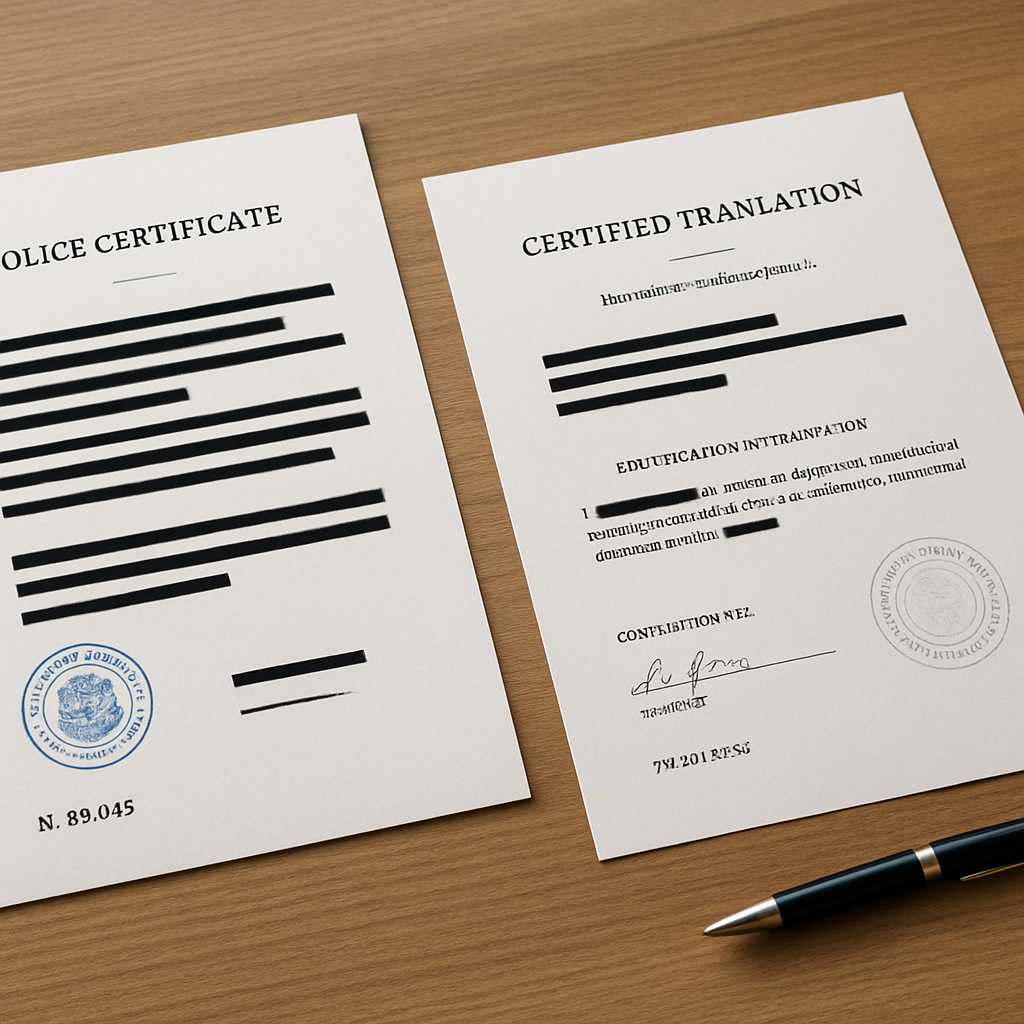
These items should be translated or clearly labelled, for example:
[Round stamp: Ministry of Interior – Criminal Records Department]
[Signature]
[Embossed seal]
[Handwritten note: illegible in part]
If a stamp contains a date, office name, or approval wording, that content is part of the document. It should not be ignored.
8) Footnotes, legends, disclaimers, and reverse-side text
Many certificates carry critical information in small print:
- legal disclaimers
- use limitations
- definitions of status terms
- explanations of codes
- official notices
- reverse-side instructions
- validation notes
A one-page front image does not always mean the document is only one page. Some “clean” certificates are submitted incomplete simply because the back page was not scanned or translated.
What must be included in the certification page
A certified translation is not just the translated text. It also needs a certification block that makes the translation credible for official review. A proper certification page should include:
- confirmation that the translation is complete and accurate
- date of translation
- translator’s full name
- signature
- contact details
- translation company details, where relevant
For some destinations or formal packs, it is also sensible to include:
- language pair
- clear identification of the document translated
- statement that all visible stamps, seals, signatures, and handwritten notes were translated where legible
- company letterhead or certification formatting that matches the purpose of submission
If you want to see how this wording is typically structured, our guide to the certificate of translation accuracy is the best companion page to keep open while you review the pack.
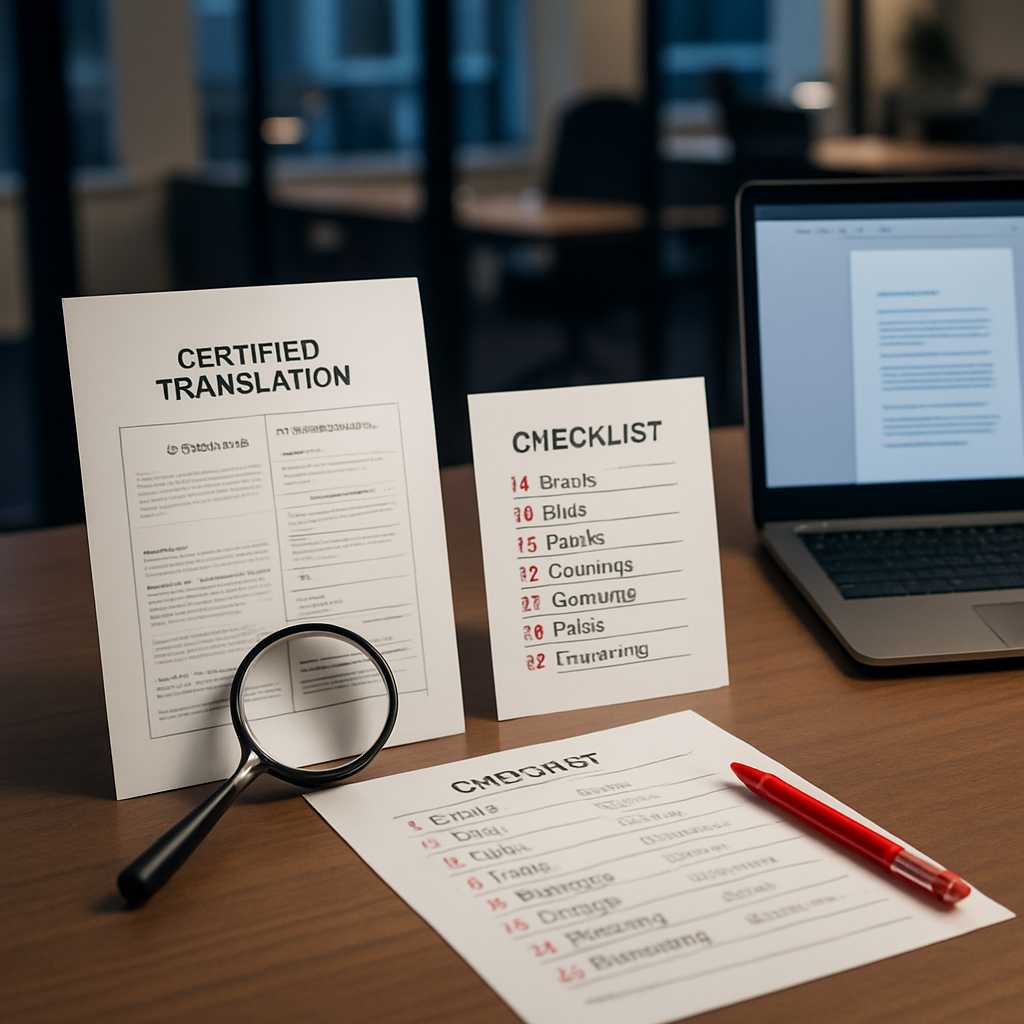
A submission-ready police certificate translation checklist
Before you send your police certificate anywhere, run through this list:
- the full document title is translated
- issuing authority and office details are included
- all identity fields are translated exactly
- names match your passport spelling consistently
- certificate number and reference numbers are included
- every date is translated clearly
- all visible stamps and seals are translated or labelled
- signatures and handwritten notes are handled properly
- reverse-side text has been checked
- any legal remarks, legends, or disclaimers are included
- offence details are translated in full where present
- the certification statement confirms accuracy
- the certification page is dated and signed
- translator or company contact details appear clearly
- the delivered PDF is readable and easy to compare against the original
That is the core police certificate translation checklist most applicants actually need.
Common reasons police certificate translations get challenged
Missing stamps and reference numbers
A translation can look polished and still fail because the stamp content was ignored or the reference number disappeared.
Over-simplified record wording
“Clean certificate” is not a substitute for the exact status wording on the original document.
Name mismatches
If the passport says one spelling and the translation introduces another, the reviewer has to stop and reconcile the inconsistency.
Cropped scans
If the scan cuts off a corner stamp, footer line, or document edge, the translator may be forced to leave out something important.
Partial translation of a multi-page document
Many police certificates include endorsements, notes, or validation content on a second page.
Wrong certification level
Some applicants order a standard translation when the authority asked for certified, notarised, or sworn format. If your document will be used in a legal or solicitor-led matter, our certified translation of legal documents service page explains how those packs are prepared with closer attention to structure, certification, and review.
ACRO police certificate translation: do you need it?
This is where confusion is common. If you have a UK-issued ACRO Police Certificate, translation is often not the first issue to solve. In many cases, the real question is whether the destination country wants the certificate legalised, apostilled, notarised, or translated by a locally authorised translator abroad. By contrast, if you are submitting a foreign police certificate in the UK, that is the point where certified translation becomes the priority.
So the right question is not simply, “Do I need police certificate translation?” It is: Which country issued the certificate, where is it being submitted, and what format has the receiving authority asked for?
If the authority only wants a standard certified translation, our certified document translation services are usually the correct starting point. If they specifically mention extra formalisation, compare our notarised translation services and sworn translation services before ordering.
Certified vs notarised vs sworn: which one applies?
Certified translation
This is the most common format for police certificate translation in the UK. It usually means a full translation plus a signed certification statement.
Notarised translation
This is usually only needed when the receiving authority specifically asks for notarisation or an extra formal layer around the certification.
Sworn translation
This is usually tied to countries that require translations to be completed or formalised by an officially authorised sworn translator. For many applicants, the expensive mistake is ordering more than they need. For others, it is ordering less. The safest move is to send the authority’s wording, screenshot, or checklist at the quote stage so the format can be matched before work starts. Upload your file here and include the destination authority in the message.
Two real-world examples that show why details matter
Example 1: the “simple” one-page certificate
A certificate appears to say only “No criminal record.” But the bottom stamp includes the department name, the issue date, and a control number. If the stamp is left untranslated, the English version no longer gives the reviewer a clean way to match the original to the translation.
Example 2: the second page nobody noticed
The first page carries the result. The second page carries the legend explaining the national status code and the legal note limiting the document’s use. If the second page is omitted, the translation is technically incomplete even though the main result line was translated.
That is why strong criminal record translation work is not just language work. It is document-control work.
How to prepare your police certificate for fast, clean translation
To reduce back-and-forth and avoid avoidable errors, send:
- a full-colour scan or straight, high-resolution phone scan
- every page, including the back
- uncropped edges
- clear visibility of stamps and seals
- any instructions from the receiving authority
- your deadline
- the passport spelling you need the translation to follow, if relevant
Poor scans do not just slow things down. They increase the chance of missed numbers, unclear stamps, and illegible notes. If your certificate is part of a wider file, it can also help to mention whether you are submitting it alongside birth certificates, court records, affidavits, or other documents that need certified translation.
What a strong police certificate translation pack should feel like
When it is done properly, the pack should feel easy to review:
- the English text follows the original logically
- important data points are easy to locate
- stamps and reference numbers are not hidden or omitted
- the certification looks formal and accountable
- the reviewer does not need to guess what belongs to what
That is the goal. Not just “translated,” but submission-ready. If you are working to a deadline, send the original certificate and the receiving requirement together through our fast quote page. That lets us confirm the right certification level before translation starts, rather than after an avoidable rejection.
Frequently asked questions
Do I need a certified translation for a police certificate in the UK?
If the police certificate is not in English or Welsh and it is being submitted to a UK authority, employer, solicitor, university, or immigration route, a certified translation is usually the safest option. The translation should be complete, clearly formatted, and supported by a proper certification statement.
Does an ACRO police certificate need translation?
Not usually for English-language ACRO documents. The more important question is whether the destination country wants apostille, notarisation, or a locally authorised translation format. Foreign-language police certificates for UK use are the ones that usually need certified translation.
Do stamps, seals, and reference numbers need to be translated?
Yes. Stamps, seals, certificate numbers, validation codes, and reference numbers are often essential to identifying the document properly. They should be translated or clearly labelled in the English version.
Can a police certificate translation be a summary?
No. For official use, a police certificate translation should be full rather than selective. A summary creates risk because footnotes, remarks, status wording, and validation details can affect how the document is interpreted.
Do I need notarisation for a police certificate translation?
Only if the receiving organisation specifically asks for it. Many police certificate submissions need a certified translation, not a notarised one. If the authority mentions a notary, sworn translator, wet-ink certification, or formal legalisation, check the requirement before ordering.
Can you translate a police certificate urgently?
Yes, in many cases. Timing depends on the language, scan quality, number of pages, and whether extra steps such as notarisation or hard-copy delivery are required. The fastest route is to send a clean scan and the authority’s instructions together.