Translate a Passport Stamp Properly: Short Notes That Prevent Confusion
Passport stamp translation looks simple until a real application depends on it. A stamp may be tiny, smudged, half-overlapping a visa sticker, written in a non-Latin script, or reduced to a date and a border code that means nothing to the caseworker reading it. That is exactly why a good passport stamp translation is not just about converting words; it is about removing doubt.
For visa applications, nationality matters, travel-history reviews, and official submissions, the goal is clarity. A strong translation tells the reader what the mark is, where it was issued, what date it shows, and whether it records entry, exit, permission, cancellation, or another endorsement. When the stamp is unclear, the translation must say so honestly. When the page includes a visa sticker, handwritten note, or border annotation, those details must be handled in a way that preserves meaning without guesswork.
This is where short, well-written translator notes make a difference. They prevent confusion, reduce back-and-forth, and help the receiving authority understand what they are looking at immediately.
If your stamped passport pages are part of an urgent submission, send a clear colour scan and have them reviewed before you upload anything. A short, accurate, certified translation is usually faster and far more useful than a vague full-page rewrite.
Why Passport Stamps Create So Much Confusion
Passport pages are unusually difficult documents to translate well because they combine visual evidence with minimal text. A caseworker is often trying to answer practical questions:
- Was this an entry stamp or an exit stamp?
- Which country or border post issued it?
- What is the actual date?
- Does the page show a visa, an extension, or a cancellation?
- Is the handwritten mark part of the official endorsement or just an internal notation?
- Is the stamp fully legible, partly legible, or impossible to read?
A poor translation leaves these questions open. A proper passport stamp translation closes them quickly. The common problem is not that the stamp contains too much text; it is that it contains too little context. One abbreviation, one partial date, and one circular seal can be enough to create uncertainty if the translation does not explain what the mark is.
When a Passport Stamp Translation is Usually Needed
A passport stamp translation is often requested when stamped pages help prove identity, travel history, lawful entry, residence periods, or visa compliance. That can come up in situations such as:
Visa and Immigration Submissions
Entry and exit stamps may support your timeline, residence history, or use of a previous visa. A visa stamp translation may also be needed where the sticker or endorsement is not in English and forms part of the evidence bundle.
Passport and Nationality-Related Applications
Where supporting documents or passport pages include non-English or non-Welsh content, the translation needs to be clear, complete, and suitable for official review.
Appeals, Tribunals, and Legal Matters
If travel dates, border entries, expired permissions, or visa conditions matter to a case, endorsement translation becomes part of the evidence chain.
Professional, Academic, and Compliance Checks
Some employers, regulators, and institutions may ask for translated passport evidence where travel history, prior visas, or identity-related records are relevant.
The practical rule is simple: if the stamp helps prove something important, translate it properly.
What Should Be Translated on a Stamped Passport Page
A proper passport stamp translation should cover more than the obvious round stamp. It should account for every meaningful mark on the page.
Entry and Exit Stamps
These usually show a country, airport or border point, date, and sometimes a code or symbol indicating arrival or departure.
Visa Stickers and Visa Stamps
These may show category, number of entries, issue date, expiry date, place of issue, validity period, or special conditions.
Handwritten Endorsements
These can include officer initials, extension notes, corrected dates, cancelled entries, or short remarks that affect interpretation.
Border Annotations and Codes
A stamp may include abbreviations, numerals, location codes, or inspection references that should not be ignored just because they are short.
Cancellation or Refusal Marks
A crossed-out visa, void stamp, overprint, or cancellation note can materially change the meaning of the page.
Partial and Overlapping Marks
If one stamp overlaps another, the translation should separate what is readable from what is obscured. Blank pages do not normally need translation. The focus should stay on content that actually helps the authority understand your record.
The Best Method: Short Translator Notes, Not Long-Winded Prose
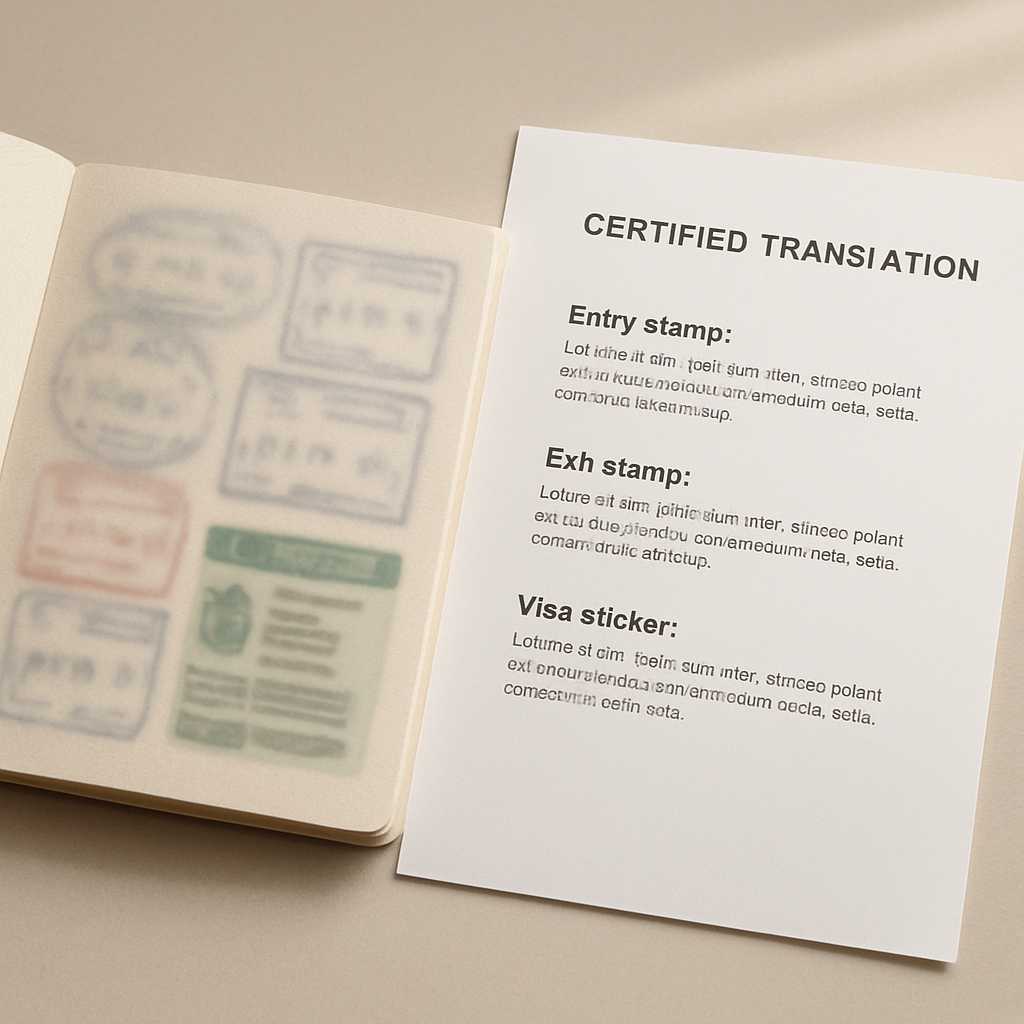
The most useful passport stamp translation is usually built around concise notes. These notes work because they are easy to scan and easy to verify against the image.
Instead of turning the page into a paragraph, a translator should identify each mark and explain it in a controlled, neutral format. A practical format looks like this:
[Type of mark] – [Country / location if legible] – [Date] – [Direction / status / condition] – [Any important note]
That structure helps the reader understand the stamp at a glance.
What a Strong Note Usually Includes
- The type of mark: Entry stamp, exit stamp, visa sticker, handwritten endorsement, extension mark, cancellation mark.
- The place: Country, airport, border crossing, city, or issuing authority, only if legible.
- The date: Reproduced carefully and without guessing.
- The function: Entry, exit, single entry visa, multiple entry visa, extension granted, cancelled, refused, etc.
- The honesty note: “Partly illegible,” “location unclear,” or “last digit unclear” where needed.
This is the difference between translation that merely looks official and translation that is genuinely useful.
Examples of Passport Stamp Translation Notes That Prevent Confusion
Below are the kinds of short notes that help an officer, solicitor, or reviewer understand the page immediately.
Example 1: Simple Entry Stamp
Entry stamp – Cairo International Airport, Egypt – 14 May 2024 – Arrival recorded.
Example 2: Exit Stamp with Partial Ink Loss
Exit stamp – Dubai, UAE – 03 September 2023 – Departure recorded – outer ring partly illegible.
Example 3: Visa Sticker with Clear Validity
Visa sticker – Single-entry visa – Issued in Ankara – Valid from 01 January 2025 to 30 March 2025.
Example 4: Handwritten Endorsement
Handwritten endorsement – Extension granted until 15 August 2024 – official handwriting present beneath border stamp.
Example 5: Overlapping Marks
Two overlapping border marks present. Upper mark: entry stamp, date visible as 12 June 2022. Lower mark: partial exit stamp, location illegible.
Example 6: Fully Unclear Text Handled Honestly
Circular border stamp present – date and location illegible due to faint ink – no reliable full reading possible.
Notice what these examples do well. They do not speculate. They do not over-explain. They give enough information to remove doubt.
A Quick Comparison: Weak Note vs Useful Note
| Weak Note | Better Note |
|---|---|
| Stamp in Arabic | Entry stamp – Amman, Jordan – 21 February 2024 – Arrival recorded |
| Visa page translated | Visa sticker – Multiple-entry visa – Valid until 10 October 2025 – issue city visible, serial number present |
| Illegible stamp | Circular border stamp present – date partly visible, location illegible |
| Handwriting on page | Handwritten endorsement beneath visa sticker – extension date reads 15 August 2024 |
The stronger version always tells the reviewer what they are seeing, not just that something exists.
What to Do When the Stamp is Unclear, Cut Off, or Damaged
This is where weak translators make mistakes and strong translators protect the client.
Never Guess
If part of the date is unreadable, say it is unreadable. If the airport code is uncertain, do not invent a city. If the handwriting could mean two things, do not choose one casually.
Distinguish Between Partly Legible and Fully Illegible
Those are not the same. A partly legible stamp can still be useful evidence. For example:
Entry stamp – date visible as 07 April 2021 – issuing location partly illegible.
That gives the authority something useful while remaining accurate.
Mention Overlap and Image Limitations
Sometimes the issue is not the stamp itself but the scan. A proper note can make that clear:
Exit stamp partly obscured by visa sticker.
or
Lower portion cut off in supplied scan.
Flag Missing Physical Stamps Where Relevant
Modern travel does not always produce a neat physical stamp. E-gates, digital permissions, and scanned border systems can leave gaps. If the client is relying on a travel-history explanation, the translation may need to work alongside boarding records or other evidence rather than pretending the passport proves everything by itself.
Passport Stamp Translation vs Full Passport Translation
These are not the same service, and confusing them wastes time and money.
A Passport Stamp Translation Focuses On
- Entry and exit stamps
- Visa stickers
- Endorsements
- Annotations
- Page-specific evidence
A Full Passport Translation Usually Covers
- Biodata page
- Issuing authority
- Passport number
- Issue and expiry dates
- Nationality
- Place of birth
- Signature fields
- Stamps and annotations where relevant
If the authority only needs the stamped evidence, translating the exact stamped pages may be enough. If identity and travel history are both under review, a fuller passport translation may be the safer option.
Before ordering, tell the translator what the document is for. That one detail often determines whether a concise page translation or a fuller certified package is the better choice.
Common Mistakes That Cause Avoidable Problems
Translating the Words But Not the Function
A stamp is not just text. It is evidence of an event. “Amman 21-02-24” is less helpful than “Entry stamp – Amman – 21 February 2024.”
Ignoring Handwritten Marks
A small handwritten note can matter more than the printed visa itself. If it changes validity or status, it cannot be skipped.
Converting Dates Carelessly
Short-number dates can be dangerous. A good translator should avoid creating ambiguity and should make the reading clear.
Omitting Partial Information Because It Is Imperfect
A stamp does not have to be fully readable to be useful. Partial details should be translated honestly.
Using Long Narrative Paragraphs
Dense prose makes review harder. Clean, short notes are easier to compare against the original image.
Forgetting Certification
For official use, the translation is not complete until it is prepared in the correct format and accompanied by the appropriate certification wording.
How a Certified Passport Stamp Translation Should Be Prepared for UK Use
For UK-facing submissions, the translation should be easy to verify and professionally presented. That usually means:
- A complete translation of the relevant non-English content
- A clear link between the translation and the original stamped page
- The date of translation
- The translator or company name and contact details
- A signed statement confirming accuracy
- Formal presentation where the receiving body expects it
For some passport-related applications, presentation standards are stricter than people expect. If the receiving authority is especially formal, it is sensible to use a provider that already handles official document submissions and pays attention to stamps, seals, names, dates, and layout.
If your deadline is close, upload the stamped pages first and have the requirements confirmed before the rest of the file bundle is finalised.
A Practical Checklist Before You Order a Passport Stamp Translation
Use this checklist to avoid delays:
- Scan the stamped page in colour, not black and white.
- Include the full page edge to edge. Do not crop the border.
- If the facing page adds context, include that too.
- Include old passports if the relevant stamps are not in the current one.
- Tell the translator what the application is for.
- Point out any stamp or endorsement you know is important.
- Ask whether a short certified stamp-note format is suitable.
- Check whether hard copy, signature, or stamp is required.
A clean scan and a clear purpose usually make the translation faster, cheaper, and more accurate.
Real-World Scenarios Where Short Notes Work Best
Travel-History Evidence for an Immigration Application
The reviewing officer is not interested in literary translation. They want a reliable record of entry, exit, and visa validity. Short notes make that review easier.
Multiple Passports with Older Stamps
Where the client has a current passport and an expired one, a good translator can organise the stamps so the date trail makes sense instead of becoming a messy pile of pages.
Visa Sticker Plus Officer Note
A visa stamp translation that ignores the handwritten extension, cancellation, or limitation is incomplete. The short-note method makes it easy to capture both.
Why This Matters More Than Most People Think
Passport stamps are small, but they can carry big consequences. They can support a timeline, confirm lawful travel, explain a previous stay, or answer questions before an officer asks them. When translated badly, they create uncertainty. When translated properly, they do the opposite.
That is why the best passport stamp translation is not the longest one; it is the clearest one. A short note that says exactly what the mark is, exactly what can be read, and exactly what cannot be read is often the difference between a smooth review and an avoidable request for more evidence.
If your passport page includes a visa sticker, entry exit stamp, border notation, or endorsement in another language, get it checked before you submit. A properly prepared certified translation can prevent confusion while your application is still moving. Send the stamped pages, explain the purpose, and get the right format the first time.
FAQs
Do I Need to Translate Every Passport Stamp?
Not always. You usually need to translate the stamps, visas, or endorsements that matter to the application or that appear in pages being submitted as evidence. If the authority needs a full travel-history review, more pages may need translating.
What Is the Difference Between a Passport Stamp Translation and a Visa Stamp Translation?
A passport stamp translation usually covers border marks such as entry and exit stamps. A visa stamp translation focuses on the visa sticker, printed visa text, validity dates, entries allowed, and any related endorsements. On many pages, both need to be translated together.
Can Translator Notes Be Short, or Do They Need to Be Full Sentences?
Short translator notes are often the better choice for stamped pages. They are faster to review and reduce confusion, as long as they clearly identify the mark, date, place, and purpose.
What Happens If the Passport Stamp Is Partly Illegible?
A professional translator should translate the visible content and clearly label the unclear parts as partly illegible or illegible. Guesswork should never be used in a certified translation.
Does a Passport Endorsement Translation Need Certification?
If the translated stamp or endorsement is being submitted for official use, certification is usually the safer route. The translation should be traceable to the original page and accompanied by the correct accuracy statement and translator details.
Can I Email a Scanned Passport Page for Translation?
Yes, in many cases a clear colour scan is enough to start. For urgent work, this is usually the fastest route. The key is scan quality. If the stamp is blurred, cut off, or too faint, the translation may be limited by the image.