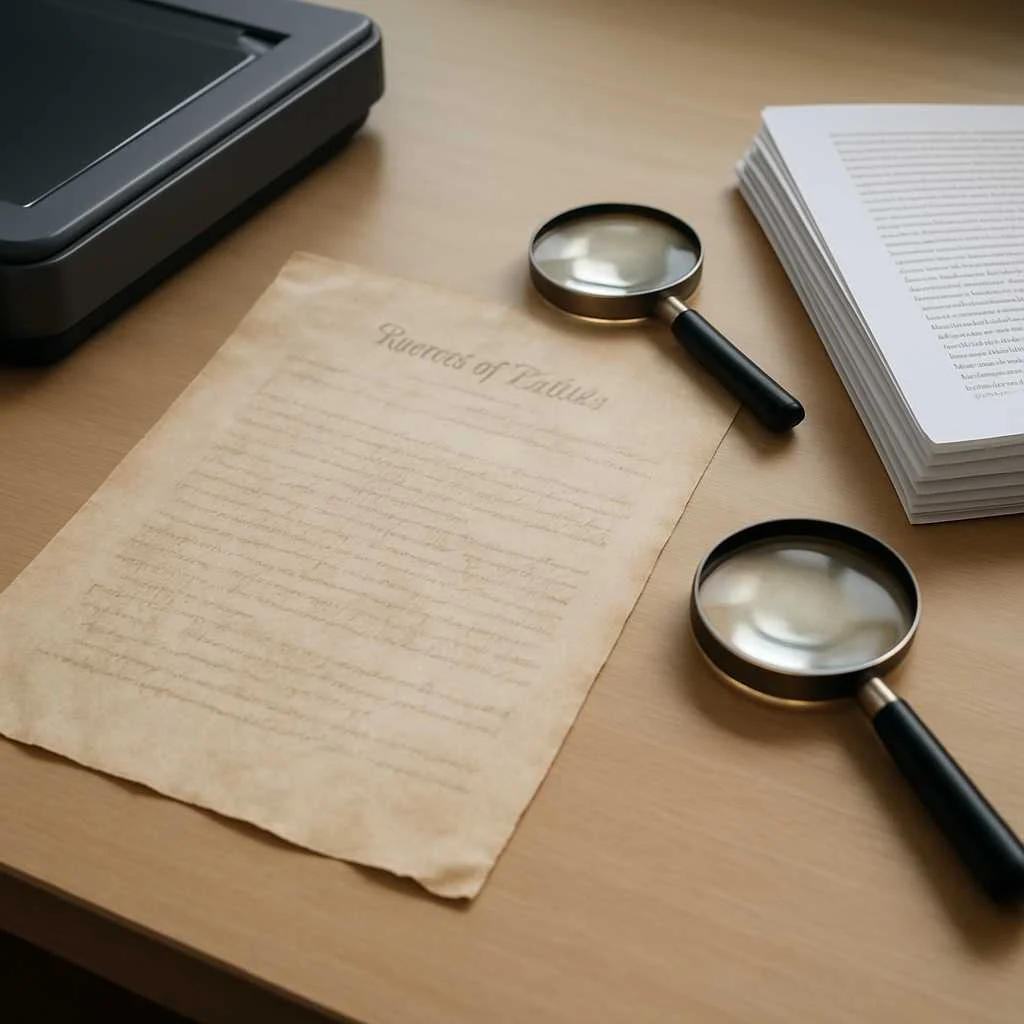
How to Translate Old Documents with Faded Text
Old documents do not always need to be replaced before they can be translated. Many can still be translated safely and professionally, even when the text is pale, the ink has weakened, or a stamp is only partly visible. The key is not guessing. The key is capturing what is readable, improving the scan responsibly, and marking every unclear section honestly.
That is where many people go wrong. They treat a faded document as a language problem when it is really a source-quality problem first. If the source image is poor, the translation becomes risky. If the source image is handled properly, a professional translator can often produce a clear, certifiable translation with accurate notes for any unclear areas.
If you are unsure whether your old certificate, register extract, deed, passport page, academic record, or family document is usable, send it for a quick review before ordering. A fast pre-check can save time, cost, and rejection risk.
What a faded document translation actually means
A faded document translation is a translation of an old, weak, low-contrast, or partly illegible record where:
- all readable text is translated fully
- uncertain text is not guessed
- missing or unreadable parts are clearly marked
- stamps, seals, signatures, notes, and side markings are described where relevant
- the final translation reflects the source honestly rather than trying to “improve” it into something it is not
This matters because official reviewers are not looking for a creative reconstruction. They are looking for a reliable translation of the document you submitted.
Can old faded documents still be translated?
Yes, often they can.
A faded document can usually still be translated when the important content is readable enough to identify names, dates, places, issuing bodies, reference numbers, and the main body text. Even if a few words are weak or a stamp is partly lost, the document may still be workable.
A faded document becomes a problem when:
- key fields are missing entirely
- names or dates cannot be confirmed
- whole lines are washed out
- the scan is dark, blurred, cropped, or full of glare
- handwriting is too faint to distinguish letter shapes
- the only available file is a poor phone photo of a photocopy of a photocopy
In those cases, the first step is usually not translation. It is rescue: rescan, re-photograph, request a better copy, or obtain a fresh certified copy from the issuing authority.
A quick triage table before you order
| Document condition | Best next step | Likely outcome |
|---|---|---|
| Light fading but text mostly readable | Rescan in colour and grayscale | Straightforward translation |
| One seal or stamp partly unclear | Provide original plus enhanced scan | Translation with a clear note |
| A few words missing at page edge | Rescan uncropped, flatten page | Often recoverable |
| Whole lines washed out | Request replacement copy | Translation may need to wait |
| Old handwriting with weak ink | Specialist review | Possible, but slower |
| Low-quality photo with shadows or glare | Retake image before ordering | Usually much better result |
The safest way to prepare old documents for translation
Before you send the file, spend ten minutes improving the source material. This is often the difference between a clean job and a delayed one.
Start with the original, not the WhatsApp version
Always send the highest-quality file you have. The best option is:
- the original scan from a scanner or archive
- a direct export from the issuing institution
- a new flat photo taken in good light
- only then a forwarded PDF or screenshot
Do not rely on compressed messenger images if you have something better.
Send two versions, not one
One of the most useful ways to handle faded records is to send:
- the untouched original file
- a second copy that has been lightly enhanced for readability
Label them clearly, for example:
- Original scan
- Enhanced working copy
This gives the translator the raw source for accuracy and the enhanced version for visibility. It also reduces the temptation to over-edit the only version available.
Use colour before black and white
People often assume black and white will make text clearer. Sometimes it does. Often it destroys faint stamps, annotations, pale signatures, and background marks that matter.
A better approach is to send:
- one colour scan
- one grayscale version
- one lightly contrast-adjusted version if needed
Different layers of faded ink become visible in different versions.
Keep the full page visible
Do not crop too tightly. The margins matter more than people think. Page numbers, marginal notes, registry markings, corner stamps, hole punches, handwritten references, and partial seals may all need to be described or translated.
Keep the page flat and avoid glare
If you are using a phone:
- place the document on a dark, matte surface
- use indirect light, not harsh flash
- keep the camera parallel to the page
- capture the full document, edge to edge
- take more than one shot
A slightly brighter retake is usually more valuable than aggressive editing afterwards.
Image enhancement tips that actually help
Good enhancement clarifies. Bad enhancement invents.
Useful adjustments
These often help with faded document translation:
- mild contrast increase
- slight sharpening
- brightness correction
- separate colour and grayscale exports
- zoomed detail shots of seals, signatures, or handwritten notes
- rotating and straightening the page
Adjustments to avoid
These often make things worse:
- heavy filters
- oversharpening that creates fake edges
- contrast pushed so far that letters break apart
- AI fill or reconstruction tools that “guess” missing text
- smoothing that erases light handwriting
- cropping off page edges or stamps
A translation should be based on what the source shows, not what software predicts it might have said.
What professional translators do with illegible parts
A good translator does not hide uncertainty. They show it clearly and professionally.
Readable stays readable
If a sentence is clear, it is translated normally.
Unclear stays marked
If one word or part of a stamp cannot be confirmed, it should be marked, not guessed. Common approaches include notes such as:
- [illegible]
- [partially illegible]
- [stamp: text partly illegible]
- [signature: illegible]
- [translator’s note: final word unclear in source]
The exact phrasing may vary by translator and destination, but the principle is the same: uncertainty must be visible.
Special features are described, not copied as images
For official documents, the translation may need to refer to:
- round stamp
- embossed seal
- handwritten note
- crossed-out line
- marginal annotation
- revenue mark
- registrar’s mark
- photograph placement
- apostille or certification note
That is especially important on old records, where the document’s form can matter almost as much as its text.
How to handle old handwriting, archaic spellings, and historical records
Old documents are not always just faded. They may also use older handwriting styles, outdated place names, old spellings, or obsolete administrative terms.
That creates a second layer of difficulty. Even when the ink is visible, the meaning may still need careful interpretation.
When older language needs extra care
This commonly affects:
- parish registers
- handwritten civil records
- property deeds
- court extracts
- military papers
- school certificates
- family books
- archive copies
- certificates issued decades ago in non-Latin scripts
In these cases, the best workflow is to provide any supporting material you have, such as a passport spelling, a clearer duplicate, a later certificate, or an official reference copy. These supporting documents can help confirm names or institutions, but they should never be used to silently replace unreadable text in the source. If something is uncertain in the original, the translation should still show that honestly.
The right way to use translator notes
Translator notes are there to explain, not to rescue weak evidence by guesswork.
A strong note is:
- brief
- neutral
- specific
- placed where the issue appears or at the end, depending on format
- clearly separated from the source text
A weak note tries to interpret too much, defend the client’s case, or rewrite the document into a cleaner version than the original supports.
Good examples
- [translator’s note: issuing stamp present; text partly illegible]
- [translator’s note: surname appears faint in source]
- [translator’s note: line crossed out in original]
- [translator’s note: handwritten addition in blue ink]
Poor examples
- [translator’s note: this probably says London]
- [translator’s note: the date must be 1984]
- [translator’s note: unclear but likely accepted]
- [translator’s note: we corrected the name based on context]
Professional notes increase credibility because they show restraint.
The biggest mistakes people make with faded documents
1. Sending only one poor image
If the only file is a blurred phone photo, the translator has nothing to compare.
2. Cropping out edges, seals, and registry marks
Those details may be required for official use.
3. Editing the image too aggressively
Once details are blown out or smoothed away, they cannot be recovered.
4. Asking the translator to “just fill in the missing bit”
That is exactly what should not happen in official document work.
5. Ignoring supporting documents that confirm names
If a faded certificate contains a weak spelling of a surname, a passport or national ID may help confirm the standard spelling used elsewhere in your application.
6. Ordering before checking whether a replacement copy exists
Sometimes the fastest route is not deciphering the weak copy. It is obtaining a fresh certified copy from the registry, archive, school, court, or municipality.
When you should request a new copy instead of translating the old one
Sometimes rescue is sensible. Sometimes it is not.
You should strongly consider getting a replacement copy when:
- the name field is unreadable
- the date is unreadable
- the document number is missing
- the issuing authority is unclear
- a seal or stamp covers key text
- the page is cut off
- the copy is several generations removed from the original
- the receiving authority is strict and time-sensitive
If a replacement is possible, it may reduce cost and risk in one step.
If a replacement is not possible, send every version you have and ask for a feasibility review first. That is often the best way to start the project without paying for the wrong path.
A practical workflow for translating faded documents safely
Step 1: Gather every version
Collect the original scan, archive copy, enhanced copy, zoomed details, and any supporting ID or reference document.
Step 2: Identify the submission purpose
Tell the translator whether the document is for immigration, court, university, employer, overseas authority, or general record use.
Step 3: Flag the weak areas
Mark where the trouble is:
- pale stamp
- weak handwriting
- clipped margin
- washout line
- low contrast section
Step 4: Ask for a readability check before full work starts
This is especially important for urgent matters. A ten-minute assessment can prevent a longer delay later.
Step 5: Translate what is legible, note what is not
That is the correct professional method.
Step 6: Certify the final translation appropriately
Depending on the destination, you may need certified translation, sworn translation, notarised translation, or added legalisation support.
What you should receive at the end
For an official-use translation of an old or faded document, the finished pack should normally include:
- the translated text
- a certification statement where required
- translator details as needed for the receiving authority
- clearly marked notes for any illegible or special features
- clean page numbering and presentation
- a digital copy, with print options if required
If the document is especially difficult, you may also receive a note explaining that certain words, fields, or stamp text were unreadable in the source provided.
Why faded documents need human review
Old records are one of the worst places to rely on automatic guesswork. Faded ink, seal impressions, registry language, handwritten amendments, and historical formats create exactly the kind of uncertainty that needs judgement, restraint, and proper notation.
A machine may try to “complete” the page. A professional translator knows when not to.
That difference matters most when the document is being submitted to an authority that expects accuracy, completeness, and traceability.
A simple rule to remember
If it is faint, clarify it. If it is unclear, mark it. If it is missing, do not invent it.
That one rule will help you avoid most problems in faded document translation.
Ready to move forward?
If you have an old certificate, deed, court paper, archive extract, academic record, passport page, or family document with weak text, send the file for a quick review first. The fastest route is usually:
- check readability
- confirm the correct certification level
- rescue the scan if possible
- translate only what the source genuinely supports
That gives you a cleaner result, a safer submission, and far less chance of having to redo the job later.
Start your project today by sending the original file, any enhanced copies, and any supporting ID pages that confirm names or dates. If the document is urgent, mention the deadline immediately so the review and translation can be prioritised correctly.
FAQs
Can a certified translation be done from a faded scan?
Yes, if the main content is readable enough. A professional translator can translate the legible text and mark unclear sections with notes. If key details are missing, a better scan or replacement copy may be needed first.
What happens if part of the document is illegible?
The unclear section should be marked clearly rather than guessed. Typical wording may include notes such as “illegible,” “partially illegible,” or a short translator’s note describing the problem.
Should I enhance the image before sending it?
Yes, but lightly. Send the untouched original as well as any improved version. Mild contrast, brightness, and straightening can help. Heavy filtering, AI reconstruction, and aggressive sharpening can make official translation less reliable.
Can old handwriting and faded stamps be translated?
Often yes, but they may need slower specialist review. Handwriting, historical spellings, and faint seals can usually be handled when enough of the text remains visible and the translation includes clear notes where necessary.
Is it better to get a new copy instead of translating the old one?
If the name, date, document number, or issuing authority cannot be read, a replacement copy is often the safer option. If no replacement is available, send all versions you have for a feasibility review.
Can supporting documents help with faded document translation?
Yes. A passport, national ID, later certificate, or cleaner duplicate can help confirm names and official spellings. However, supporting documents should not be used to silently replace unreadable text in the original source.