Council Tax Bill Translation: What to Include
If you are searching for council tax translation in the UK, it is important to note that a UK council tax bill typically does not require translation for a UK authority, as it is already in English. The need for translation usually arises in two scenarios: when submitting a foreign address or local tax document to a UK body that requires a certified English translation, or when translating a UK council tax bill for use abroad. In both cases, the translation must ensure that the bill is understandable as proof of address, rather than merely translating a few obvious headings.
Council tax bills serve as evidence of address or residence in various UK contexts, including family visa applications, identity checks, and proof-of-address processes. However, many individuals make the mistake of only translating the name, address, and total amount due, neglecting crucial details such as the billing period, council tax band, reductions, instalment schedule, or reference numbers. These seemingly minor sections are often essential for verifying the document’s currency, property connection, and completeness.
A comprehensive council tax bill translation should enable the reader to ascertain the bill’s ownership, the address it pertains to, the relevant period, and whether the translation is thorough and professionally certified. The Home Office guidance clearly states that documents not in English or Welsh must be accompanied by a full, verifiable certified translation; otherwise, the document may be deemed as not provided.
When a Council Tax Bill Translation is Actually Needed
A council tax bill translation is commonly required for one of the following reasons:
- You need to submit a foreign proof of address document to a UK authority, using a council tax bill as shorthand for the local tax or residence bill.
- You need to submit a UK council tax bill to an overseas authority, bank, university, municipality, court, or notary.
- You are compiling a wider application bundle and need your proof of address documents to match the rest of the translated file set.
- You require a translation that includes a certified translation statement for official acceptance as supporting evidence.
In the UK, council tax bills and utility bills are recognized as valid proof of address and residence. The GOV.UK guidance for family visa evidence refers to utility bills or council tax bills as confirmation that two individuals reside at the same address. Additionally, Companies House identity verification guidance includes UK council tax statements and utility bills as acceptable proof of a person’s current address. The EU Settlement Scheme guidance also acknowledges that a dated, addressed council tax bill serves as evidence of residence for the period indicated on the bill.
The Simple Rule: Translate the Evidence, Not Just the Heading
The safest approach is to translate all elements that help the receiving body understand the legal and practical implications of the bill. This typically includes:
- The full name of the liable person or account holder: If two names are present, both should be translated or reproduced exactly as shown.
- The billing address and property address: If the address is in another script, it should be transliterated carefully and consistently. Both correspondence and property addresses should be included if applicable.
- The council or issuing authority name: The receiving body should clearly see who issued the bill.
- The bill date and the period covered: A bill without its issue date or coverage period is less credible as address evidence.
- The council tax account number and any key reference numbers: These should be copied exactly as they appear, clearly labeled in the target language.
- The valuation band or property band: This is a core part of the bill and should not be omitted.
- The breakdown of charges: If the bill includes separate amounts for various authorities, those labels should be translated.
- Any discount, exemption, reduction, or support shown on the bill: These can significantly alter the document’s meaning.
- The total amount due and any arrears or balance brought forward: These figures help demonstrate the bill’s completeness.
- The instalment schedule and payment plan: Monthly instalment dates and amounts should be translated where shown.
- Explanatory notes that affect interpretation: Important notes tied to the account or reductions should be included.
- Barcodes, QR fields, online keycodes, or portal references: These should be noted if relevant to account identification.
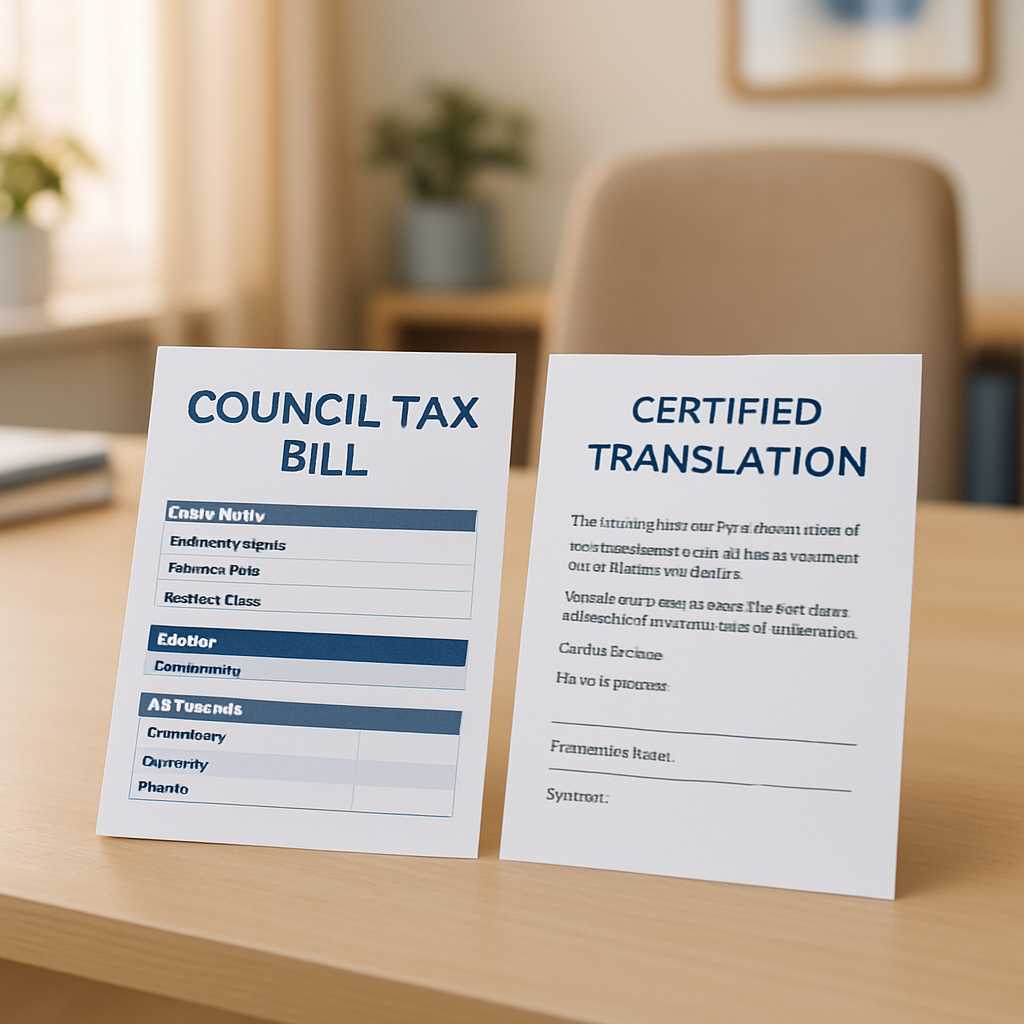
A council bill explainer from Cambridge City Council illustrates how a council tax bill is structured: address and account number at the top, followed by the band and yearly breakdown, discounts, outstanding total, instalment plan, and key online reference. This structure highlights the risks of partial translation.
Which Sections of the Bill Matter Most
Account Holder Details and Address
This section is often the first consideration, as it connects the document to a named individual and a specific address. A strong translation should clarify:
- Who is responsible for the bill
- Which property the bill pertains to
- Whether there is a separate correspondence address
- Whether there are joint account holders
- Whether the spelling of the name matches other documents in the application bundle
If the same person’s name appears differently across various documents, the translation can include a brief note to explain script conversion or naming order, but it should never “correct” the source document.
Bill Date, Financial Year, and Coverage Period
Date fields are crucial for proof-of-address use, as they often determine whether the document is recent enough to be relied upon. UK proof-of-address rules can be very date-sensitive. For instance, council tax bills and original utility bills are only accepted within specific timing and format rules, and blurred or out-of-date documents are not acceptable.
When translating a council tax bill, include the bill date, financial year, coverage period, and any notes explaining why a replacement bill was issued.
Band, Annual Charge, and Breakdown Lines
The band and charge table is essential for proving that the document is a legitimate council tax bill rather than a generic letter. This section should not omit:
- The property band
- The annual charge
- Any individual authority lines
- Discounts or adjustments
- The total payable figure
A council or overseas reviewer may not understand the UK council tax structure, but they will expect a properly translated official bill to show how the total was calculated.
Discounts, Exemptions, and Reductions
This section is often overlooked but is critical. It may indicate:
- Single person discount
- Student exemption
- Disability reduction
- Council tax support
- Empty property treatment
- Revised liability after a change in occupants
Omitting these lines can render the translated bill inconsistent or incomplete, as the totals may no longer make sense.
Instalments, Balance, and Arrears
If the bill includes monthly payment dates, missed instalments, or balances, these details should also be translated. They help the recipient determine whether the document is a current billing document rather than an outdated summary.
What Should Stay Exactly as Shown
Good translation does not equate to over-editing. The following elements should typically be preserved exactly:
- Account numbers
- Reference numbers
- Postcode formatting
- Property band letters
- Monetary figures
- Dates as shown in the source, with clear translation of month names if needed
- Names as written on the source, unless a translator note is necessary to explain script conversion
The translator’s role is to ensure the document is understandable, not to alter it into a new style. This is particularly important for reference numbers, as a reviewer may compare the translated bill against the original line by line. Any discrepancies in formatting can undermine confidence in the document.
Full Translation or Summary Extract?
For official use, a full translation is generally the safer option. A summary extract may only be acceptable if the recipient has confirmed in advance that they require selected fields only. Otherwise, an extract can lead to three avoidable issues:
- It may omit evidence the reviewer expects to see.
- It may make totals appear unsupported.
- It may weaken independent verification.
The Home Office guidance for translated documents emphasizes that the translation must be comprehensive enough to be independently verified. Therefore, a full certified translation is typically the best default for council tax bills, utility bills, and other proof-of-address documents.
What the Certified Translation Statement Should Include
A council tax bill translation intended for official use should be accompanied by a certification statement that includes the following essentials:
- Confirmation that the translation is accurate
- The date of translation
- The translator’s full name
- The translator’s signature, if required by the receiving body
- Contact details for the translator or translation company
In certain immigration contexts, the wording may specify that the translation can be independently verified, and the credentials of a qualified translator may also be relevant. The GOV.UK guidance reflects these core requirements.
A practical best practice version for this kind of document is: I certify that this is a true and accurate translation of the original document. Followed by the date, translator or company name, signature if needed, and contact details.
Scan Quality, Paper Copies, and Format Issues People Miss
Translation quality cannot compensate for a poor source file. If the original bill is blurred, cropped, or poorly photographed, the final translated pack will be weaker from the outset. Some proof-of-address processes differentiate between paper bills and documents downloaded from online accounts. GOV.UK explicitly states that while a scanned or photographed paper copy is acceptable, a downloaded online copy is not. Blurred, illegible, out-of-date, and incomplete documents are also rejected.
This is crucial because clients sometimes mistakenly believe that the translation itself ensures acceptability. The source document format must still adhere to the recipient’s rules. Before ordering, verify:
- Whether the recipient accepts PDFs from an online portal
- Whether they require a photographed paper bill
- Whether they care about the bill’s recency
- Whether they need the original and translation submitted together
A Practical Checklist Before You Order
Before sending your file for translation, ensure you have:
- The full bill, not just the first page
- All pages containing the address, charges, dates, notes, and instalments
- A clear scan or straight-on photo
- Confirmation of the target language
- Confirmation of whether you need certified, sworn, notarised, or apostilled output
- Any deadline or submission date
- Any instructions from the receiving authority regarding paper or digital copies, or full translations
If the bill is to be used alongside other proof of address documents, it is advisable to send those simultaneously to maintain consistency in names, addresses, and date conventions across the entire set.
A Better Way to Think About Council Tax Translation UK
The most effective council tax bill translations do not merely “translate a bill.” They preserve the document’s value as evidence. This means translating the lines that confirm recency, address linkage, liability, and completeness. It also involves maintaining stable figures and reference numbers, including a proper certified translation statement, and checking the original file format before beginning the work.
If you need a council tax bill or other proof-of-address document translated urgently, provide the full scan rather than a cropped screenshot. A quick pre-check at the outset can often prevent the slower issue of resubmitting a translation that was technically readable but practically incomplete.
FAQs
Do I need a certified translation of a council tax bill in the UK?
Only if the receiving body requires it. A UK council tax bill typically does not need translation for a UK authority, as it is already in English. You are more likely to need a certified translation when submitting a foreign proof-of-address document to a UK body or when translating a UK council tax bill for use overseas.
What should a council tax translation UK service include?
It should include the full name, address, bill date, coverage period, council or issuing authority, account or reference numbers, band, charge breakdown, discounts or reductions, instalment schedule, total due, and a certified translation statement.
Can I translate only the address section of a council tax bill?
For official use, this is usually risky. If the bill is being used as proof of address, the reviewer may also need to see the period covered, the account reference, the band, and the billing breakdown. A full translation is generally the safer option.
Do reference numbers need to be translated?
They should typically be copied exactly as shown, rather than being reformatted into a new style. It is essential that the translated document clearly labels them so the reviewer can match them to the original.
Is a utility bill better than a council tax bill for proof of address documents?
This depends on the receiving body. Different organizations accept different proof-of-address documents. In UK guidance, both council tax bills and utility bills are included in relevant contexts, but the rules regarding dates and source formats can differ.
What should the certified translation statement say?
At minimum, it should confirm that the translation is accurate, provide the date, and include the translator’s full name and contact details. Many official uses also expect a signature and a format that can be independently verified.