How to Avoid Inconsistent Terminology Across Multiple Documents
Consistent translation across documents is crucial, especially when your files are reviewed as a bundle rather than as individual pages. Whether it’s a visa application, court pack, university submission, corporate compliance file, or banking set, documents are often read side by side. If one document states “share capital,” another refers to “capital stock,” and a third uses a more ambiguous phrase, it creates confusion and delays.
This issue extends to personal names, place names, institution titles, dates, document numbers, and recurring legal or business phrases. When these details vary across a set of documents, the translation may appear unreliable, even if each individual page is technically accurate.
The good news is that most inconsistencies can be avoided. By implementing the right workflow, maintaining a terminology list, ensuring careful name matching, and following a proper batch translation process, you can achieve alignment across all documents from the first page to the last.
If you are preparing a complete document pack for official use, it is advisable to send the entire bundle together before translation begins. This approach simplifies the process of locking terminology, allows for a single review, and results in a cleaner final set.
What “Consistent Translation Across Documents” Really Means
Consistency does not imply that different documents should sound identical. Instead, it ensures that repeated items are handled deliberately each time they appear. This typically includes:
- The same personal name written consistently across the full set
- The same institution translated uniformly in every file
- The same defined legal or business term maintained throughout
- The same date and number style applied consistently
- The same treatment of stamps, seals, handwritten notes, headers, and labels
- The same approach to untranslated items, abbreviations, and transliterations
A translation set is more trustworthy when reviewers do not have to pause and question whether two different phrases refer to the same concept. Consistency is not about uniformity; it is about making every repeated term, name, and reference traceable, intentional, and defensible.
Why Terminology Drifts Across Multiple Documents
Most inconsistency issues arise not from a single major error but from a series of minor decisions made at different times.
The Most Common Causes
Documents Arrive One by One
When files are translated in stages, each stage introduces new choices. A term selected on one day may be phrased differently on another if the earlier document is not reviewed alongside the new one.
More Than One Translator or Reviewer Touches the File
This situation is not inherently problematic, but it can lead to inconsistencies without a shared glossary, terminology list, or locked reference file.
The Client Sends No Preferred Spellings
Many official bundles contain names that can be transliterated in multiple ways. Without an agreed-upon spelling, variations can quickly arise.
The Source Documents Are Inconsistent Themselves
For instance, one source document may say “Mohamed,” another “Muhammad,” and a third may use a middle name differently. A robust translation process should not obscure these issues but rather identify and manage them early.
The Project Is Treated as Separate Pages Instead of One Batch
Translating at the page level is rarely sufficient for official document packs. A bundle-level review is essential for protecting consistency.
The Safest Workflow for Consistent Translation Across Documents
The most effective results typically stem from a five-step process:
1. Collect the Full Document Set First
Before translation begins, gather all documents that will be submitted together, including:
- Certificates
- Passports or IDs
- Affidavits
- Bank statements
- Academic records
- Contracts
- Company documents
- Supporting letters
Even seemingly minor items may contain names, dates, addresses, or institution titles that impact the entire file. A complete pack enables the translation team to identify repeated terminology before any wording is finalized.
2. Build a Terminology List Before Translating
A terminology list is the quickest way to prevent unnecessary drift. It should encompass:
- Repeated technical, legal, academic, or corporate terms
- Personal names and preferred spellings
- Place names
- Issuing authorities and institution titles
- Abbreviations
- Phrases that should remain untranslated
- Notes on tone, format, or document-specific wording
This does not need to be complex; even a simple project glossary created at the outset can save significant rework later.
3. Confirm Name Matching Rules Early
Name matching is a critical risk area in multi-document projects. Before translating the first page, confirm:
- The preferred spelling that should match the passport or primary ID
- Whether hyphens, apostrophes, accents, or middle names should be preserved
- How family names and given names are ordered
- Whether alternate spellings in the source documents need to be flagged
This step is vital because reviewers often compare translated names against the identity document first.
4. Translate as a Batch, Not as Isolated Files
Batch translation provides the translator and reviewer with context. A term in a contract may also appear in a certificate, annex, affidavit, or supporting letter. Seeing these documents together enhances decision-making.
Here is the practical difference:
| Approach | Typical Result |
|---|---|
| One-by-one translation | Faster to start, but more likely to create drift in terms, names, and formatting |
| Batch translation | Slightly more planning upfront, but stronger consistency across the whole submission |
If your deadline is tight, the best strategy is usually not to send files one at a time but to submit the entire bundle immediately so that one terminology pass can occur before translation begins.
5. Review Across the Full Set Before Delivery
A thorough final check should not only focus on page accuracy but also compare the documents against each other. This review should examine:
- Repeated terms translated differently
- Names appearing in more than one spelling
- Date formats switching between styles
- Authority names written differently across files
- Missing labels for stamps, seals, signatures, or notes
- Inconsistent treatment of bold headings, tables, and document structure
This cross-document review is where many avoidable submission problems are identified.
What to Put in a Terminology List or Glossary
A useful glossary should be practical rather than overloaded. It should focus on the items most likely to recur or cause confusion.
A Strong Glossary Usually Includes
- Source term: The exact wording from the original document.
- Approved translation: The preferred version that should be used every time.
- Context: A brief note explaining where or how the term is used.
- Document scope: Which documents in the set the term applies to.
- Usage notes: Any rules about capitalization, abbreviation, non-translation, or alternative forms to avoid.
Example Glossary Structure
| Source Term | Approved Translation | Context | Notes |
|---|---|---|---|
| Registro Civil | Civil Registry Office | Civil status documents | Use this form consistently |
| Poder Notarial | Power of Attorney | Legal document heading | Capitalize in formal heading |
| Apellidos | Surname(s) | Personal data field | Match passport spelling where confirmed |
| Fecha de Expedición | Date of Issue | Certificates and IDs | Keep date style consistent across set |
A terminology list is especially valuable in legal, academic, medical, immigration, and business files where the same concept appears across multiple document types. If your project includes contracts, certificates, declarations, and supporting evidence, request a glossary check before translation begins. This single step often prevents the most costly corrections later.
Name Matching Across Documents: Where Most Problems Start
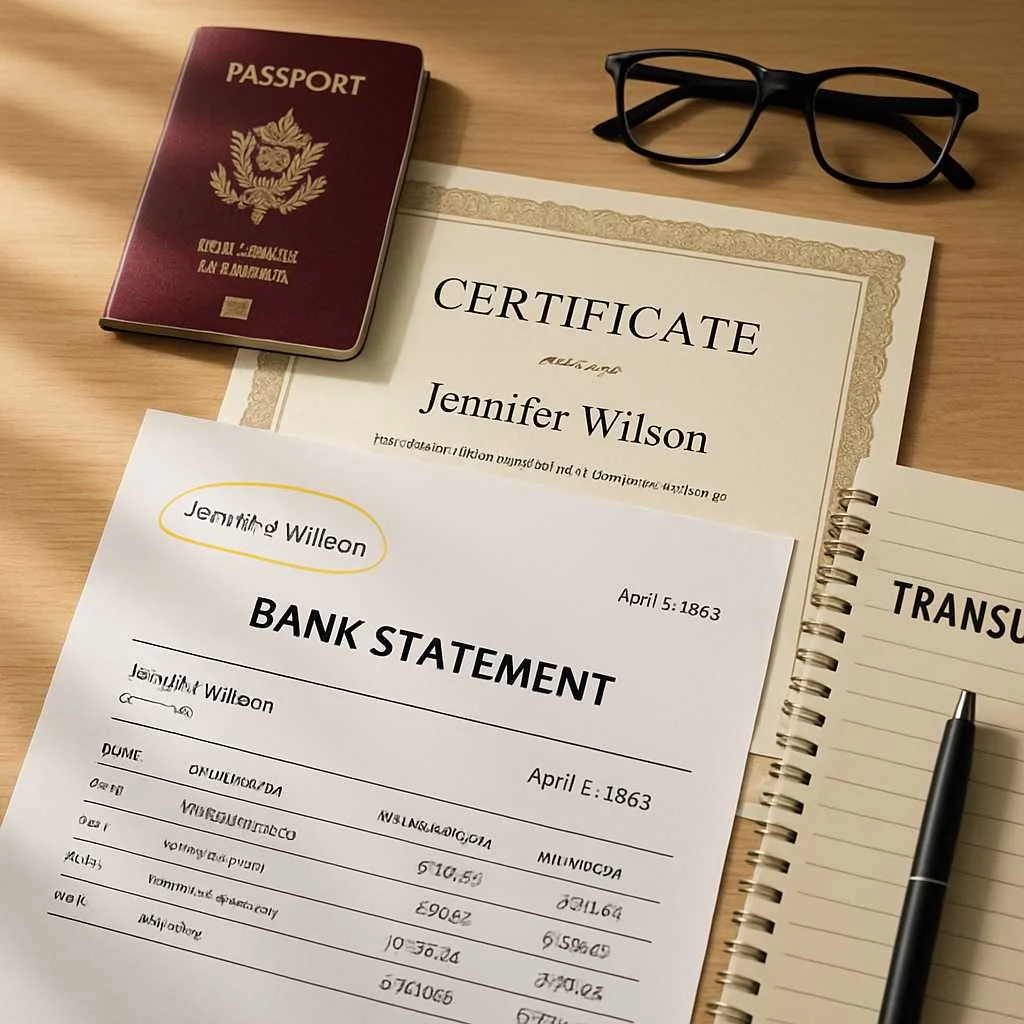
While terminology is important, names often pose the greatest challenge. A document pack may include:
- A birth certificate
- A passport
- A marriage certificate
- A bank statement
- An affidavit
- A degree certificate
If one translated file uses “Abdul Rahman,” another uses “Abdelrahman,” and another splits the surname differently, the reviewer may be unsure whether the documents all belong to the same individual.
The Safest Approach to Name Matching
Match the Primary ID Wherever Possible
If the translated set is to be submitted to an authority, align the preferred spelling with the passport or main identity document unless there is a clear reason not to.
Do Not Silently Fix the Source
If the original documents already contain different spellings, the translation should not obscure this difference.
Flag Genuine Discrepancies
Where source spellings vary, it is often better to maintain the document’s integrity and add a brief translator note if appropriate, rather than normalizing everything invisibly.
Preserve Structure as Well as Spelling
Name order, initials, middle names, compound surnames, and diacritics are all significant.
Case-Style Example
A client submits a passport, bank statement, degree certificate, and affidavit. The variations in spelling are:
- Passport: “Mariam Al Hashimi”
- Degree certificate: “Mariam Al-Hashemi”
- Bank statement: “Mariam Alhashimi”
- Affidavit: “Maryam Al Hashimi”
Each variation may have a simple explanation, but if the translation process ignores them, the final set appears less coherent. A better process identifies the differences at the outset, confirms the preferred spelling for cross-reference, and handles each source document consistently and transparently.
What to Do When the Source Documents Already Disagree
This is where experienced handling is crucial. You generally should not select one spelling or term and impose it everywhere without review. While this may make the translated set look neater, it can also create mismatches with the originals.
Instead, the safer process involves:
- Identifying the inconsistency early
- Confirming whether one form should be treated as the primary reference
- Translating each document faithfully
- Keeping recurring terminology aligned where the source meaning is the same
- Flagging source-side differences that could matter to the receiving authority
This is particularly important for:
- Names
- Addresses
- Company names
- Authority titles
- Registration numbers
- Issue dates
- Place of birth or place of issue fields
When in doubt, transparency is preferable to silent correction.
Why Batch Translation Usually Beats Piecemeal Translation
Batch translation is not merely about convenience; it enhances quality control.
It Gives the Translator Context
A term in a company certificate may only make complete sense when read alongside the memorandum, board resolution, and bank letter.
It Improves Glossary Accuracy
The full set reveals which terms genuinely recur and which are one-off phrases.
It Reduces Duplicate Review Time
Instead of correcting the same inconsistency in multiple stages, the team can address it once.
It Makes Final QA More Useful
The reviewer can compare similar documents across the full pack.
For official submissions, batch translation is often the safer and quicker route overall, even if the initial step requires a bit more coordination. If you are facing an urgent deadline, the simplest way to avoid inconsistent terminology across multiple documents is to upload the entire file set together and request a single terminology pass across the batch.
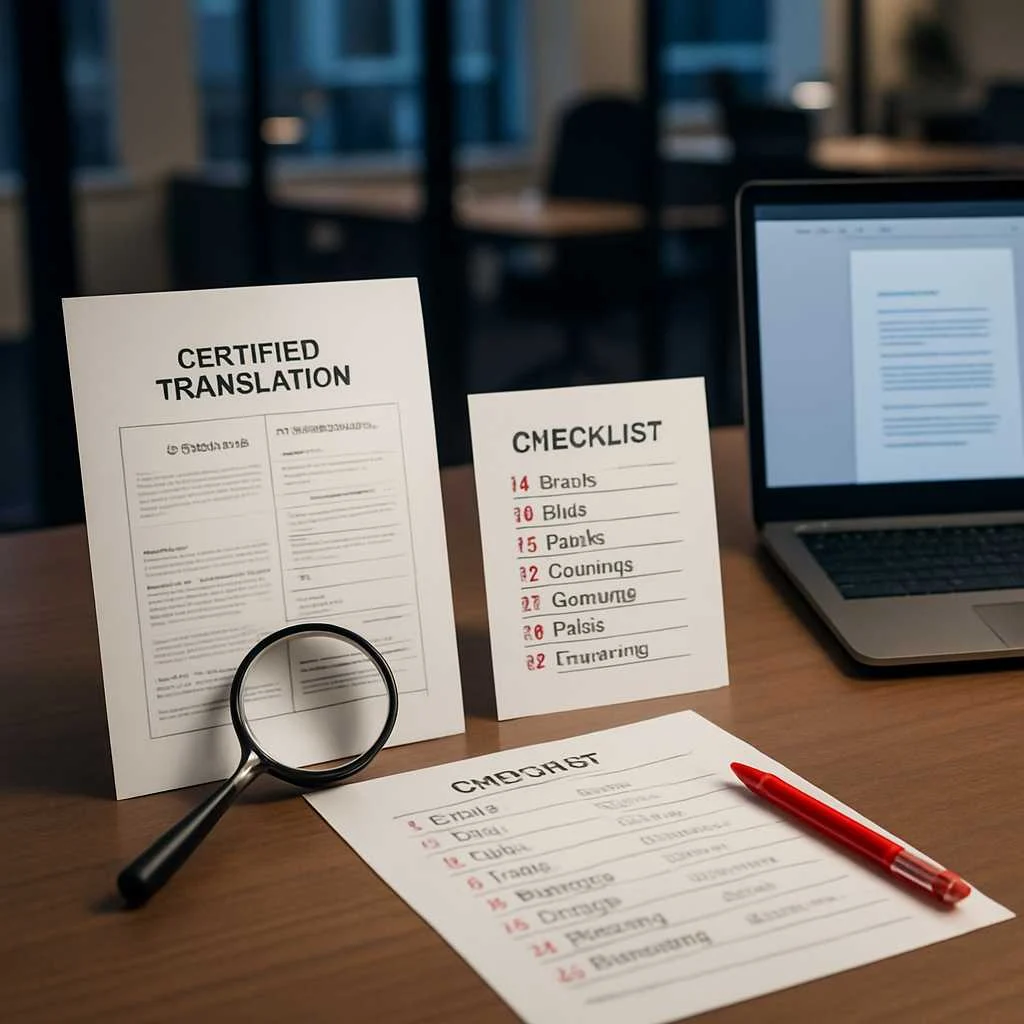
A Practical Review Checklist Before Delivery
Before releasing a multi-document translation, the final set should be checked against the following list:
Cross-Document Consistency
- Are repeated terms translated the same way?
- Are institution names stable across the full set?
- Are abbreviations treated consistently?
Name Matching
- Do recurring names follow the agreed spelling?
- Are initials, middle names, hyphens, and surname order handled consistently?
- Have source-side spelling differences been identified where relevant?
Numbers and Dates
- Are issue dates, birth dates, and document numbers copied accurately?
- Is date presentation consistent across the set?
Formatting and Labels
- Are stamps, seals, handwritten notes, and signatures clearly marked?
- Are tables, headings, and official fields easy to compare with the original?
Submission Readiness
- Are all pages included?
- Are file names clear?
- Does the final bundle read like one coordinated submission rather than a collection of separate jobs?
Where This Matters Most
Consistent translation across documents is essential in nearly every official context, but it is particularly critical in:
- Immigration and visa packs
- Court and tribunal bundles
- Probate and family law matters
- School and university admissions
- Overseas banking and compliance files
- Company incorporation and regulatory submissions
Whenever a reviewer is checking multiple documents side by side, consistency contributes to credibility.
A Smarter Way to Order Multi-Document Translation
If your submission includes more than one document, treat it as a single project from the outset. Send:
- The full document set
- Your deadline
- The target language
- The receiving authority, if known
- The preferred spelling of names that must match ID documents
- Any prior translations that should be followed
- Any terms you want kept in a specific form
This brief helps create a cleaner glossary, tighter batch translation, and a more reliable final result. If you need assistance with a multi-document pack, send the entire bundle at once so that terminology, names, and formatting can be checked across the entire set before translation begins.
FAQs
How do you keep consistent translation across documents?
The safest method is to translate the files as one batch, create a glossary before work starts, confirm name matching rules early, and conduct a final review across the full set rather than checking each page in isolation.
What is a terminology list in translation?
A terminology list is a project-specific glossary of approved words, names, phrases, and notes. It helps translators use the same wording across every document in the set.
Why is name matching important in certified translation?
Reviewers often compare translated names against passports, IDs, or prior records. If a person’s name appears in different forms across the translated bundle, it can lead to questions, delays, or requests for clarification.
Is batch translation better than sending documents one by one?
In most official cases, yes. Batch translation provides the translator with more context, improves glossary building, reduces repeated corrections, and enhances cross-document quality checks.
What happens if the original documents already use different spellings?
A good process identifies those differences early, translates each document faithfully, and flags important discrepancies instead of silently rewriting the source to create uniformity.
Can a glossary help with legal, academic, and business documents?
Yes. A glossary is especially beneficial in document sets where the same terms, institutions, job titles, legal phrases, or corporate wording appear repeatedly across certificates, letters, contracts, and supporting evidence.