Introduction
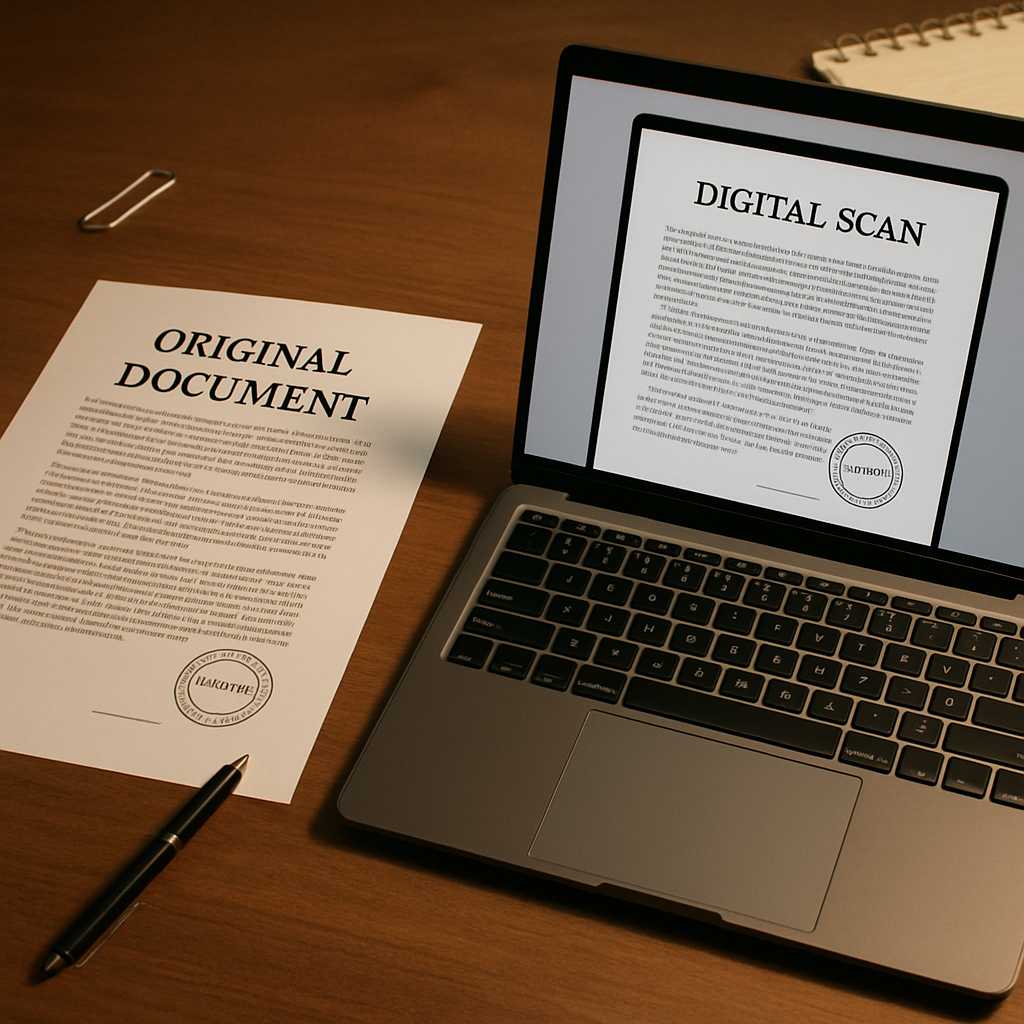
If you are comparing certified translation scan vs original, the answer is usually simpler than people expect: for many certified translations, a clear scan is enough to start and often enough to finish. But that does not mean originals never matter. The moment your case involves apostille, notarisation, passport applications, or a body that insists on original records or certified copies, the rules can change quickly.
That is why the real question is not just “Can a translator work from a scan?” It is: What does the receiving authority want, and what stage of the process are you at?
For a standard certified translation, the translator normally needs a clear, complete, readable image of the source document. For legalisation, certain notarisation routes, or document packs that must be physically examined, the original paper document or a certified copy may still be required.
If you want a fast answer for your exact case, send the file first. A specialist team can usually tell from the document type, destination country, and submission purpose whether a scan is enough or whether you should stop and prepare an original or certified copy before paying for anything.
Upload your file for a fast review and get a clear answer before the wrong format causes delays.
The Short Answer
Here is the practical rule most applicants need:
- Standard certified translation for many visa, legal, academic, or business submissions: Usually yes. The scan must be clear, complete, and legible.
- Translator review and quotation stage: Yes. A scan or high-quality phone photo is normally enough for assessment.
- Certified translation where the authority only wants the translation plus certification: Often yes. Final acceptance still depends on the receiving body.
- Notarised translation: Sometimes. A scan may be enough to begin, but extra formalities can apply.
- Apostille or legalisation route: Often no, or not by itself. The authority may require an original document or a certified copy.
- Passport or similar original-document process: Usually no. The receiving authority may insist on originals.
That is the part many websites skip. A scan can be perfectly acceptable for translation purposes, but still be insufficient for the wider submission process.
Why a Scan is Often Enough for Certified Translation
A certified translation is about the accuracy and completeness of the translated text, not about whether the source paper is physically sitting on the translator’s desk.
In practical terms, many certified translation jobs begin from:
- a scanned PDF
- a phone photo
- a high-resolution image
- a digital copy emailed by the client
That works because the translator mainly needs to see:
- all text clearly
- all pages in full
- stamps, seals, signatures, notes, and handwritten elements
- document numbers, dates, and names without blur or cropping
If the image is clean, the translation can be prepared accurately, checked, certified, and delivered as a professional PDF. That is one reason fast online document translation has become standard for many official submissions.
This is also the most efficient route for people handling urgent documents such as birth certificates, marriage certificates, academic transcripts, bank statements, police records, and court papers. A readable scan avoids courier delays and lets the work begin immediately.
The Part People Get Wrong: Translation Requirements Are Not the Same as Submission Requirements
This is where most confusion starts. A person may hear:
“A scan is fine.”
That may be true for the translation stage. But the actual authority might still say:
- send the original
- provide a certified copy
- provide a notarised certification
- obtain an apostille on the original or on the notarial certification
- submit official records directly from the issuing body
So the safest way to think about it is this:
Level 1: Translation Only
The translator can often work from a scan.
Level 2: Translation Plus Certification
A scan is still often enough, provided the receiving body accepts a properly certified translation.
Level 3: Translation Plus Notarisation or Apostille
The original document, a certified copy, or a specific signing route may become important.
Once you separate those three levels, the whole topic becomes much easier to understand.
When the Original Document Really Does Matter
1. When You Need an Apostille
If your document is going abroad, especially for official use, you may need legalisation. At that point, the question is no longer just about translation. It becomes a document-authentication issue.
For some cases, the apostille sits on the original document or a certified copy. In other cases, the apostille may relate to the notarised translator’s certification. Those are not the same route, and choosing the wrong one can waste time and money.
If your case may involve legalisation, review the requirements early and use a specialist service that understands both the translation and the document route.
2. When Notarisation is Specifically Requested
A notarised translation is different from a standard certified translation. In many cases, the notary is verifying the identity or signature connected to the certification, not “checking the translation” line by line.
That means the formal pack matters more. A scan may be enough to begin, but the notarial route can add extra document-handling requirements depending on who is requesting it.
If your instructions mention notary, notarial certificate, notarised translation, or legalisation, go straight to a service built for that route rather than assuming a normal certified translation will be enough.
3. When the Receiving Authority Wants Originals
Some processes are strict about originals regardless of translation. That usually happens where the authority is assessing the authenticity of the source document itself, not just the translated wording.
This often affects:
- passport applications
- certain registry or civil status procedures
- some academic or licensing submissions
- some overseas legal or consular processes
In those cases, a scan may help you get a quote, confirm requirements, or prepare the translation, but it does not replace the original record if the authority insists on one.
4. When the Copy is Poor
Even where a scan is acceptable in principle, a bad scan is effectively unusable. A scan is not “enough” if it is:
- blurred
- cropped
- shadowed
- low resolution
- missing pages
- missing reverse sides
- hiding embossed seals, signatures, or marginal notes
A translator cannot safely certify what cannot be clearly seen.
Certified Translation, Notarisation, and Apostille Are Not Interchangeable
People often use these terms as if they mean the same thing. They do not.
Certified Translation
A professional translation supplied with a signed statement confirming that it is accurate and complete.
Notarised Translation
A translation pack where a notary is involved in confirming the signature or declaration connected to the certification.
Apostille
A form of legalisation used for international recognition under the Hague Convention route.
That distinction matters because many rejections happen when someone orders the wrong service:
- they needed certified, but paid for notarised
- they needed notarised, but ordered only certified
- they needed an apostille on the original document, but arranged an apostille on the translation certification instead
- they assumed “scan acceptance” for translation meant “scan acceptance” for the whole application
If you are not sure which route applies, start with the destination and purpose:
- UK visa
- overseas marriage registration
- university admission
- passport application
- court filing
- embassy submission
- employer compliance
- property transaction
A good document team will map the route before translation starts.
Is a Phone Photo Acceptable, or Does It Need to Be a Proper Scan?
A proper flatbed scan is ideal, but a phone photo can often work perfectly well if it is captured correctly. Use this checklist before sending the file:
Your Image is Usually Good Enough If:
- all four corners are visible
- text is sharp when zoomed in
- there is no glare across stamps or signatures
- nothing is cropped off the top, bottom, or margins
- both front and back are included where relevant
- the whole document is sent, not just the “important” page
- colours, seals, and annotations are visible
Your Image is Not Good Enough If:
- the paper curves upward and distorts the text
- the camera is taken at an angle
- shadows cover names, dates, or seals
- the file was compressed heavily in a messaging app
- the image is out of focus
- pages are mixed up or incomplete
A good rule is simple: if an officer, solicitor, university administrator, or caseworker would struggle to compare the translation against the source image, the file is not ready.
The Documents Most Likely to Create Confusion
Some documents are especially prone to “scan vs original” mistakes because they sit close to legal or official thresholds.
Birth and Marriage Certificates
A scan is often enough for translation, but the original or an official copy may matter for passport, legalisation, or registry use.
Academic Transcripts and Diplomas
A translator can usually work from a clear copy, but some institutions want official documents or certified copies issued by the school or university.
Passports and ID Pages
A clear scan may be enough to translate the content, but some authorities want certified copies or originals for identity verification steps.
Powers of Attorney
These regularly cross into notarisation and legalisation territory. A translation may begin from a scan, but the submission route often depends on the original execution and certification chain.
Police Certificates
These are frequently used in immigration or international compliance processes, which means the translation may be simple but the broader document route is not.
A Better Way to Decide: Ask These 5 Questions
Before ordering, ask:
- Who is receiving the document? A visa office, passport authority, university, court, notary, registry, bank, or employer?
- What exactly have they asked for? Certified translation, notarised translation, apostille, official copy, original, sealed transcript, or something else?
- Does the source document itself need authentication? If yes, the original or a certified copy may matter.
- Can the translator read every detail clearly from the image? If not, retake the file first.
- Do you need digital delivery only, or a physical pack too? This affects the best route from the start.
These five questions prevent most expensive mistakes.
A Simple Real-World Framework
Here are three common examples.
Example 1: UK Visa Supporting Documents
You have a bank statement and a birth certificate in another language. You need certified translations for submission. In many cases, a clear scan is enough to begin and complete the translation pack.
Example 2: First Adult Passport Application
You may still need a certified translation for foreign-language documents, but the passport process itself can require original documents. A scan helps the translator; it does not replace the originals in the passport application.
Example 3: Marriage Certificate for Overseas Legalisation
You are not just translating the document. You are entering a chain that may involve a registry-issued certificate, notarial handling, and apostille. Here, the original or official copy often matters far more than people expect.
What We Recommend Clients Do Before They Pay
The safest sequence is:
- Send the scan first for a requirement check
- Confirm the receiving body and destination country
- Ask whether you need certified translation only, notarisation, or apostille support
- Retake any poor images before translation begins
- Only order hard-copy or legalisation extras once the route is confirmed
That approach is faster than rushing into the wrong service and correcting it later. For this reason, it makes sense to begin with a quick upload rather than a guess.
How Urgent Certified Translation UK Handles Scan vs Original Cases
The most efficient workflow is:
- you upload a clear scan or photo
- the team reviews the document type and submission purpose
- you are told whether standard certified translation is enough
- if extra steps are needed, the route is matched to the case before work starts
That matters because clients do not just need translated words. They need a document pack that is usable. This is especially important for:
- immigration document translation
- legal document translation
- academic document translation
- urgent same-day cases
- notarised and apostille-related submissions
If your deadline is close, the best move is not to wait for the “perfect” paper route before asking. Send the file now, explain where it is going, and let the required level be confirmed first.
Common Mistakes That Cause Avoidable Delays
Assuming “Clear Enough” is Good Enough
If a stamp, signature, handwritten note, or edge text is unclear, it can become a rejection point.
Sending Only One Page
Multi-page records, reverse sides, annexes, and endorsements are often missed.
Ordering Certified Translation When You Actually Need Notarisation
This is one of the most common wasted-cost scenarios.
Ordering Notarisation When Only Certified Translation Was Requested
This adds cost and time without adding value.
Ignoring the Destination Country
A document going to a UK body is not handled the same way as one going to Spain, Italy, the UAE, or another apostille destination.
Waiting Until the Final Day to Ask About Originals
Original or certified-copy issues are much easier to solve early than after the translation has already been prepared.
Final Answer: Scan First, But Do Not Guess the Route
So, certified translation scan vs original comes down to this:
- For translation itself, a clear scan is often enough.
- For acceptance, the receiving authority decides.
- For apostille, legalisation, passport, or certain notarisation routes, the original or a certified copy may be essential.
That is why the most accurate answer is not simply yes or no. It is: A scan is often enough to start. The original matters when the authority, legalisation route, or document type says it does.
If you want to avoid paying twice, upload the document first, state where it will be submitted, and get the right route confirmed before anything is issued.
FAQs
Is a scan enough for a certified translation?
In many cases, yes. A clear scan or high-quality photo is often enough for the translator to prepare a certified translation. The exception is when the receiving authority separately requires originals, certified copies, notarisation, or legalisation.
Do apostille needs originals, or can I use a scan?
A scan may be enough to review the case, but apostille requirements often go beyond translation. Depending on the document and route, you may need the original document, a certified copy, or a notarially signed PDF for the correct legalisation process.
Do notarisation requirements mean the original document is required?
Not always, but notarisation introduces an extra formal step. A scan may be enough to begin, but the exact requirement depends on what the receiving authority wants the notary to confirm.
Can I use a phone photo instead of a scanner for a certified translation?
Yes, if the image is sharp, complete, evenly lit, and shows every part of the document clearly. Poor-quality photos create risk and may need to be retaken before translation starts.
Will passport authorities accept a scan instead of the original?
You should never assume so. Some passport processes require original documents even when a certified translation is also needed. The translation and the source-document submission rules are not the same thing.
What should I do if I only have a poor scan right now?
Send it for an initial review, but expect to provide a better copy before the translation is finalised. It is better to correct image quality early than pay for a translation based on an incomplete or unclear document.