The short answer
Yes, you can often email a certified translation directly to an authority if all four of these conditions are met:
- The authority accepts email or digital upload for supporting documents.
- The translation is properly certified.
- The PDF is complete, readable, and easy to match against the original.
- No separate requirement applies for originals, notarisation, sworn translation, or apostille.
If even one of those points is missing, a perfectly good translation can still be rejected.
The 3-check test before you send anything
A quick way to avoid mistakes is to run every submission through this three-check test:
1. Channel
How does the authority want the file delivered?
- Direct email
- Online portal
- Hard-copy post
- In-person submission
- A mix of digital first, originals later
2. Certification
What makes the translation acceptable?
- Signed certification statement
- Translator name and contact details
- Date of certification
- Company letterhead or stamp if expected
- Member of a recognised professional body if specifically requested
3. Chain
Will anyone need more than the PDF?
- Original document
- Certified copy
- Notarised translator declaration
- Apostille or legalisation
- Hard copy for file inspection
This matters because many applicants focus only on the translation wording. Authorities often focus just as much on how the file arrives, how clearly it is labelled, and whether the certification format matches the process.
What usually decides whether email is acceptable
Here is the practical reality:
| Situation | Is direct email usually acceptable? | What matters most |
|---|---|---|
| Visa or sponsorship documents with a named submission email | Often yes | Correct file format, readable scans, certified translation included |
| University admissions or credential review | Often yes | Clear PDF bundle, reference number, all pages included |
| Employer, recruiter, or licensing body asking for supporting evidence | Often yes | Fast digital delivery, easy-to-review formatting |
| Court or tribunal matter handled through a portal | Usually no | Use the portal unless specifically told to email |
| Passport or identity process requiring originals | Usually no | Original documents and certified translation may both be needed |
| Apostille or legalisation stage | Not as a normal email attachment | The process may require post, notarisation, or a specific electronic route |
When emailing a certified translation directly works well
Direct email is often the right route when the authority has already given you a contact address or when the process is clearly digital.
A named caseworker, admissions team, or HR contact
If a person or department has asked for documents by email, a certified PDF can be ideal. It is fast, simple, and easy to forward internally. This works best when the email includes:
- Your full name
- Application or case reference
- Document name
- Original file plus certified translation
- A short note explaining what is attached
Digital-first applications
Many modern processes begin with document upload or email review. In these cases, the translation does not need to arrive on paper first. What matters is that the reviewer can open the file, verify the certification details, and compare the translation to the original without confusion.
Urgent deadline cases
When the issue is speed, email delivery can save a day or more. If the authority accepts digital submissions, there is no reason to wait for post before making progress. At Urgent Certified Translation UK, digital PDF delivery is standard and hard copy can be arranged where needed. That makes it easier to handle both kinds of authorities without ordering twice.
When direct email is the wrong move
This is where many avoidable rejections happen.
Portal-only authorities
Some systems want documents uploaded inside the case record, not sent to a general inbox. If you email instead of upload, the file may never attach correctly to the application.
Authorities that still require originals
A certified translation is not a substitute for an original document where the authority insists on original evidence. This is common in some passport, legalisation, and identity-related processes.
Cases needing notarisation or apostille
If the receiving body wants notarisation or apostille, a normal emailed PDF may be useful for review, but it may not be the final submission format.
Cases with strict ownership of submission
Some authorities want the applicant, solicitor, or authorised representative to send the documents from the correct account. A translator can prepare the file, but the applicant may still need to submit it personally.
PDF submission rules that matter more than people expect
A lot of submissions fail for practical reasons rather than translation errors.
The PDF should be easy to review
A reviewer should be able to understand the file in seconds. That usually means:
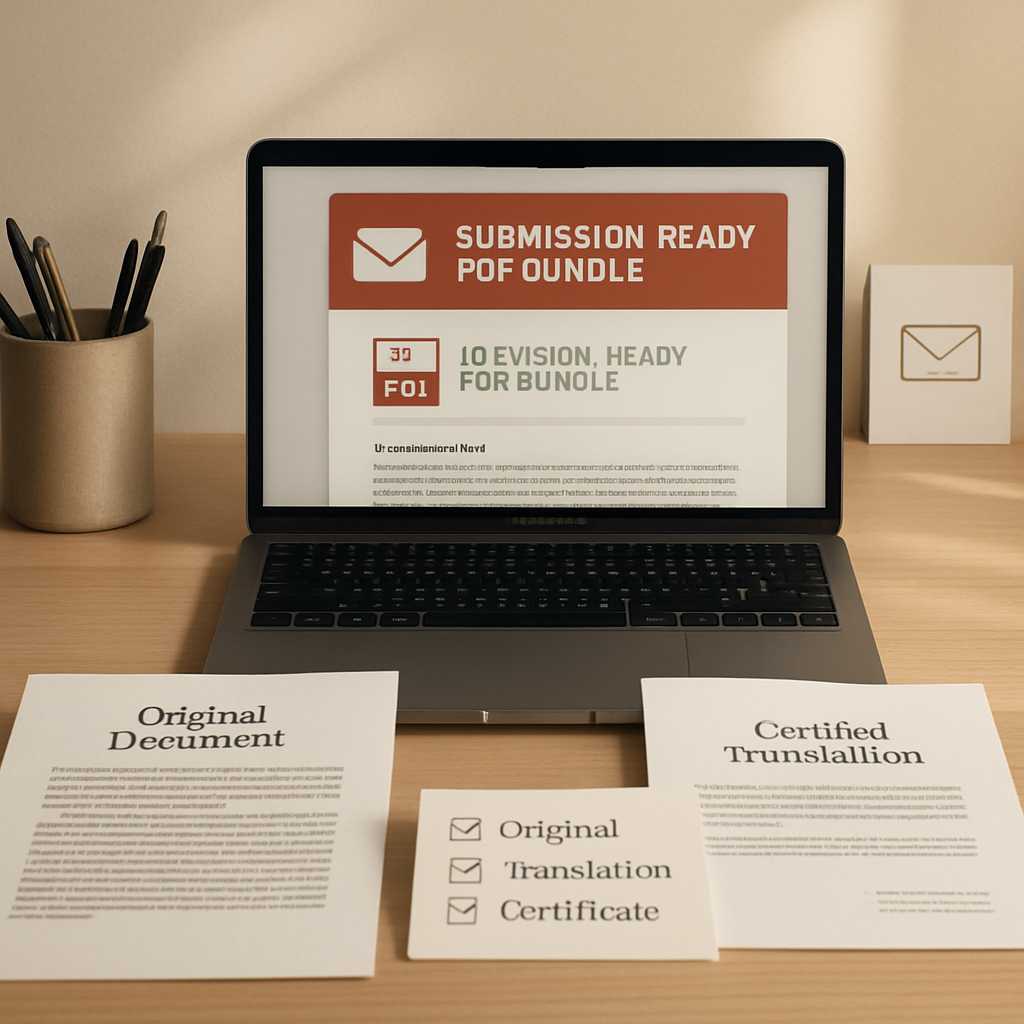
- Original document included
- Translation included
- Certification statement included
- Pages in the correct order
- No cropped edges
- No missing reverse pages
- No blurred stamps or faint handwriting
Do not send a broken document bundle
A common mistake is sending only the translation and not the source document, or sending separate files with vague names like:
- scan1.pdf
- final-final.pdf
- document new copy.pdf
Use clear naming instead. For example:
- surname-birth-certificate-original.pdf
- surname-birth-certificate-certified-translation.pdf
- surname-birth-certificate-original-and-translation.pdf
Keep the formatting reviewer-friendly
The best certified translations are not just accurate. They are easy to compare line by line. That includes:
- Headings preserved
- Tables mirrored where possible
- Stamps and seals translated
- Handwritten notes marked where legible
- Illegible sections clearly noted rather than guessed
Ask whether one combined PDF or separate files are preferred
Some authorities like one clean bundle. Others want separate uploads for original and translation. Never assume.
Digital certification is often enough for review, but not always enough for final acceptance
This is the point most articles gloss over. A digital certified translation can be fully valid for online review, preliminary checks, and supporting documents upload. But that does not automatically mean the same PDF is the final form of acceptance.
Stage 1: initial review
The authority checks whether the document is understandable and properly translated.
Stage 2: formal verification
The authority may ask whether the translation is properly certified, whether the translator can be identified, or whether additional wording is required.
Stage 3: final acceptance
At this stage, they may ask for:
- Original evidence
- Printed certified copies
- Notarised declaration
- Apostille
- Country-specific sworn translation format
This is why it is smart to order the right package once, rather than buying a PDF first and discovering later that a notarised or posted version is required.
Should the translation company email the authority, or should you?
Both can work. The right choice depends on the situation.
Best sender
Best used when:
- Portal uploads, personal case files, identity-based applications: You, the applicant. You control the case reference and submission trail.
- A named authority contact has asked for the translation by email: The translator or agency. It can add clarity and keep the certified file exactly as issued.
- Time-sensitive official submissions: Both, with you copied in. Creates a clean audit trail and reduces “we didn’t receive it” confusion.
A good middle ground is simple: have the translation company send the certified PDF to you first, then use that same file for submission unless the authority specifically asks for direct transmission from the translator. If direct emailing is required, include the authority’s full contact details and reference number when ordering. That avoids last-minute repackaging.
Practical submission tips that prevent rejection
These small details save disproportionate amounts of time.
Put the case reference in the subject line
Examples:
- Certified translation attached – Case ref 48291
- Supporting documents – certified translation – applicant surname
State exactly what is attached
A simple line works:
Attached are the original document, the certified translation, and the certification statement.
Mention the destination authority when you order
Different destinations can expect different wording, formatting, and delivery options. A translation for a university admissions office is not always packaged the same way as one for a court or overseas ministry.
Do not compress the file so heavily that it becomes unreadable
If a stamp, seal, signature, or date becomes unclear, the document may be questioned even if the translation is correct.
Include every page
This sounds obvious, but it is one of the most frequent causes of delay. Missing reverse pages, annexes, notes, or stamp pages create problems fast.
Do not rewrite the original meaning to make it “clearer”
Authorities expect a faithful certified translation, not a rewritten summary. Any note or clarification should be clearly marked as a translator’s note where appropriate.
Real-world examples
Visa or sponsorship case
If the route is a supporting documents email or digital upload, a certified PDF is often the correct format. What matters is that the translation contains the proper certification details and the file is readable, complete, and correctly labelled.
Court filing
A court or tribunal may still accept translated evidence, but the submission route can be much stricter. If the matter is inside a case management system, upload usually matters more than email.
Passport application
This is where people get caught out. A certified translation may be necessary, but it does not cancel any requirement to provide original supporting documents.
Apostille or overseas legalisation
This is another area where “digital certified translation” and “final accepted document” are not always the same thing. A translation may be fine in PDF form, while the legalisation step still demands notarisation, original signatures, or a specific electronic signing route.
University or credential evaluation
These are often the most email-friendly processes. But the acceptance still depends on file quality, completeness, and whether the admissions or evaluation team can verify what they are looking at quickly.
A better question to ask before ordering
Instead of asking only: Can you email a certified translation directly to an authority? Ask this: Can you prepare a submission-ready certified translation in the exact format this authority accepts? That question leads to better results because it covers:
- Certification wording
- PDF structure
- Hard-copy needs
- Notarisation
- Apostille
- Deadline handling
- Direct email versus self-submission
If you are working to a tight deadline, send the file, the authority name, and the target submission date together. That gives the translation team everything needed to prepare the correct version the first time.
Before you hit send: a final checklist
- The authority accepts email or digital upload
- The translation is fully certified
- The original document is included where required
- All pages are present
- Names, dates, and numbers match
- Stamps, seals, and notes are translated
- The PDF is clear and readable
- The file name is simple and descriptive
- The email includes your reference number
- You have checked whether hard copy, notarisation, or apostille is needed next
Need a submission-ready file without the back-and-forth?
If the authority has given you a deadline, do not wait until the translation is finished to ask about format. Upload the document, say where it is being sent, and request the certified version in the exact submission format needed. That is the fastest way to avoid rework, duplicate fees, and last-minute rejection over something as simple as the wrong file type or missing certification detail. A clean PDF is often enough. Sometimes it is not. The safest service is the one that tells you which applies before the work begins.
FAQs
Can you email a certified translation to an authority as a PDF?
Yes, often you can, provided the authority accepts digital submissions and the certified translation includes the required certification details. The safer approach is always to check the authority’s submission channel first.
Can a translator email a certified translation directly to an authority?
Yes, if the authority has provided a direct email address or specifically asked for the translation to be sent that way. In many cases, though, it is still better for the applicant or authorised representative to control the submission.
Will a scanned certified translation be accepted?
Often yes for review or upload stages, but not always for final acceptance. Some authorities later ask for originals, hard copies, notarisation, or apostille.
Do I need to send the original document with the certified translation?
Very often, yes. Many authorities want the original-language document and the certified translation together so they can compare them.
Is digital certification enough for apostille or legalisation?
Not always. A digital certified translation can be suitable for review, but apostille and legalisation processes may require a notarised signature, paper submission, or a specific electronic signing route.
What should a certified translation include for official use?
A complete translation, a signed certification statement, the date, the translator’s name, and contact details are typically expected. Some authorities may also expect a stamp, letterhead, or specific wording.