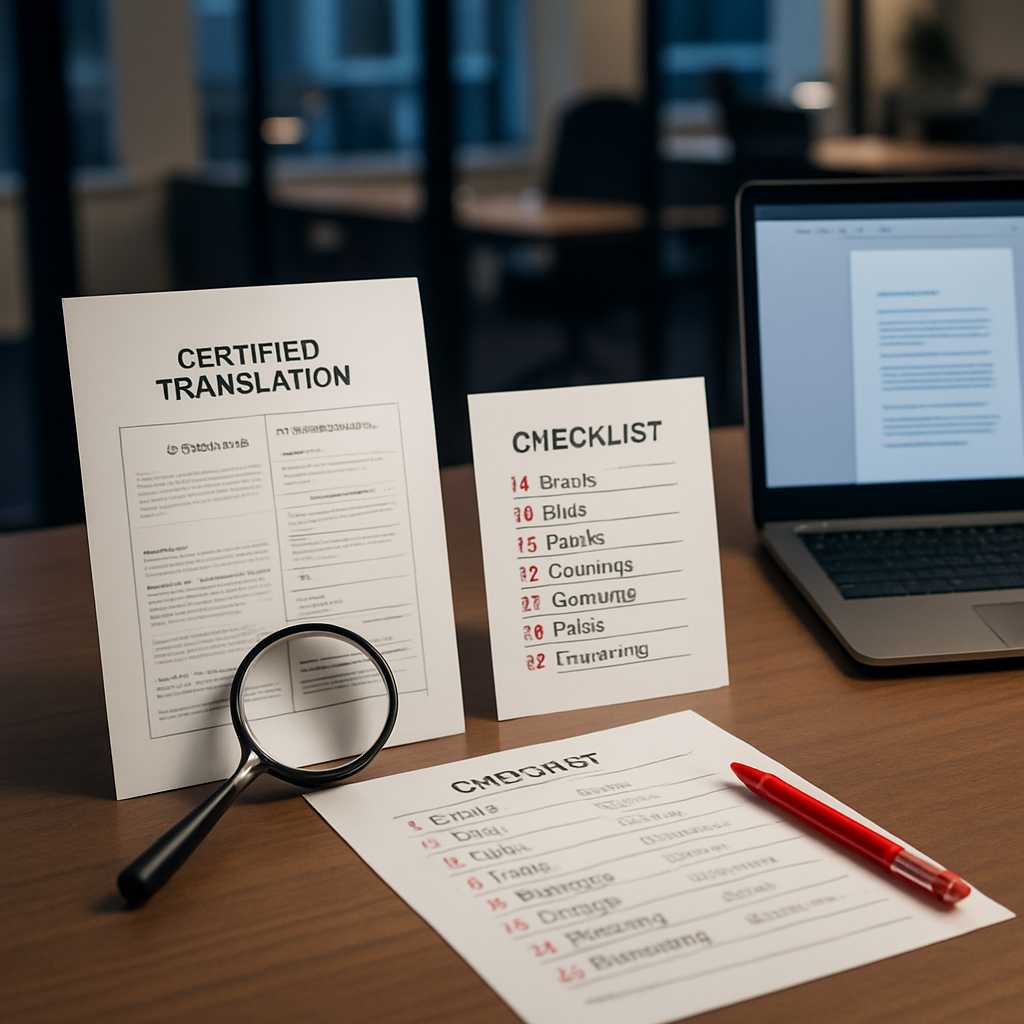
The three checks that expose most fake providers
Before we get into the full list, most bad providers fail on at least one of these three tests:
- Traceability — Can you identify the translator or company behind the certification?
- Recipient fit — Can they explain why this format suits your authority, court, employer, or university?
- File integrity — Do they handle names, dates, seals, notes, tables, and non-standard formatting properly?
If the answer to any of those is vague, you are not dealing with a provider you should trust with official paperwork.
Why this matters more than people think
A fake “certified” translation is rarely exposed by dramatic fraud. More often, it fails quietly.
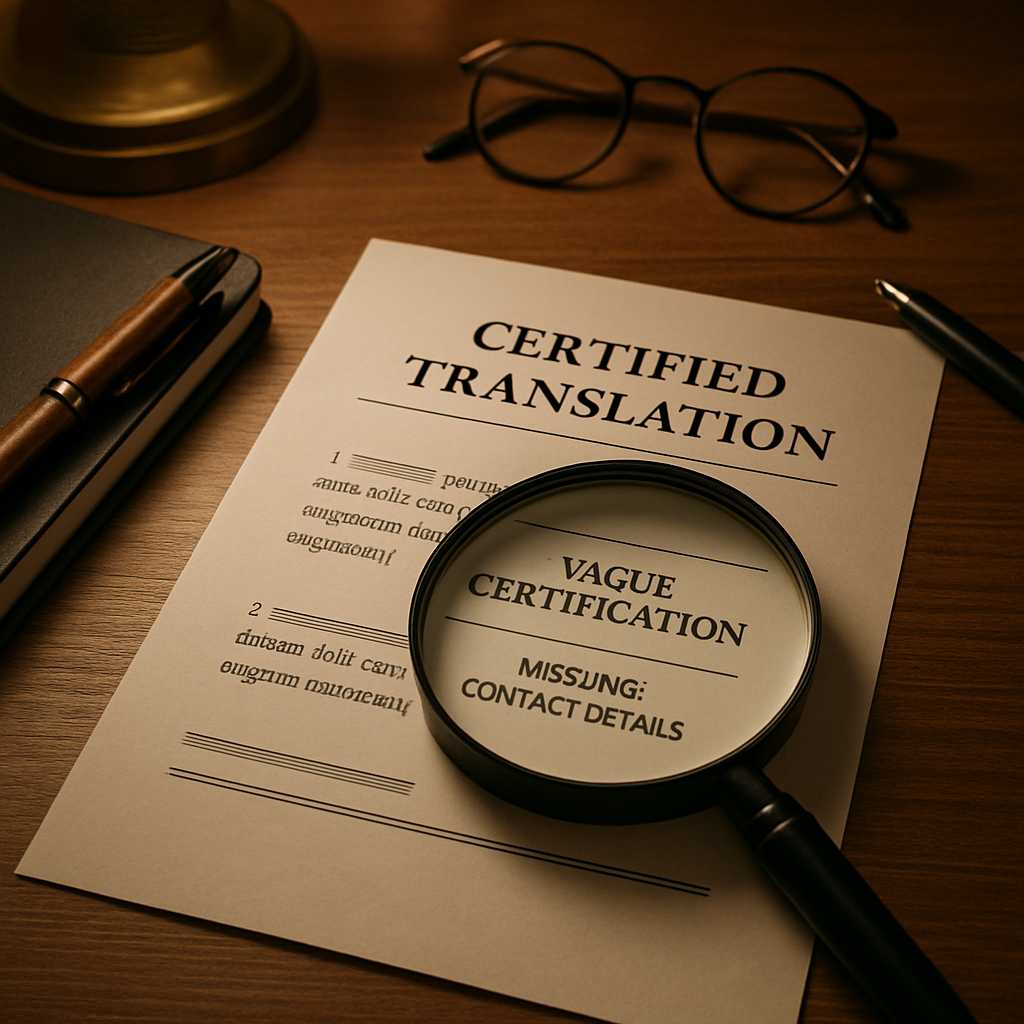
- A marriage certificate arrives with a nice-looking stamp but no meaningful contact details.
- A bank statement translation skips footnotes, column headings, or page totals.
- A court order is translated quickly, but the certification wording is generic and the provider cannot answer who signed it or whether the file is actually suitable for court use.
The customer only discovers the problem when the receiving body rejects the document or asks for a corrected submission.
That is why choosing a provider is not really about finding the prettiest website or the lowest quote. It is about finding a service that can be checked, questioned, and held accountable.
12 red flags of a fake “certified translation” provider
1) They cannot clearly tell you who is certifying the translation
If you ask, “Who signs the certification?” and the answer is blurry, evasive, or overcomplicated, stop there.
A trustworthy provider should be able to explain whether the certification is being issued by the translator or by an authorised representative of the translation company, and what identifying details will appear on the final document. If all you get is “Don’t worry, it’s official,” that is not reassurance. That is avoidance.
This matters because official-use translations are not judged by branding alone. They are judged by whether the translation can be traced back to a real, contactable professional or company.
2) They cannot explain what “certified” means for your exact use case
“Certified” is not a magic word. It is a format used for specific submission contexts.
A reliable provider will ask where the translation is going and whether the recipient has asked for certified, notarised, sworn, or apostilled documents. A fake one treats every case the same and pretends one label solves everything.
That is especially risky when people confuse certification with authentication. If you are unsure whether you need certification, notarisation, sworn translation, or an apostille, read apostille vs certified translation before ordering the wrong service.
3) They sell the stamp, not the translation
This is one of the clearest certified translation scam signs.
Bad providers often talk endlessly about stamps, seals, logos, or “official formatting,” but say very little about accuracy, completeness, terminology, layout fidelity, or how they treat handwritten notes, marginalia, seals, and attachments.
A stamp by itself proves very little. The real value lies in the quality of the translation and the credibility of the certification behind it. If the sales pitch is basically “We add an official stamp,” you are looking at presentation over substance.
4) They claim their translation is accepted everywhere
No serious provider should promise universal acceptance.
Different authorities ask for different things. Some want a straightforward certified translation. Some want notarisation. Some overseas authorities want sworn translation. Some want apostille or legalisation as well. Some accept digital delivery; others want hard copies or specific presentation.
A trustworthy company will say something like: “This format is commonly accepted for X, but we’ll confirm the receiving authority’s wording if you send it over.” A risky one says: “Accepted everywhere worldwide.” That claim is not confidence. It is usually a sign that no one is checking the actual requirement.
5) They never ask who the recipient is
If a provider gives you a quote without asking who the translation is for, that is a serious warning sign.
The right questions are basic but essential:
- Is this for UK immigration, court, university, employer, bank, or overseas use?
- Do you need digital only, printed copies, or both?
- Is the document straightforward, or does it include stamps, handwriting, notes, or tables?
- Has the recipient specified certified, sworn, or notarised format?
A provider who skips all of that is not choosing the right delivery format. They are selling a generic template and hoping it works.
6) The price makes no practical sense
Low pricing is not automatically fraudulent. But a quote that ignores the reality of the file is a bad sign.
Certified translation is not just text conversion. Official documents often require careful handling of names, dates, issue numbers, seals, table structure, footnotes, and repeated consistency checks. A provider quoting a suspiciously low flat fee for complex documents may be planning to cut corners, automate heavily, or deliver something too thin to survive scrutiny.
The opposite problem also exists: vague add-ons that appear only after payment. If the price is not clearly broken down, ask what is included:
- translation
- certification statement
- revisions
- digital delivery
- printed copies if required
- notarisation or apostille if separately needed
If the answer remains fuzzy, walk away.
7) They are happy to certify a translation they did not produce or properly review
This is a major red flag, especially when someone says, “Send us your existing translation and we’ll just stamp it.”
A serious provider should be extremely cautious about certifying work they did not create or fully verify. If they are willing to add certification to unknown text with little or no review, they are telling you exactly how lightly they treat the whole process.
That should worry you even if the price looks attractive. The issue is not just ethics. It is accountability. If something is wrong in the final file, who actually stands behind it?
8) They push you to pay before they have properly reviewed the document
A trustworthy service usually wants to see the file first, even if only briefly.
Why? Because official documents vary. One birth certificate may be simple. Another may contain handwritten annotations, registration notes, marginal stamps, or damaged scans. One bank statement may be clean text. Another may span multiple pages with tables, abbreviations, and issuer notes.
If the provider insists on immediate payment without even checking the file, they may be using a one-size-fits-all workflow that ignores the real work involved. A fast quote is helpful. Blind pricing is not.
9) They promise impossible turnaround for difficult files
Urgent service is real. Impossible service is not.
A legitimate provider can absolutely turn around short, clear documents quickly. But if someone promises a complex multi-page pack, low-quality scans, heavy tables, handwriting, or legal material in an unrealistically short window without any caveats, that usually means one of two things: they have not read the file, or they do not care about quality.
A strong provider explains what can realistically be done now, what needs more time, and whether staged delivery is sensible. A fake one just says yes to everything.
10) They handle sensitive documents carelessly
Passports, IDs, bank statements, birth certificates, police records, and court papers are not casual files. If a provider treats them casually, that is a serious problem.
Warning signs include:
- no privacy or confidentiality explanation
- pressure to send documents only through chat apps
- no visible business email
- no clear company website trail
- sloppy handling of uploaded files
- no mention of secure document processing
You do not need military-grade language on every site. But you do need evidence that the provider understands they are handling personal and official documents, not general marketing copy.
11) They offer no correction, rejection, or accountability policy
Ask one simple question: “If the recipient asks for a correction or clarification, what happens?”
A serious provider will tell you what support is included, how revisions are handled, and what happens if the receiving body asks for an adjustment to formatting or certification wording.
A fake or weak provider often becomes slippery at exactly this point. There is no clear policy. No service scope. No real aftercare. Once the file is sent, you are on your own.
That is dangerous because many document issues are fixable quickly when the provider is real, responsive, and accountable.
12) The final file lacks traceability or reads like raw machine output
Sometimes the scam signs only become obvious after delivery.
Look out for:
- missing or generic certification wording
- no date
- no signature or identifiable signatory
- no contact details
- names or dates handled inconsistently
- stamps, seals, notes, or handwritten items ignored
- awkward phrasing that looks machine generated
- formatting that does not reflect the source document
- unexplained omissions such as blank fields, side notes, or page references
The most dangerous files are not always obviously bad. They are often almost convincing. That is what makes them risky. They look official enough to fool the buyer, but not solid enough to satisfy the recipient.
A better way to verify a certified translation provider in 10 minutes
You do not need to become an expert to protect yourself. You just need a repeatable screen.
The 30-second check
Open the website and look for:
- a real domain-based business email
- clear service explanations
- a real contact page
- specific document types
- explanation of certified vs notarised vs sworn where relevant
If the site is vague, overpromising, or built almost entirely around urgency and discounts, treat that as a warning.
The 3-minute check
Ask the provider these five questions:
- Who signs the certification?
- What exactly is included in the certified pack?
- Is this suitable for my specific recipient?
- How do you handle stamps, seals, handwriting, and notes?
- What happens if the recipient asks for a correction?
You are not just looking for the answers. You are judging whether the provider sounds calm, specific, and experienced.
The 10-minute check
Verify the provider from outside their own website:
- search the company name and domain
- check whether the business can be contacted directly
- look for consistent company details
- see whether they can point to professional membership or directory verification where relevant
- compare their explanation with the authority’s wording, not just their marketing
If the provider cannot stand up to light verification, do not give them official documents.
What a trustworthy provider sounds like
Here is the kind of answer you want to hear:
“Please send the file and the recipient requirement if you have it. We’ll confirm whether you need certified, sworn, notarised, or apostilled format. We’ll review the document for seals, notes, and formatting, tell you what is included, and confirm delivery options before you pay.”
That is a very different tone from:
“Yes, fully official, accepted everywhere, special offer today, pay now.”
The first response shows process. The second shows pressure.
Case-style examples: how fake providers usually fail
Example 1: The cheap marriage certificate translation
A client needs a marriage certificate translated for an official submission. They choose the cheapest result online. The file arrives quickly with a bold stamp and a decorative letterhead, but the certification page does not clearly identify who signed it. The receiving body asks for a proper certified translation with traceable details. The client pays twice.
Example 2: The fast bank statement bundle
A provider promises same-day turnaround on a multi-page bank statement pack without reviewing the scans first. The final translation misses table labels, opening and closing balances, and issuer notes. It looks tidy, but key details are incomplete. The document has to be redone.
Example 3: The “we do everything” provider
A customer asks whether they need certified, notarised, or sworn translation. The answer is “We do all of them, no problem,” with no follow-up question about country, authority, or purpose. That is not expertise. That is sales-first guesswork.
What to do if you already paid a suspicious provider
If you have already ordered and the file feels wrong, act quickly.
Do not submit the translation just because you are under deadline.
Compare the translation against the source document page by page.
Check the certification page for date, signatory, and contact details.
Ask the provider, in writing, who certified it and what exactly is being certified.
If the answers stay vague, reorder with a provider who will review the source file properly.
Keep every email, invoice, and attachment in case you need to dispute the payment.
It is frustrating, but it is still better to lose a small amount of time now than lose an application window later.
How to choose a translator without getting burned
The safest approach is not “pick the cheapest” or even “pick the biggest-looking website.” It is this:
Choose the provider who can clearly explain the process, match the format to the receiving authority, and stand behind the final file.
That is also why it helps to work with specialists rather than generic “translation for anything” shops. If your document set is personal or official, start with the relevant service path:
- document translation services for official documents
- sworn translation services
- passport translation services
- translation requirements by country
And if you want the quickest safe route, upload your file here so the requirement can be checked before anything is quoted or certified.
The bottom line
The biggest mistake people make is looking for a stamp instead of looking for accountability.
A real certified translation provider is not mysterious. They are identifiable, specific, contactable, and careful. They ask questions. They explain what is included. They review the file before promising a format or deadline. They care about names, dates, seals, notes, and how the translation will actually be used.
A fake provider tends to do the opposite. They hide behind urgency, certainty, and presentation.
So when you evaluate a service, remember this:
The safest certified translation is not the one that looks most “official.” It is the one that can be traced, checked, and confidently submitted.
If you need a second opinion on a document before you order, the safest next step is simple: send the file for review and get a clear answer on what the recipient is likely to need.
FAQs
How can I verify certified translation before I pay?
Ask who signs the certification, what details will appear on the final document, whether the provider has reviewed the actual file, and whether the format matches your specific recipient. A trustworthy provider should answer clearly and without pressure.
Are fake stamps a common warning sign in translation service red flags?
Yes. A fake or meaningless stamp is one of the most common translation service red flags because it creates a false sense of legitimacy. The more important question is whether the translation is accurate, complete, signed properly, dated, and traceable to a real provider.
Can a translation company promise acceptance everywhere?
No serious company should promise universal acceptance. Different authorities have different rules, and some require certified, sworn, notarised, or apostilled documents depending on the destination and purpose.
What are the biggest certified translation scam signs on the final file?
Missing contact details, generic certification wording, no date, no signature, inconsistent names or dates, ignored seals or notes, and wording that feels machine generated are all strong warning signs.
How do I choose a translator for official documents safely?
Choose a provider who asks about the recipient, reviews the source file before quoting, explains the correct certification route, and offers clear accountability if changes are needed. Avoid anyone who relies only on “official stamp” language or pushes you to pay immediately.
Is the cheapest certified translation usually the riskiest?
Not always, but very low pricing on complex or official documents is often a sign that the provider is skipping quality checks, reusing templates, or treating certification as a cosmetic add-on rather than a responsibility.